

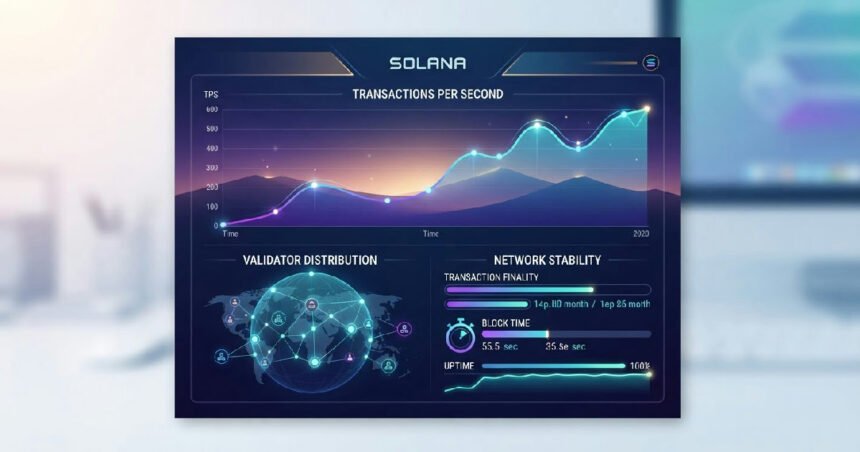
Assessing Solana network performance involves evaluating several key indicators that measure its efficiency, speed, and operational status. These metrics provide crucial insights for investors and users into the network’s capacity to process transactions, maintain stability, and support its decentralized applications effectively.
Understanding these data points helps in gauging Solana’s overall health and its potential for sustained growth in the competitive blockchain landscape. From transaction throughput to validator distribution, each indicator offers a unique perspective on the network’s operational integrity.
Solana network performance indicators: TPS
Transactions Per Second (TPS) quantifies the average number of confirmed transactions processed by the Solana network during each one-second interval. This metric directly reflects the network’s real-time throughput and its intensity of usage.
Solana’s theoretical maximum TPS is stated to be as high as 65,000, with some estimates suggesting a potential for up to 710,000 TPS under optimal conditions. In practice, Solana consistently handles between 1,500 to 4,000+ TPS, often hitting peaks of 2,000–5,000 during periods of high network activity.
Impact of Alpenglow Upgrade on TPS
A significant change occurred with the Alpenglow upgrade on October 21, 2026. Before this update, raw TPS figures were influenced by validator vote transactions, which inflated the overall count. Post-Alpenglow, the TPS count now accurately reflects only user transactions, as validator votes are processed off-chain with certificates.
The Solana dashboard calculates TPS by taking the median transaction count across all metrics-enabled nodes. It then averages this figure over a two-second period to provide a stable and representative measure of current activity.
Understanding Transaction Finality and Commitment Levels
Transaction finality refers to the critical point at which a transaction becomes irreversible. Once finalized, a transaction can no longer be rolled back or reordered, guaranteeing its permanent place on the blockchain. Until this stage, there’s always a chance of a chain reorganization.
Solana employs a tiered commitment system to define finality: “Processed,” “Confirmed,” and “Finalized.” Each level signifies a progressively stronger guarantee of immutability within the network’s Proof of History (PoH) and Tower BFT consensus mechanisms.
Commitment Levels Explained
At the “Processed” stage, a block has been produced through Proof of History but has not yet undergone widespread voting. “Confirmed” means the cluster votes, governed by Tower BFT, have reached a supermajority on the block, offering optimistic consensus. The broader cryptocurrency ecosystem continues to evolve, with various platforms like Charles Schwab expanding crypto trading options, reflecting ongoing market developments.
“Finalized” is the highest level, achieved when the block has persisted as the chain “root” after numerous votes. This means nodes representing two-thirds of the total stake have a common root. A finalized block is typically at least 31 blocks behind the head, confirming it was never abandoned for another fork and is part of the immutable history.
Alpenglow’s Role in Finality
Before the Alpenglow upgrade, full finality on Solana typically took around 12.8 to 13 seconds. However, with the Alpenglow upgrade, activated on October 21, 2026, Solana’s transaction finality target significantly improved to approximately 150 milliseconds. This dramatically reduces the waiting period for transaction confirmation.
Block Production Rates and Network Speed
Block time measures the average duration required to produce a new block of transactions on the blockchain. The block production rate consequently indicates how frequently these new blocks are generated and added to the ledger.
Solana has undergone several targeted upgrades to refine its target slot time, which is the specific period a designated validator has to create a block. These enhancements aim to boost the network’s overall responsiveness and efficiency.
Recent Block Time Reductions
Initially, Solana’s average block time stood at approximately 400 milliseconds. Through a series of strategic upgrades, culminating on October 9, 2026, the network successfully halved its block time from 400 milliseconds to 200 milliseconds. This effectively doubles the opportunities for block production to five per second.
This change ensures that new blocks land twice as often as they did at the network’s genesis, altering the epoch duration from roughly two days to about one day. While block production has accelerated, the compute limits per block were adjusted to maintain theoretical network processing capacity. For example, compute units reduced from 37.5 million at 250ms to 30 million at 200ms.
Analyzing Transaction Success and Failure Rates
The transaction success rate represents the percentage of non-vote transactions that successfully execute on the network. Conversely, the transaction failure rate indicates the proportion of transactions that fail to complete their intended operations, offering a clear picture of network reliability from a user perspective.
Transactions can fail for a variety of reasons, including insufficient user funds or excessive slippage on decentralized exchanges. User errors and application-level issues also frequently contribute to these failures, distinct from underlying network problems.
Historical Context and Recent Improvements
Historically, Solana has faced notable transaction failure rates. For instance, in August 2026, 43% of 5.2 billion non-vote transactions reportedly failed to execute. This often stemmed from automated arbitrage attempts and Maximal Extractable Value (MEV) bots congesting the network. Such activity can influence how platforms like Coinbase Wallet observe trading patterns on the network.
A Blockworks Research analysis observed a reduction in Solana’s transaction failure rate from 44.5% to 30.6%, excluding validator consensus votes, coinciding with a decreased target slot time. This improvement suggests a larger share of compute resources is now dedicated to successful transactions, indicating a healthier and more efficient network state.
Monitoring these rates helps differentiate between network-wide issues and problems originating from user or application interactions.
Network Uptime and Validator Decentralization
Uptime signifies the percentage of time the Solana network is fully operational and available for use. A Solana outage, by contrast, involves an interruption or complete halt of the blockchain, leading to dramatically slowed or entirely stopped transaction confirmations.
Solana’s unique architecture, particularly its Proof of History (PoH) protocol, relies on synchronized validator nodes. Any synchronization bugs or fundamental design flaws within this system can quickly escalate, causing instability and potentially leading to network halts. Solana aims for high availability.
Maintaining Stability and Decentralization
The network reported 99.94% uptime during the 12-month period from March 1, 2023, to February 29, 2024. Even with 100% uptime, congestion can still occur, potentially delaying or dropping transactions temporarily. Uptime primarily confirms the network is running, not that all blocks are processed instantly.
Validators are crucial network participants who process transactions, vote on the blockchain’s state, and produce new blocks. Their role secures the network, operating on a Proof of Stake (PoS) model enhanced by Proof of History (PoH) for transaction ordering. Broader ecosystem developments, such as Samsung Electronics launching USDC on various blockchains, highlight the expanding utility of stablecoins.
Validator Count and Distribution Concerns
Validators earn rewards from assigned leader slots for block production and through vote rewards. A greater number of geographically distributed validators generally enhances network decentralization and resilience. Concerns about decentralization can arise if the validator count drops, or if stake becomes concentrated among a few entities.
For example, Solana’s validator count reportedly fell by 68% to 795 from a peak of 2,560 in March 2023, reaching that lower figure by January 2026. Its Nakamoto Coefficient, a measure of decentralization, also declined during this period. Validator performance is also judged by uptime during assigned slots, vote-credit efficiency, and skip rate, which tracks missed block production opportunities.
Latency and Fee Structure in Focus
Network latency refers to the delay in communication across the network, specifically the time it takes for data to travel between points. This metric is crucial, encompassing RPC request latency and transaction landing latency, particularly for high-frequency trading and Maximal Extractable Value (MEV) operations on Solana.
Key latency metrics include QUIC handshake latency, which measures the network distance to validators from global probes. RPC request latency tracks the round-trip time for read methods like `getLatestBlockhash` and `getAccountInfo`. Transaction landing latency measures the time from submission to inclusion in a block. Factors like validator proximity and network congestion directly influence these delays.
Solana’s Fee Mechanism
Solana’s fee structure comprises a base fee and an optional priority fee. These fees serve to deter network spam and incentivize validators for their work. The base fee is currently set at 0.000005 SOL (5,000 lamports) per signature.
Half of this base fee is burned, removing it from circulation, while the remaining 50% is allocated to the validator that processes the transaction. This base fee remains static and does not adjust dynamically based on prevailing network demand. Users can, however, add an optional priority fee to their transactions to increase their chances of faster inclusion during periods of high demand.