

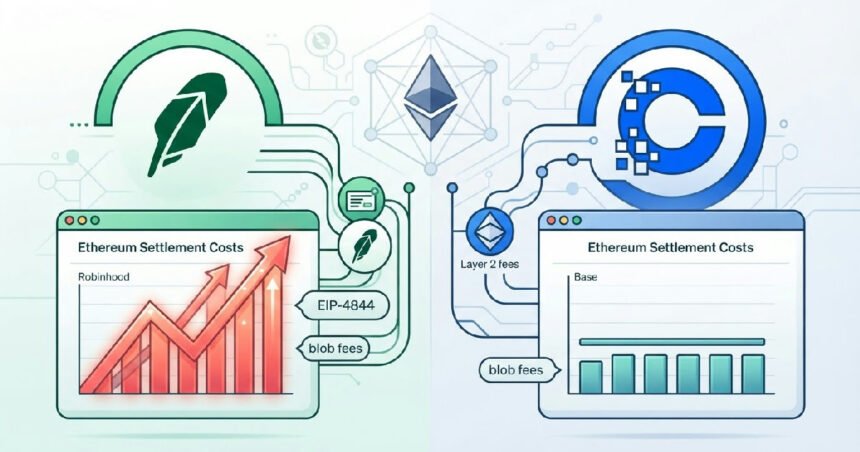
Robinhood Chain incurred 70% higher Ethereum settlement costs than Coinbase-backed Base between October 23 and November 21, 2026. This significant disparity emerged despite Robinhood Chain collecting 64% less in user transaction fees during the same 30-day period. The figures, compiled from Castle Labs data, indicate a notable difference in operational efficiency between the two prominent Layer 2 networks.
Specifically, Robinhood Chain spent approximately $25,700 on Ethereum settlement, while Base paid roughly $15,100. Over these same weeks, Base generated $2.97 million in transaction fees, nearly three times Robinhood Chain’s $1.07 million. This translates to Robinhood Chain spending $2.41 for every $100 collected from users for Ethereum settlement, in stark contrast to Base’s mere 51 cents.
Understanding the divergent Ethereum settlement costs
The core of this cost divergence lies in how each Layer 2 network manages its data posting and state updates to Ethereum. Both Robinhood Chain and Base leverage the Ethereum blockchain for security and finality, but their approaches to these critical functions yield dramatically different financial outcomes. This impacts their overall profitability and the economic burden passed on to their respective users.
An analysis of the components making up these settlement costs reveals a deeper story. Ethereum’s EIP-4844 upgrade introduced “blobs” to lower data availability costs for Layer 2s. Despite Base posting approximately 350,000 blobs during the period, nearly twice Robinhood Chain’s 182,000, its blob fee expenditure was only $4,478, compared to Robinhood Chain’s $2,315.
This suggests Base is optimizing its use of this cheaper data channel more effectively on a per-transaction basis.
Non-blob settlement costs reveal a major gap
The most striking difference appears when isolating costs beyond blob fees. Robinhood Chain spent approximately $23,379 on other settlement expenses. This figure is more than double the $10,602 spent by Base. These additional expenses encompass standard Ethereum transaction fees necessary for posting aggregated data and updating the state of the Layer 2 network on the mainnet.
The data further shows that Robinhood Chain consistently paid more in settlement costs across all four full weeks of the analyzed period. This pattern held even when excluding a specific spike observed on October 29, 2026. Such consistent outspending suggests a fundamental difference in how transactions are batched, compressed, or otherwise processed before being sent to Ethereum for finalization.
Robinhood Chain’s rapid growth and fee dynamics
Robinhood Chain launched its public mainnet on July 1, 2026, built on Arbitrum Orbit technology. It uses Ether (ETH) as its native gas token, with transaction fees comprising both an L2 execution fee and an L1 data fee. The network quickly gained traction, aiming to transform Robinhood into a major on-chain financial infrastructure provider focusing on tokenized real-world assets.
The network demonstrated impressive fee generation shortly after its launch. In its first full month of operation in July 2026, Robinhood Chain generated approximately $3.6 million in transaction fees, accounting for about 38% of total fees across major Layer 2 platforms during that period.
By Q3 2026, it collected $51.11 million in transaction fees, paying only $69,170 to the Ethereum network for settlement. This represented an over 700-fold gap between its revenue and Ethereum expenses.
Drivers of Robinhood Chain’s activity
Much of Robinhood Chain’s peak activity and fee revenue, particularly during Q3 2026, was driven by speculative trading in memecoins. The Pons launchpad, a platform for new memecoins, became a significant source of fees for the chain. Decentralized exchanges like Uniswap and GMGN also contributed substantially to its application revenue during these periods of high engagement.
The network also operated with a 90-day gas subsidy program at launch, covering transaction costs for users. Although this subsidy expired by the end of September 2026, Robinhood Wallet continued to absorb gas costs for eligible swaps executed within its app, an arrangement scheduled to conclude on December 31, 2026.
The shift from subsidized gas to user-borne costs could influence future transaction volumes and fee collection.
Base’s efficient scaling strategy
Base, incubated by Coinbase and launched on August 9, 2023, has rapidly established itself as a highly efficient Ethereum Layer 2 network. It was built in partnership with Optimism on the OP Stack, leveraging optimistic rollups to enhance scalability. Base has consistently demonstrated its ability to handle high transaction volumes while maintaining comparatively low costs for both users and for settlement on Ethereum.
Within months of its launch, Base surpassed 4 million active addresses and often processed more daily transactions than the Ethereum Layer 1 blockchain itself. This rapid adoption and operational scale highlight its robust infrastructure and its capacity to efficiently batch and process transactions.
By 2025, Base had captured over 60% of all Ethereum Layer 2 revenue, processing significant stablecoin volume and illustrating its broad economic impact.
Coinbase’s strategic integration and vision
Base was conceived as a foundational component of Coinbase’s strategy to onboard a billion users to the blockchain. Its integration within the Coinbase ecosystem provides a ready user base and significant liquidity.
This strategic backing, a vision articulated by Jesse Pollak, and deep integration have allowed the network to scale effectively while optimizing its interactions with the Ethereum mainnet. The network’s design, which includes paying gas fees in ETH and not having its own native token, simplifies its economic model and aligns it closely with Ethereum.
Ethereum captures a fraction of layer-2 fees
The comparison highlights a broader imbalance in Ethereum’s scaling economy, where layer-2 networks collect transaction fees while paying relatively little to the blockchain securing their operations.
Across all tracked Ethereum layer-2 networks, users paid approximately $5 million in fees during the 30 days ending November 21, while the networks paid Ethereum just $74,500 for settlement and data availability. That represents roughly 1.5% of user fees, leaving approximately 98.5% after Ethereum settlement expenses, before accounting for other operating and revenue-sharing costs.
Base and Robinhood Chain accounted for about $4.04 million of those combined fees but paid Ethereum only $40,800. The difference reflects how Ethereum’s scaling architecture distributes economic activity. Layer-2 networks handle user transactions and collect their associated fees, while Ethereum provides settlement and data availability for a comparatively small charge.
For Ethereum, the resulting payments contribute to transaction fee burning and validator income, but remain modest relative to the economic activity taking place on its scaling networks. The November figures raise two questions: whether Robinhood Chain can narrow its settlement-cost disadvantage against Base, and how much additional revenue Ethereum can capture as layer-2 networks continue handling most user activity.