

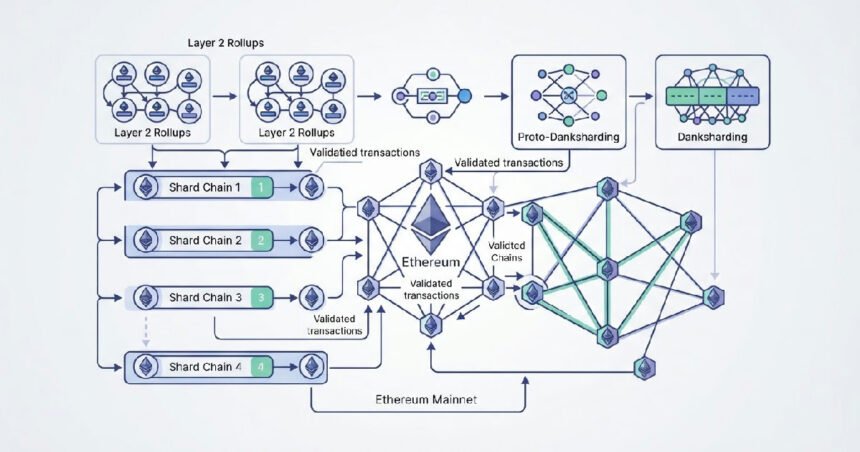
Ethereum sharding is a fundamental upgrade designed to dramatically enhance the network’s capacity and efficiency. This critical development, now evolving into what’s known as Danksharding, shifts focus from dividing transaction execution to optimizing data availability for Layer 2 (L2) rollup solutions. It sets the stage for Ethereum to process hundreds of thousands of transactions per second, significantly improving its ability to handle global demand.
Understanding Ethereum Sharding
Initially, Ethereum sharding was conceived as a method to split the blockchain into multiple execution chains, each handling a portion of the network’s transactions. This traditional database partitioning technique aimed to allow for parallel processing and increased scalability. However, as Layer 2 rollup solutions matured faster than anticipated, the strategy pivoted towards a “rollup-centric” roadmap.
The contemporary vision for sharding, spearheaded by Danksharding, primarily focuses on making data cheaper and more abundant for L2s. Instead of splitting the main network’s execution layer, it creates vast new space for rollups to post their bundled transaction data to the Ethereum mainnet.
This refined approach means the Ethereum mainnet concentrates on consensus, settlement, and crucial data availability, while L2s manage the heavy lifting of transaction execution.
The Mechanics of Danksharding for Scalability
Danksharding is a multi-phase upgrade, building upon foundational elements already in place. It represents a significant technical evolution designed to transform Ethereum’s throughput capabilities.
This ambitious roadmap is primarily driven by the need to support the explosive growth of Layer 2 rollup solutions.
By dramatically increasing the availability and reducing the cost of data storage on the Ethereum mainnet, Danksharding empowers these rollups to process a far greater volume of transactions off-chain, thereby offloading computational burden from the core network. This strategic pivot ensures Ethereum can meet future global demand.
The implementation involves a careful progression, starting with Proto-Danksharding, which has already introduced crucial data blob functionality. These initial steps pave the way for the full Danksharding vision, which will further amplify data capacity through innovative techniques like Data Availability Sampling and Proposer-Builder Separation, ensuring a robust and scalable infrastructure for the entire ecosystem.
Proto-Danksharding (EIP-4844) and Data Blobs
The journey towards full Danksharding began with Proto-Danksharding, implemented as part of the Dencun upgrade on March 13, 2024. This phase introduced a new transaction type that carries “blobs” of data. These data blobs are not processed by the Ethereum Virtual Machine (EVM) and are automatically deleted after approximately 18 days.
This innovation allows rollups to post their compressed transaction data to Ethereum at a significantly reduced cost compared to traditional CALLDATA. For end-users, this translates directly into cheaper and more efficient transactions on L2 solutions. It marked a crucial step in scaling Ethereum settlement costs for wider adoption.
Full Danksharding and Massive Data Space
Full Danksharding represents the complete realization of this rollup scaling vision. It will vastly expand the data capacity by increasing the number of blobs attached to blocks from six (in Proto-Danksharding) to 64. This massive data space is critical for supporting a high volume of L2 transactions.
To manage this increased data, Full Danksharding incorporates Data Availability Sampling (DAS), which distributes the responsibility of verifying data blobs across subsets of network nodes. This ensures data availability without requiring every node to store all data, thus efficiently scaling Ethereum’s data capacity.
Additionally, Proposer-Builder Separation (PBS) will separate block-building from block-proposing, which is essential for managing the complexity of large blobs and mitigating Maximal Extractable Value (MEV) concerns.
Danksharding Overview
Evolution from Traditional Sharding
A common misconception about Ethereum sharding is that it aims to split the main blockchain into many independent execution chains, each processing its own transactions. The original blueprint for “execution sharding” has largely been superseded by the “rollup-centric roadmap” proposed by Ethereum co-founder Vitalik Buterin in October 2020.
As ethereum.org states, “Neither Danksharding nor Proto-Danksharding follow the traditional ‘sharding’ model that aims to split the blockchain into multiple parts. Shard chains are no longer part of the roadmap.”
Instead, the focus is on “data sharding,” which provides expansive data space for Layer 2 rollups to post their data, rather than directly executing transactions on separate shards. This strategic shift leverages the rapid development of L2s as the primary execution layer.
Addressing Common Misconceptions
The evolution of Ethereum sharding has led to several common misunderstandings about its function and impact.
These misconceptions often stem from the project’s early history, where the term ‘sharding’ traditionally implied splitting the execution layer into independent segments. However, the current ‘rollup-centric’ strategy has fundamentally redefined this approach. It’s crucial to understand that contemporary sharding focuses on data availability rather than fragmenting the core blockchain’s transactional processing capabilities.
Another frequent misinterpretation is viewing sharding as a singular, magic bullet for scalability. In reality, it operates as a vital component within Ethereum’s broader scaling roadmap, working synergistically with Layer 2 solutions. This layered architecture ensures that while data capacity is vastly expanded, the core principles of decentralization and security remain paramount, actively resisting any compromise to network integrity.
Not Splitting Execution Chains
One prevalent misconception is that sharding will fragment the Ethereum mainnet into multiple, independent execution shards. In reality, Danksharding does not split the execution layer. The main Ethereum blockchain remains a single, unified execution environment. The “sharding” aspect applies to how data is made available and verified across the network, specifically for the benefit of L2s.
Part of a Broader Scaling Solution
Another misunderstanding is that sharding is a standalone solution that will instantly resolve all of Ethereum’s scalability challenges. Rather, Danksharding is an integral component of a wider “rollup-centric roadmap.” It works in concert with Layer 2 rollups, making them significantly more efficient and cost-effective, but it does not replace the need for these L2 solutions. This approach allows for a layered scaling strategy.
Enhancing Decentralization and Security
Concerns sometimes arise that sharding could compromise Ethereum’s decentralization or security. However, Danksharding is designed to maintain and even bolster these core tenets. Features like Data Availability Sampling reduce the hardware requirements for individual nodes, as they don’t need to store all data. This lower barrier to entry encourages more network participation, fostering greater decentralization.
For comparison, understanding Solana transaction speeds highlights differing approaches to blockchain scalability.
The Future Outlook for Ethereum Throughput
The full implementation of Danksharding promises to fundamentally alter Ethereum’s capacity. With the expansion to 64 blobs per block and efficient data handling mechanisms, the network aims to scale to potentially over 100,000 transactions per second (TPS). This dramatic increase in throughput will enable Ethereum to support hundreds of individual rollups with ease, potentially making millions of transactions per second a reality across the ecosystem.
This scaling is not just about raw transaction numbers; it’s about creating a more accessible and cost-effective blockchain for global use. Cheaper L2 transactions, facilitated by Danksharding, will reduce barriers to entry for users and developers alike.
The groundwork laid by researchers like Dankrad Feist and Protolambda for Proto-Danksharding (EIP-4844), from which Danksharding gets its name, highlights the collaborative effort behind this ambitious vision. These advancements are critical for the long-term viability and competitiveness of the Ethereum network, ensuring it can handle the demands of a global decentralized economy.
Moreover, improved blockchain transaction validation methods are key across various networks.
Frequently Asked Questions (FAQ)
- Q: What is the main difference between traditional sharding and Danksharding?
- A: Traditional sharding aimed to split the blockchain into multiple execution chains. Danksharding, however, focuses on providing vast data space for Layer 2 rollups, enabling them to post transaction data cheaply and efficiently, rather than directly splitting execution.
- Q: How does Danksharding benefit Layer 2 rollups?
- A: Danksharding makes data significantly cheaper and more abundant for L2s by providing “data blobs.” This reduces the cost for rollups to post their bundled transaction data to the Ethereum mainnet, leading to lower transaction fees and higher throughput on L2s for end-users.
- Q: Will Danksharding make Ethereum less decentralized or secure?
- A: No, Danksharding is designed to maintain and even enhance Ethereum’s decentralization and security. Features like Data Availability Sampling (DAS) reduce the hardware requirements for individual nodes, encouraging more participation and thus fostering greater decentralization.
- Q: What is Proto-Danksharding?
- A: Proto-Danksharding (EIP-4844) is the initial phase of Danksharding, already implemented. It introduced the concept of “data blobs” – a new transaction type for L2s to post data at reduced costs. It’s a foundational step towards the full Danksharding vision.