

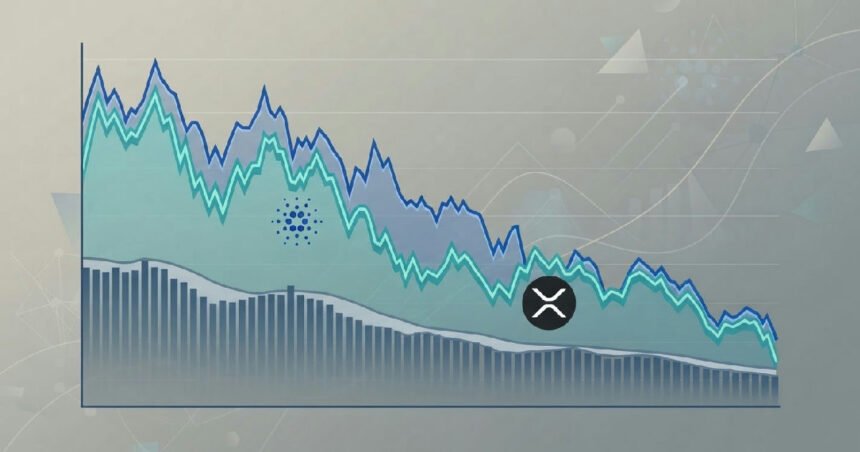
Cryptocurrency markets experienced a broad retreat on Sunday, March 10, 2024, with XRP and Cardano (ADA) leading the losses. XRP saw its price drop by 2.15% over 24 hours, settling at $0.6084, while Cardano’s ADA also faced significant downward pressure. This downturn signaled a period of volatility across digital assets, even as Bitcoin managed a slight gain.
The wider crypto market felt the impact, with multiple altcoins registering declines. This specific Sunday reflected underlying market anxieties, setting a cautionary tone for investors monitoring digital asset valuations. The retreat highlighted the interconnected nature of the cryptocurrency ecosystem.
Cardano, XRP face turbulence to drive broad crypto market
The broad market pullback on March 10, 2024, particularly affected XRP and Cardano, which registered some of the sharpest declines. XRP, a prominent digital asset, closed the day at $0.6084, reflecting a 24-hour change of -2.15% and a more extended seven-day drop of -2.97%. Its 24-hour trading volume stood at $1,510,773,122.75, indicating active selling pressure.
While XRP and Cardano faced headwinds, Bitcoin (BTC) presented a contrasting picture. Bitcoin was priced at $69,019.79 on March 10, 2024, showing a positive 0.76% change over 24 hours and a notable 9.26% increase over seven days. This divergence suggested a flight to perceived safety within the crypto market, with investors consolidating holdings in the largest cryptocurrency during times of uncertainty.
The immediate aftermath of this retreat saw investors re-evaluating their portfolios and risk exposure. This early 2024 event foreshadowed a period of sustained volatility and shifting market dynamics, impacting how various digital assets would perform over the subsequent months. It was a clear indicator that market sentiment could turn quickly.
Shifting tides: a look at Cardano’s broader trajectory
Cardano’s ADA, while experiencing losses on March 10, 2024, continued to face significant challenges through late 2025 and 2026. By November 29, 2026, Cardano had declined by 2.56% to $0.14, making it one of the morning session’s sharpest fallers.
The cryptocurrency has plummeted by 56.9% since December 31, 2025, and lost 30.9% over the preceding month, hitting an intraday low of 13.32 cents on November 21, 2026.
Historically, Cardano’s current trading levels are approximately 95% below its all-time high of $3.10, which it reached in September 2021. The token also experienced a “death cross” on its daily chart in November 2026, a bearish technical indicator that had previously occurred in November 2025 and was followed by months of falling prices. This pattern underscored persistent difficulties in maintaining upward momentum.
Technical evolution and ecosystem growth
Despite price pressures, the Cardano ecosystem has actively pursued technical advancements. Preparations for the Dijkstra upgrade are underway, with testing of protocol version 12 continuing on the Musashi and Dijkstra testnets. The Dijkstra hard fork is targeted for the first quarter of 2027 on the mainnet, aiming to bring further enhancements to the network.
Intersect, a Cardano ecosystem organization, is also planning the next Cardano upgrade, dubbed Euler. The first meeting of the Euler Scoping Working Group is scheduled for December 1, 2026, reflecting a continuous commitment to network development. Such upgrades are crucial for Cardano ecosystem growth and functionality.
Moreover, network decentralization has seen progress, with five different node implementations—cardano-node, Amaru, Dingo, cardano-bean, and TSUNAGI—successfully producing blocks on the Cardano mainnet as of November 22, 2026. This diversification of node operators bolsters the network’s resilience and security. The platform also recently highlighted its growing payment and interoperability infrastructure.
Initiatives like Subbit, a layer 2 protocol designed for non-custodial subscription payments, and VIA Labs, a cross-chain messaging network connecting Cardano to over 150 other networks, demonstrate practical applications. Furthermore, Cardano’s stablecoin market reached $59.4 million when Brale launched its issuance services on November 24, indicating expanding financial utility.
Founder’s focus raises questions
Concerns among ADA holders have emerged due to Cardano founder Charles Hoskinson’s increased focus on Midnight, a privacy network, which he refers to as his “magnum opus.” This shift has drawn attention, particularly as Midnight’s NIGHT token has seen gains while ADA has slumped.
Investors often look to founder involvement as a sign of project health and commitment. Hoskinson’s redirection of energy, while potentially beneficial for the broader blockchain space, introduces questions about the immediate future and dedicated leadership for Cardano’s primary asset. This has arguably contributed to the perception of a wavering Cardano price trend.
XRP’s volatile path and regulatory clarity
XRP’s performance on March 10, 2024, was part of a broader trend of volatility that has characterized its market behavior. Later, by November 29, 2026, XRP had fallen by 1.57% to $0.92, continuing its downward pressure. This places XRP on track for its worst November since trading records began in 2013, having declined 25.8% in November 2026 alone, surpassing previous losses in 2018 and 2019.
The cryptocurrency opened November 2026 at $1.25 but fell as low as $0.86 earlier in the month, marking its lowest price point since November 2024. Overall, XRP is down roughly 49% in 2026, hitting a one-year low of about 91 cents on November 20.
On-chain activity also reflected this bearish sentiment, with daily payment volume on the XRP Ledger experiencing a steep 64% drop in 24 hours on November 29, 2026. Users transferred roughly 168 million XRP, significantly below the 30-day average of 800 million XRP, likely due to weekend timing and broader market pullbacks.
Ripple lawsuit concludes, commodity status confirmed
A pivotal development for XRP was the conclusion of the SEC v. Ripple lawsuit in August 2025. New York district judge Analisa Torres ruled that XRP itself is not a security. Importantly, sales on crypto exchanges to anonymous buyers did not fall under securities law, though direct sales to institutional investors did. Ripple paid a civil penalty of approximately $125 million.
Following this ruling, in March 2026, the SEC and Commodity Futures Trading Commission (CFTC) introduced a regulatory interpretation. This interpretation explicitly identified XRP as a digital commodity, placing it alongside Bitcoin, Ethereum, and Solana. This clarity has been a significant factor for XRP’s regulatory standing, potentially paving the way for broader institutional adoption.
Further demonstrating this shift, ProShares, a prominent exchange-traded fund (ETF) provider, amended its spot XRP ETF filing on April 16, 2025. The company targeted an ambitious launch date of April 30, signaling growing interest in structured investment products for XRP in traditional finance. This move indicated increasing confidence in XRP’s market viability.
Broader market pressures and macroeconomic headwinds
The retreat observed on March 10, 2024, for XRP and Cardano was part of a larger pattern of market pressures evident through 2025 and 2026. The overall crypto market capitalization, for instance, fell by 3.3% in the 24 hours leading up to Wednesday, April 16, 2025.
During that period, Bitcoin dropped to nearly $83,500 from a high above $84,200 a day earlier, and Ether (ETH) and Cardano’s ADA fell as much as 5%.
These market shifts were heavily influenced by several macroeconomic factors. Expectations of further Federal Reserve monetary tightening have been a primary driver of market weakness. Although the Federal Reserve kept interest rates steady at 3.75% to 4.00% in early November 2026, hawkish commentary from officials suggested an impending rate hike before the year concluded.
This policy outlook typically dampens investor appetite for riskier assets like cryptocurrencies.
Federal Reserve policy and recession fears
Persistent U.S. inflation, with October 2026 Consumer Price Index (CPI) data showing a 0.4% month-over-month increase in headline CPI and a 0.3% rise in core CPI, fueled expectations of continued rate hikes. Such inflationary pressures and the Federal Reserve’s response create an environment of uncertainty for investors, who often pull capital from volatile markets.
Additionally, a firm U.S. Dollar Index (DXY), supported by strong third-quarter U.S. GDP growth of 3.4%, created friction for cryptocurrencies. A strong dollar typically makes dollar-denominated assets more attractive, drawing capital away from alternative investments. Fears of a U.S.
recession also intensified, with major institutions revising their forecasts upwards, predicting economic growth to stall between 0.1% and 1%. This risk-off sentiment led investors to reduce exposure across multiple markets.
Institutional withdrawals and deleveraging events
Institutional capital movements significantly impacted market dynamics. U.S. spot Bitcoin ETFs recorded approximately $1.91 billion in cumulative net outflows over seven consecutive trading sessions through November 13, 2026. Total net outflows from these ETFs reached a historic high of $4.71–$5.39 billion in November, surpassing the previous record from June 2026.
Ethereum products also faced substantial institutional redemptions, with CoinDesk Research reporting $1.86 billion in net outflows from digital-asset exchange-traded products in October 2026. U.S. spot Ether ETFs alone lost $1.2 billion that month, marking their largest monthly outflow of the year.
This capital flight indicates a significant deleveraging event, as total cryptocurrency market open interest declined by over $100 billion from its all-time high, falling to $83.93 billion.
Further exacerbating market sentiment were security incidents, such as reports of a security breach at Binance. Market liquidations accelerated as stablecoin supply contracted by $10.7 billion, marking the largest 18-day drop since the Terra-LUNA ecosystem collapse. Although Binance later resumed full customer withdrawals on Thursday, November 26, 2026, after a record $6.3 billion heist a month prior, such events erode investor confidence.
Outlook: navigating a complex crypto landscape
The broad crypto market retreats, exemplified by Cardano and XRP’s performance, highlight the ongoing complexities facing digital asset investors. While specific technical developments within ecosystems like Cardano demonstrate progress, broader macroeconomic forces and institutional sentiment continue to exert significant influence.
The intertwining of traditional finance indicators—such as Federal Reserve policies and recession fears—with cryptocurrency valuations means that the crypto market operates within a much larger global financial tapestry.
For Cardano, continued development and ecosystem expansion are critical for long-term value, even if founder attention diversifies. The successful implementation of upgrades like Dijkstra and Euler, alongside growing decentralization, could bolster its fundamental strength.
Similarly, XRP’s newfound regulatory clarity as a digital commodity and the increasing interest from ETF providers may provide future tailwinds, separating its trajectory from previous legal ambiguities. Both assets will need to navigate persistent market volatility and intense competitive pressures. XRP’s price movements will remain a key indicator for many investors.
Looking ahead, the market will likely remain sensitive to inflation data, interest rate decisions, and overall global economic health. While the March 10, 2024, retreat was a snapshot, the subsequent events through 2025 and 2026 suggest that investors must maintain a nuanced perspective.
The ability of individual cryptocurrencies to innovate and attract genuine utility, combined with their resilience against external shocks, will ultimately determine their long-term viability and growth in a dynamic financial landscape.