

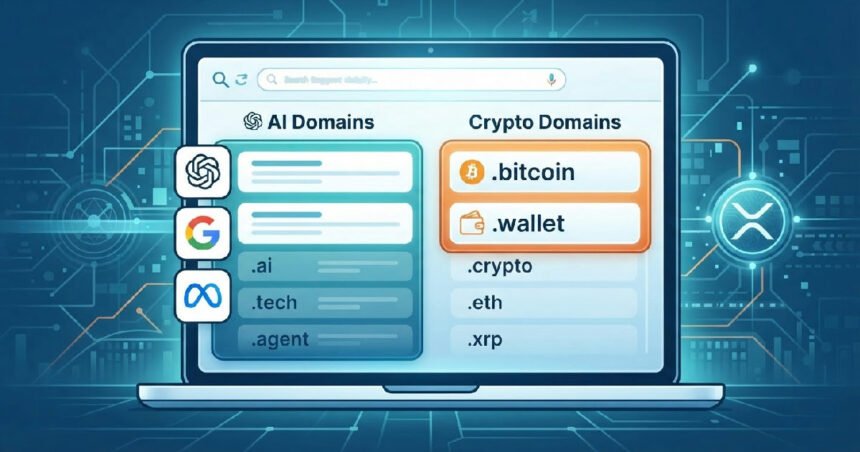
Major technology giants OpenAI, Google, and Meta are locked in a fierce contest for control over artificial intelligence-related internet domains, while a parallel struggle sees cryptocurrency firms staking their claims on extensions like .bitcoin and .wallet.
This dual battle for digital real estate, revealed by the Internet Corporation for Assigned Names and Numbers (ICANN) on October 7, marks the first significant expansion of the internet’s address system since 2012. The outcomes of these high-stakes applications could profoundly influence the future online presence and integration of various digital assets.
The Scramble for AI and Crypto Domains
The global race for these new generic top-level domains (gTLDs) highlights a pivotal moment in internet governance and digital identity. With 1,615 applications submitted by 481 applicants, the sheer volume underscores the perceived value in owning these foundational pieces of the internet.
Companies are looking to secure their future in an increasingly digitized world, where the lines between AI and crypto and traditional internet infrastructure are rapidly blurring.
The fight for AI-centric domain names is particularly intense. OpenAI, Google, and Meta are among 13 applicants aggressively pursuing the .agent domain extension, recognizing its potential as a critical identifier for future AI applications and services. This makes .agent one of the most contested names in ICANN’s latest offering.
OpenAI, a leader in AI research and deployment, demonstrated its ambitious vision by submitting applications for 15 extensions. Its portfolio includes not only .agent but also .agi, .asi, .gpt, .model, .skill, .voice, and .mcp. This wide-ranging interest suggests a comprehensive strategy to brand and control various facets of the emerging AI landscape.
Google, through its parent company Alphabet, isn’t far behind, also seeking control over .agent and .mcp. Meta, another tech behemoth, is similarly targeting .agent along with other extensions linked to its artificial intelligence initiatives. This convergence of interests from the world’s largest tech firms underscores the strategic importance they place on these digital assets.
The competition extends beyond specific company brands. Seven different applicants are vying for .agi, referencing artificial general intelligence, which many believe represents the pinnacle of AI development. Moreover, five applications were submitted for .mcp, an abbreviation for Model Context Protocol.
This protocol, developed by AI safety and research company Anthropic, serves as a standard for connecting AI applications with external tools and data, highlighting a push for interoperability within the AI ecosystem. Anthropic itself opted for just two extensions, .anthropic and .claude, leaving the contested .mcp to others.
Cryptocurrency Companies Secure Naming Rights
The contest isn’t limited to AI. Cryptocurrency companies are also making significant moves to secure digital asset-related domain extensions. These firms are looking to bridge the gap between conventional internet addresses and blockchain-based identities and financial services, reflecting a broader shift towards Web3 integration.
ICANN’s preliminary data reveals substantial interest in crypto-specific domains. There are 11 applications for .bit, making it another highly contested individual name alongside .agent. Additionally, five applicants are seeking .crypto, while both .wallet and .dao have attracted four applications each. The foundational extensions .bitcoin and .btc, alongside .nft, each received two applications.
The Cardano Foundation, a key player in the blockchain space, announced on October 8 that its application for .ada was progressing to the next stage of ICANN’s review. This move aims to integrate the Cardano blockchain’s name directly into the global internet domain system, enhancing its digital presence and accessibility.
Similarly, Frax Finance disclosed an application for .frax, outlining ambitions to connect internet naming with on-chain ownership, payments, and AI-driven commerce.
These applications underscore a strategic push by crypto entities to establish recognizable and intuitive digital addresses. Such infrastructure could simplify user interaction with decentralized applications and blockchain services, potentially attracting a wider audience to digital assets. The ultimate goal is to create a more seamless and integrated experience between the traditional web and the decentralized internet.
ICANN’s Expanded Domain Landscape and Financial Stakes
The current ICANN application round is the first since 2012, making it a landmark event for the internet’s naming structure. The sheer volume of 1,615 applications from 481 different entities highlights the intense demand for new digital identifiers. This expansion is set to reshape how users navigate the internet and interact with online services, both centralized and decentralized.
The financial commitment for these applications is substantial. Each standard application carries a significant evaluation fee of $227,000. This upfront cost is just the beginning; intense competition for highly sought-after names can quickly escalate into costly auctions.
Historical precedents, such as Google’s registry subsidiary paying $25 million in a 2015 ICANN auction for the .app domain, illustrate the potential for these contests to become extremely expensive.
These investments signal a long-term strategic play by companies to control essential pieces of future internet infrastructure. Owning a successful top-level domain registry means a company can manage registrations and collect fees for addresses using that extension, all while adhering to ICANN’s established rules. This revenue stream, coupled with the brand control and strategic positioning, makes the high costs worthwhile for major players.
The current round of applications reflects a forward-looking perspective, where companies are positioning themselves for decades to come. The domains being contested today could become the digital cornerstones of tomorrow’s most innovative technologies, from advanced AI systems to fully integrated Web3 platforms. This foundational struggle is about shaping the very fabric of the internet