

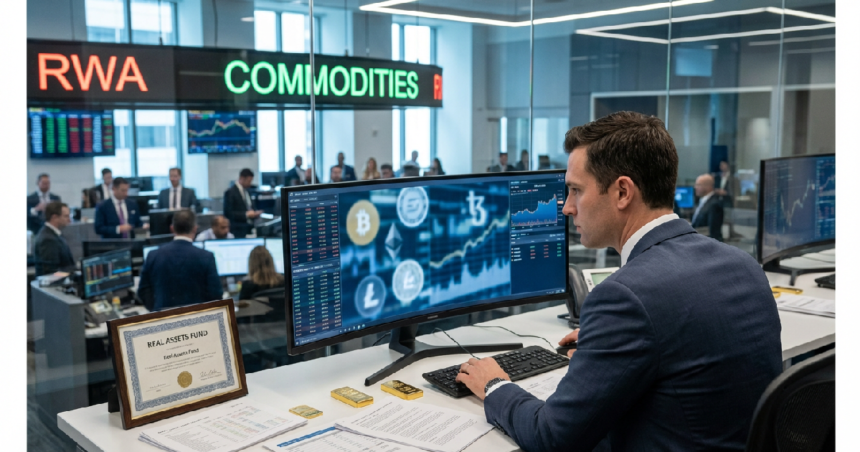
Institutional interest in the digital asset market appears to be undergoing a fundamental recalibration. While previous market cycles were often defined by speculative fervor surrounding decentralized finance and competition among Layer-1 blockchains, the prevailing narrative has shifted toward tangible value. Reports from industry observers and market data providers indicate a capital rotation that is pulling liquidity from several altcoin sectors, with funds reportedly moving toward real-world assets (RWA) and traditional commodities.
This transition represents a broader structural change in how digital portfolios are being managed. For a significant period, investors held onto the promise of utility that often remained theoretical. Now, as the digital asset industry faces its final test for global utility, market participants seem to be prioritizing assets backed by verified cash flows or physical collateral over speculative governance tokens.
The Rotation Toward Tangibility
The movement away from certain altcoins has been particularly visible among mid-cap projects that have yet to secure meaningful institutional partnerships. Observations suggest that capital is being redirected toward tokenized treasury bills, real estate ventures, and gold-backed tokens. This move aligns with a broader macroeconomic trend where some investors are swapping “paper wealth” for assets they perceive as “hard wealth.”
And it’s not just digital assets feeling the heat. Traditional markets have seen a resurgence in physical goods. For instance, precious metals rally as silver eyes a massive long-term target, drawing attention away from high-volatility altcoin markets. When silver and gold show strength, the “digital gold” narrative occasionally supports Bitcoin, but it can leave smaller altcoins struggling to present a clear value proposition to conservative investors.
The following table illustrates the reported shift in sector sentiment, highlighting the contrast between traditional altcoin categories and the rising interest in the RWA sector.
| Asset Category | Reported Interest Trend | Primary Driving Factor |
|---|---|---|
| Real-World Assets (RWA) | Increasing | Institutional Grade Yields |
| Layer-1 Altcoins | Decreasing | Oversupply of Infrastructure |
| Tokenized Commodities | Increasing | Inflation Hedging |
| Metaverse / Gaming | Stagnant | Lack of Active User Retention |
Regulatory Pressure and the Search for Yield
Part of the reason for this shift in altcoin dominance is the tightening regulatory environment. Traders are increasingly hesitant to hold tokens with uncertain legal standings, preferring products that offer greater transparency. This sentiment has been influenced by legislative discussions that aim to clarify how certain digital assets can generate returns for their holders.
Reports regarding the New Clarity Act suggest risks to interest payments on certain stablecoins, which could force yield seekers to look elsewhere. Without the straightforward mechanics of certain previous cycles, capital appears to be moving into tokenized private credit and other RWA vehicles that fall under more established legal frameworks. The result is a potential thinning of order books for even some well-known altcoins.
Survival of the Fittest for Layer-1s
Does this mean the altcoin market is finished? Not necessarily, but it is maturing. The projects remaining relevant are those that have managed to integrate themselves into industrial or financial workflows. The market is moving away from a period where a roadmap alone was enough to sustain a multi-billion dollar valuation.
But the window for these projects to prove their worth is reportedly narrowing. As capital flows into real assets, the pressure on altcoin liquidity is expected to continue. Many investors are now prioritizing assets that can survive a period of cooling market signals, favoring stability over the high-risk moonshot potential that characterized previous years.
The Path Forward
In the coming months, analysts expect a “thinning” of token lists on major exchanges. Smaller projects that cannot demonstrate a link to real-world revenue will likely see their valuations drift lower as they lose institutional backers. The focus has moved from “what could this be?” to “what does this do today?”
For many observers, this suggests a need for a more defensive posture. While the allure of a quick recovery in altcoins remains, the data suggests that the shift to real-world assets is a long-term play rather than a temporary swing. Professionals are increasingly looking for assets that serve as a bridge between the efficiency of the blockchain and the reliability of the physical world.
Frequently Asked Questions
Why are altcoins losing value despite a stable Bitcoin?
Investors are currently prioritizing safety and tangible returns. While Bitcoin is often viewed as a store of value, many altcoins are seen as speculative technology bets. During periods of economic uncertainty, capital often rotates out of high-risk assets and into those with proven utility or physical backing.
What exactly are Real-World Assets (RWA) in crypto?
RWAs refer to the tokenization of physical or traditional financial assets on a blockchain. This includes real estate, commercial debt, gold, and government bonds. They have gained traction because they offer blockchain efficiency while holding inherent value outside of the crypto ecosystem.
Is this the end of the traditional “Altseason” cycle?
The traditional cycle—where small coins often increased in value simply because Bitcoin did—appears to be evolving. While individual projects with strong fundamentals may still see growth, the market is becoming much more selective and critical of speculative assets.


