

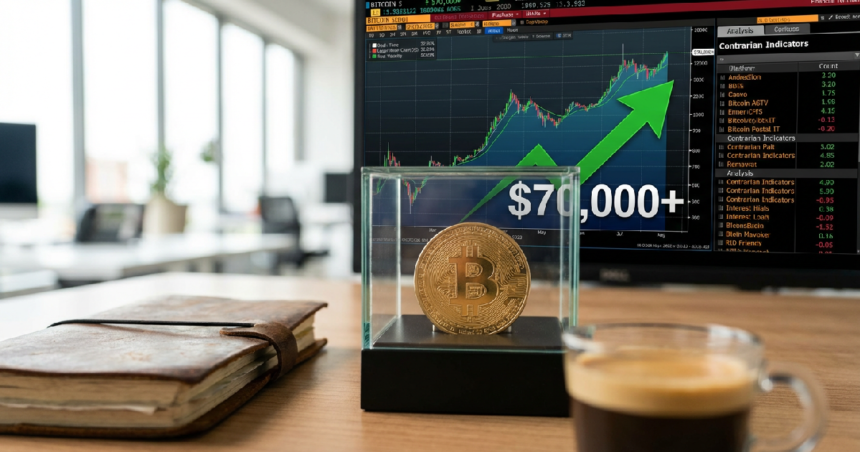
Bitcoin reclaimed the $70,000 level during early trading on Monday, shaking off weeks of stagnant price action. The move comes as several unconventional metrics suggest the market’s recent cooling period may have reached a local floor, catching many bearish traders off guard.
While the $70,000 mark has acted as a psychological barrier for much of 2026, the current push suggests a shift in buyer exhaustion. Market data indicates that long-term holders, who typically sell into strength, have stayed their hand over the last 48 hours. This lack of selling pressure, combined with a slight uptick in spot demand, has allowed the flagship cryptocurrency to drift upward through a zone that previously saw heavy resistance.
Contrarian Indicators Flash Green
The climb back above $70,000 isn’t just about price; it’s about the signals flashing under the hood. Traditionally, when social media sentiment reaches a state of “extreme boredom” or “disbelief,” the market tends to do the opposite of the prevailing mood. Recent weeks have seen a sharp decline in retail interest and Google search volume for “Bitcoin,” a classic contrarian indicator that the froth has been washed out of the system.
And it’s not just retail sentiment. On-chain analysts have noted a peculiar trend in the “funding rates” on perpetual futures exchanges. For the first time in several weeks, these rates have neutralized. When funding is high, it’s expensive to be “long,” often signaling a top. When it stays low or turns negative while prices rise, it suggests the move is driven by spot buying rather than reckless leverage—a much healthier foundation for a sustained rally.
But the most telling sign might be the behavior of so-called “whale” wallets. Large-scale entities that had been distributing their coins since the start of the year appear to be moving back into an accumulation phase. This suggests that the institutional class, which has a far longer time horizon, sees the current price as a fair entry point rather than a peak.
Matching Macro Movements
The timing of this recovery aligns with a broader shift in global financial markets. As we’ve seen in recent months, Bitcoin edges higher as geopolitical tensions see temporary pauses, allowing risk assets to breathe. Investors are also keeping a close eye on the U.S. Treasury’s activity, looking for signs of liquidity injections that historically lift all boats, from stocks to Satoshi’s coin.
The current price action also follows a period where Bitcoin’s narrow range signaled an impending volatility spike. That squeeze appears to be resolving to the upside. For traders who were positioned for a deeper correction toward the $60,000 mark, this move above $70,000 has triggered a “short squeeze,” as those betting against the market are forced to buy back their positions, accidentally fueling the very rally that hurt them.
The Road to Previous All-Time Highs
The big question now is whether Bitcoin can turn $70,000 from a ceiling into a floor. In previous cycles, clearing this level with conviction has often led to a rapid price discovery phase. However, the market remains sensitive to external shocks. If the Federal Reserve maintains a hawkish stance on interest rates for longer than expected, the recent gains could easily be erased.
For now, the technicals look supportive. The 50-day moving average, a metric professional desks watch closely, has begun to curl upward again. If Bitcoin closes the week above $72,500, analysts believe the path toward $80,000 is wide open. For those who were waiting for a “bottom” to buy in, these contrarian signs suggest the opportunity may have already passed.
Frequently Asked Questions
Why is $70,000 considered such a significant price?
It’s largely psychological. In the world of trading, big “round numbers” act as magnets and barriers. Sellers tend to place orders just below those levels, and buyers like to wait for a breakout above them to confirm a trend. Successfully holding above $70,000 signals to the broader market that the bulls are back in control.
What does a ‘contrarian bottoming sign’ actually mean?
In simple terms, it means looking for signs that the market is too pessimistic. When almost everyone expects prices to fall further, they have usually already sold. If there’s nobody left to sell, the only direction left to go is up. Indicators like low social media hype or negative sentiment often signal that a price bottom is in.
Could this rally be a ‘bull trap’?
It’s always possible. A bull trap happens when a price breaks above a resistance level, attracting buyers, only to reverse sharply. To avoid this, traders look for high trading volume to support the move. If $70,000 is reclaimed on low volume, it’s a red flag. If it happens with heavy buying, it’s more likely to be a genuine breakout.


