

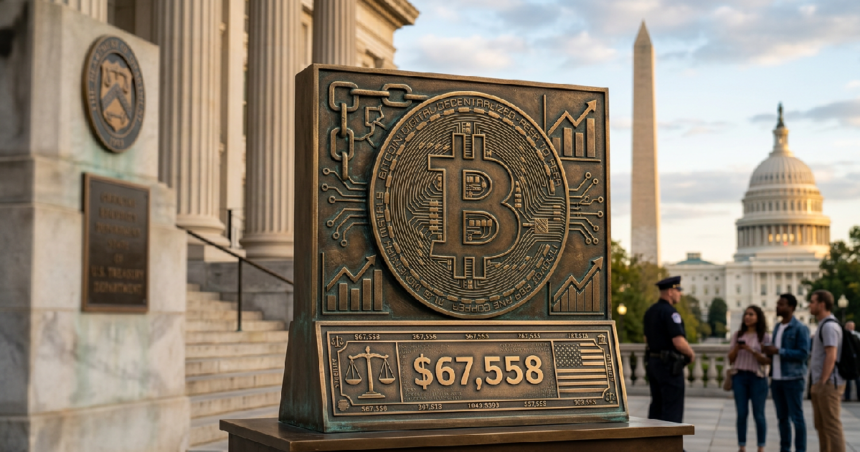
Bitcoin prices held steady near the $67,558 mark on Monday as investors parsed a flurry of policy signals emerging from Washington. The digital asset, which has spent much of the month oscillating in a tight range, is increasingly sensitive to U.S. regulatory movements and the shifting stance of the Treasury Department regarding stablecoin liquidity.
The current price action reflects a market that is essentially catching its breath. While the frantic buying witnessed during the institutional surge of early 2024 has subsided, the floor for Bitcoin appears to have solidified around these levels. Traders are no longer just looking at exchange inflows; they are watching the Federal Reserve and the U.S. Capitol for any indication of how the next phase of digital asset oversight will take shape.
Policy Shifts in Washington Dictate Market Sentiment
The recent stability around $67,558 isn’t happening in a vacuum. Market participants have been closely following the legislative progress of the New Clarity Act, which seeks to redefine how stablecoins operate within the U.S. financial system. Because Bitcoin often serves as the primary liquidity pair for these assets, any change in how they are governed has an immediate ripple effect on Bitcoin’s valuation.
And it’s not just about the legislative branch. The White House has recently signaled a more cautious approach to international tensions, which has historically acted as a stabilizer for risk assets. When geopolitical rhetoric cools, as seen in the recent pause in Iran-related responses, Bitcoin tends to find a comfortable base. For now, that base seems to be the mid-$67,000 range.
Institutional Retention and Wealth Management Growth
One reason Bitcoin hasn’t succumbed to a deeper correction is the deepening involvement of Wall Street. It’s one thing for retail traders to flip coins for a quick profit, but it’s quite another when firms like Morgan Stanley begin expanding access for their wealth management clients. This institutional “stickiness” creates a different kind of market dynamic—one where sudden flash crashes are often met with calculated buying orders from large-scale advisors.
However, the road ahead isn’t without its hurdles. Analysts have pointed out that while the $67,000 level is resilient, there is a visible volatility squeeze forming on the charts. When Bitcoin moves sideways for this long, the eventual breakout—or breakdown—tends to be aggressive. The current “wait-and-see” attitude from U.S. regulators has kept the price in a holding pattern, but it won’t stay here forever.
Looking Toward the Next Major Catalyst
If the U.S. developments continue to lean toward a more structured, albeit restrictive, environment, we might see Bitcoin transition from a speculative asset into a more “boring” index-like performer. For those who enjoy the 10% daily swings, this might be disappointing. But for the broader industry, it represents the professionalization of the asset class.
The next few weeks will be telling. If the U.S. economic data shows cooling inflation, the argument for Bitcoin as a “digital gold” hedge might lose some steam in the short term, leading to the institutional pullback some analysts have warned about. Conversely, any further delay in the SEC’s oversight decisions could provide the regulatory “quiet” necessary for a push toward the $70,000 milestone.
Frequently Asked Questions
Why is $67,500 considered a key level for Bitcoin?
It’s less about a magic number and more about where the buying and selling pressure have found an equilibrium. Currently, this price point represents a psychological middle ground between the all-time highs seen earlier and the support levels established during the last market dip. It shows that institutional buyers are comfortable holding at this valuation.
How do U.S. stablecoin laws affect Bitcoin’s price?
Stablecoins are the “grease” in the wheels of the crypto market. If new laws make it harder or less profitable to hold stablecoins—such as the reported bans on interest payments—investors might move that capital back into Bitcoin, or they may exit the ecosystem entirely. This creates significant price volatility.
Is the current stability a sign of a market peak?
Not necessarily. In crypto, “crab price action” (moving sideways) often precedes a large move. While some see it as a lack of momentum, others view it as a consolidation phase where Bitcoin is building the necessary support to move higher without immediately crashing back down.


