

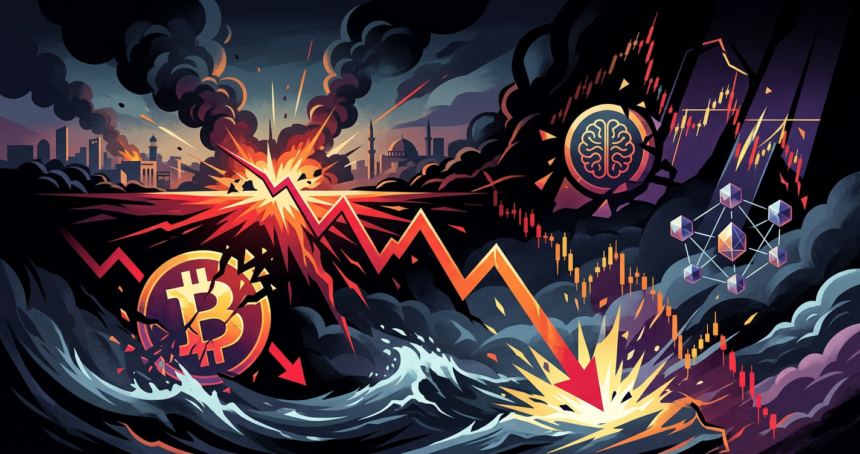
Geopolitical tension has once again become the primary architect of volatility in the digital asset markets. As markets digest signals of a temporary pause in direct hostilities between Israel and Iran, Bitcoin and high-beta altcoins like Bittensor (TAO) are oscillating between relief rallies and deep-seated caution.
The White House’s recent efforts to de-escalate the situation in the Middle East have provided a much-needed breather for risk assets. Bitcoin, which often acts as a liquidity barometer during times of conflict, has seen a modest recovery. However, the shadow of a wider regional escalation remains, leaving investors to weigh the “digital gold” narrative against the reality that, in a crisis, liquidity is king.
And it is not just the market leaders feeling the heat. The emerging AI-crypto sector, led by Bittensor, has seen outsized price swings as traders grapple with the dual pressures of technological disruption and macroeconomic instability.
The Pivot from Safe Haven to Risk Asset
For years, proponents argued that Bitcoin would serve as the ultimate hedge against geopolitical chaos. The reality of 2026 has proven more nuanced. When the first reports of renewed tensions surfaced, the market did not flood into Bitcoin; it fled to the dollar and U.S. Treasuries. While Bitcoin edges higher as the White House pauses its Iran response, the initial sell-off served as a reminder of the asset’s current correlation with traditional risk indicators.
This “risk-off” behavior is particularly evident when looking at the broader altcoin market. Unlike Bitcoin, which has institutional backstops through spot ETFs, altcoins are frequently the first to be liquidated when margins are called. The threat of a hot war in the Middle East forces a flight to quality, and for many institutions, quality still means cash or gold.
For those looking for historical context, the current price action mirrors the “volatility squeeze” seen in previous cycles. As noted in recent technical breakdowns, a Bitcoin narrow range often signals an impending volatility spike. The current geopolitical pause might simply be the calm before a more aggressive directional move.
AI Infrastructure Tokens Face the Brunt
Bittensor (TAO) has become a lightning rod for volatility within the decentralized AI space. As one of the most successful projects at the intersection of blockchain and machine learning, its price reflects a massive “innovation premium.” When the threat of Iranian escalation spikes, that premium is often the first thing to evaporate.
The risk here is not just sentiment-driven. Many of the specialized firms providing compute power to these networks are navigating shifting energy costs and supply chain constraints that could be exacerbated by regional conflict. As decentralized GPU networks pivot toward AI compute needs, they become increasingly sensitive to the global energy market—an area directly impacted by any closure of the Strait of Hormuz.
Investors are now watching to see if TAO can hold its support levels or if it will lead a broader retreat of the “utility” tokens. The market’s patience for high-valuation projects without immediate cash flows is thinning as the digital asset industry faces its final test for global utility.
Regulatory Headwinds and the Stability Factor
The tension in the Middle East is not the only variable keeping prices capped. Domestic policy in the United States is fundamentally altering how capital flows through the ecosystem. The introduction of the New Clarity Act has stripped away one of the primary incentives for holding stablecoins: yield. By blocking interest payments on these assets, regulators have forced a rethink of how “dry powder” is stored during periods of high risk.
This legislative shift means that during an Iran-Israel escalation, traders can no longer simply sit in yield-bearing stables to wait out the storm. They are forced either back into the volatile crypto market or out of the ecosystem entirely and into traditional banking rails. This drain of internal liquidity could make future “flash crashes” more severe than what we saw in the early 2020s.
Diverging Paths for Older Assets
While Bitcoin and AI tokens capture the headlines, older “legacy” tokens like XRP are trading on a different set of fundamentals. While they aren’t immune to geopolitical shocks, their established legal status and cross-border payment use cases offer a different risk profile. Some analysts project diverging paths for XRP, suggesting it may decouple from the “meme” and “AI” hype cycles as institutional adoption for settlement increases.
However, no asset is a true island. If the situation with Iran deteriorates into a direct conflict involving global powers, the resulting “liquidity vacuum” would likely hit every digital asset on the board. We have already seen signals of institutional pullback as market makers reduce their exposure to hedge against weekend gaps in traditional trading hours.
Watching the Horizon
The immediate outlook depends on the back-channel diplomacy currently underway in Washington and Tehran. For the crypto trader, the strategy has shifted from “buying the dip” to “managing the hedge.” The current bounce in Bitcoin and TAO suggests that the market believes an immediate large-scale war has been averted, but the bid is fragile.
Ultimately, 2026 is becoming the year where “macro” and “crypto” finally merged into a single, inseparable narrative. Whether it is a pause in military action or a shift in Federal Reserve policy, the triggers for the next Bitcoin move are no longer found solely on the blockchain—they are found in the headlines of the mainstream press.
Market Impact FAQ
How does geopolitical conflict usually affect Bitcoin’s price?
Initially, Bitcoin often drops alongside other risk assets like stocks as investors seek the safety of the U.S. Dollar. However, if the conflict leads to currency devaluation or bank instability in affected regions, Bitcoin can see a secondary surge in “haven” demand.
Why is TAO more volatile than Bitcoin during these events?
Bittensor and other AI-focused tokens are considered high-growth, high-risk assets. They have lower liquidity than Bitcoin, meaning smaller sell orders can cause larger percentage drops. They are also sensitive to global tech sentiment, which usually sours during times of war.
What is the biggest risk for crypto if the Iran situation escalates?
The primary risk is a global “liquidity crunch.” If energy prices spike and inflation returns, central banks may keep interest rates higher for longer, which traditionally sucks capital out of speculative markets like cryptocurrency.


