

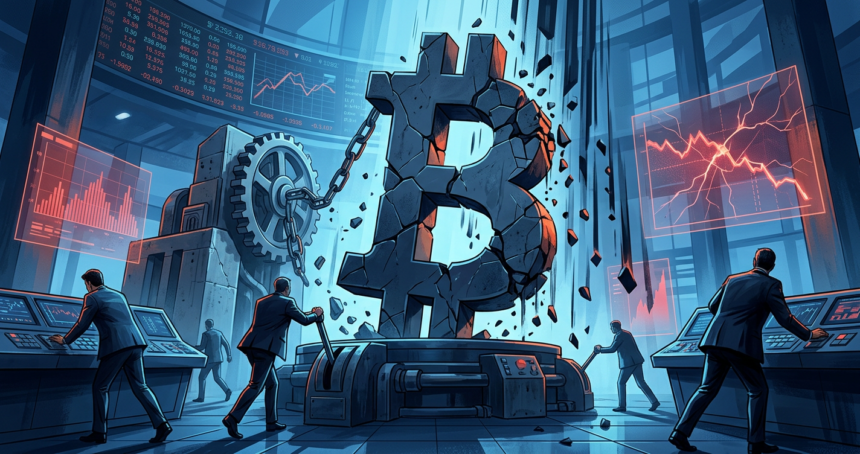
The honeymoon phase for Bitcoin’s recent price climb appears to be hitting a wall of institutional fatigue. After weeks of steady gains that tempted retail investors back into the fray, a series of technical indicators and shifts in capital flow suggest the market is entering a high-risk zone. Traders who were comfortably riding the trend are now staring at a wall of resistance that hasn’t been breached with any real conviction.
Market data from the last 48 hours shows a cooling of the aggressive buying seen earlier this month. While the asset remains well above its yearly lows, the momentum that drove it through previous psychological barriers has thinned. For those watching the tape, the message is clear: the easy money has been made, and the next move is likely to involve a painful shakeout for overleveraged participants.
Institutional Appetite Hits a Saturation Point
The narrative for much of early 2026 was dominated by the entry of heavy-duty institutional players. But that tailwind is turning into a headwind. Large-scale holders, often referred to as “whales,” have begun shifting their assets toward more liquid positions. This isn’t necessarily a sign of a total collapse, but it indicates a “wait and see” approach that typically precedes a sharp correction in price action.
We’re seeing a divergence between what the perpetual futures market is pricing in and what’s actually happening on-chain. Funding rates have been consistently positive, which sounds good on paper, but in practice, it often means the market is “top-heavy.” When everyone is betting on the price to go up using borrowed money, even a small dip can trigger a liquidation cascade that wipes out billions in a matter of minutes.
The macro backdrop isn’t helping either. With the White House currently navigating complex geopolitical tensions, the “digital gold” narrative is being put to a rigorous test. While Bitcoin has edged higher during recent pauses in international friction, any escalation often sees investors flee toward the actual dollar or physical gold, leaving crypto assets vulnerable to sudden sell-offs.
Technical Squeezes and the Liquidity Gap
Technically, Bitcoin is trapped. Analysts are pointing toward a tightening range that has historically been the precursor to a violent move. This “volatility squeeze” means that while the daily price moves look boring, the pressure under the surface is building. You can think of it like a coiled spring; the longer it stays in this tight corridor, the more explosive the breakout—or breakdown—will be.
Recent reports suggest that a volatility spike is impending. The concern for bulls is that liquidity on the “ask” side of the order books is significantly thinner than the “bid” side. If a major fund decides to take profits now, there simply isn’t enough immediate buying interest to absorb that volume without the price sliding several percentage points. It’s a classic liquidity gap that often gets filled during late-night trading sessions when volume is at its lowest.
Furthermore, the broader crypto market is going through a structural shift. The days of “a rising tide lifts all boats” are mostly over. Investors are becoming more discerning, moving capital away from speculative tokens and toward projects with proven utility. As the market window narrows, Bitcoin’s dominance is being challenged not just by Ethereum, but by a growing demand for specialized assets like AI-focused compute networks. This fragmentation of capital means there is less “dumb money” available to keep Bitcoin’s price propped up during a slide.
What the Smart Money is Watching
The coming weeks will likely be defined by how well the support levels hold around the previous month’s median price. If Bitcoin fails to maintain its current floor, the next logical stop is a deep dive into “value territory” where long-term accumulators usually step in. For those who believe in the theoretical floor of the asset, these dips are buying opportunities, but for the average person with a high-street brokerage account, the volatility may be stomach-churning.
Keep an eye on the “New Clarity Act” and its impact on the broader ecosystem too. While the act specifically targets stablecoin interest payments, the secondary effect is a reduction in the “yield-chasing” behavior that often provides the collateral for Bitcoin trades. Less collateral in the system generally leads to lower prices across the board.
So, where does that leave us? Bitcoin isn’t going to zero, but it isn’t going to the moon this afternoon either. The market is tired, the leverage is high, and the whales are looking for the exit. It’s a environment that rewards patience and punishes those trying to catch a falling knife.
Frequently Asked Questions
Why is everyone talking about a price correction now?
It’s mostly down to a combination of high leverage in the futures market and a noticeable slowdown in buying from large institutions. When the market gets “long-heavy,” it only takes a small catalyst to trigger a large downward move as automated sell orders get hit.
Is Bitcoin still a hedge against geopolitical instability?
The data is mixed. Sometimes it behaves like gold, rising when traditional markets are stressed. Other times, it trades like a high-risk tech stock. Recently, it has shown a tendency to dip during the initial moments of a global crisis before stabilizing later, making it a tricky hedge for short-term traders.
What are the most important price levels to watch?
You should keep a close eye on the 200-day moving average and the recent local lows. If the price closes a weekly candle below these levels, it often signals a shift from a “buy the dip” market to a “sell the rally” market, which can last for months.


