

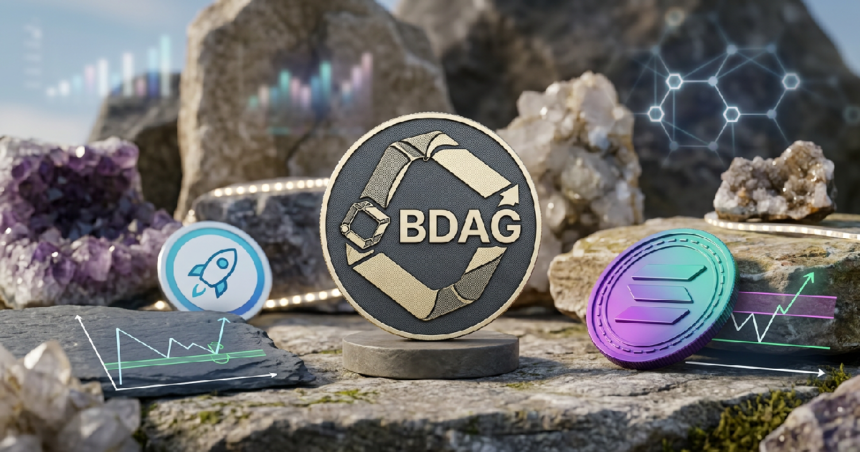
The cryptocurrency market is entering a decisive phase as the first quarter of 2026 winds down. While much of the institutional focus has remained fixed on the largest assets by market cap, a series of idiosyncratic price movements among altcoins is beginning to suggest a divergence in trader sentiment. BlockDAG is currently making waves with a bold $0.50 valuation target, while veteran assets Solana and Stellar have reached technical thresholds that could dictate their trajectory for the remainder of the spring.
BlockDAG momentum builds toward 50-cent milestone
BlockDAG has managed to sustain a level of retail interest that few new layer-1 projects have achieved this cycle. The project, which utilizes a directed acyclic graph structure to address scalability issues, is reportedly seeing increased capital inflows as its presale phases progress. Investors are now eyeing the $0.50 mark as a psychological and financial milestone. Early participants appear to be betting on the network’s promise of high throughput and low latency, though the transition from a successful presale to a functional, liquid mainnet remains the primary hurdle.
Unlike traditional blockchains that process blocks in a linear fashion, BlockDAG’s architecture allows for parallel processing. This isn’t just a technical quirk; it’s a necessity in a market where [decentralized GPU networks are pivoting toward AI compute needs](/render-crypto-ai-infrastructure-shift-2026). If BlockDAG can prove its infrastructure handles real-world load better than existing competitors, that 50-cent target may move from a speculative goal to a fundamental floor. But as with any emerging network, the risk of “pre-launch hype” versus “post-launch utility” remains a central theme for skeptics.
Solana faces a reckoning at resistance
Solana (SOL) remains the heavy hitter of the high-performance blockchain sector, but its recent price action suggests the easy gains are behind us for now. SOL has hit a critical resistance level that has historically served as a gateway to new all-time highs—or a springboard for a sharp reversal. Network activity remains high, driven largely by memecoin trading and stablecoin settlement, yet the asset is struggling to break through localized sell walls.
And it’s not just a matter of chart patterns. The broader regulatory environment is shifting. With the [New Clarity Act blocking interest payments on stablecoins](/crypto-clarity-act-bans-stablecoin-yields-analysis-2026), the yield-seeking behavior that often fuels on-chain activity on Solana is being forced to adapt. For SOL to push through its current critical level, it will likely need more than just retail trading volume; it needs to prove it can capture the institutional “utility” shift that is defining 2026.
Stellar XLM tests a long-term floor
While BlockDAG and Solana chase upside targets, Stellar (XLM) is fighting a different battle. The cross-border payment veteran is currently testing a critical support level that has held firm for several quarters. XLM has long been overshadowed by its neighbor, XRP, but it remains a lynchpin for many global payment corridors. The current price level is what many traders call a “make-or-break” zone.
Stellar’s future is increasingly tied to the concept of real-world asset (RWA) tokenization. As [analysts project diverging paths for XRP value by 2030](/xrp-price-projections-2030-analyst-breakdown), Stellar is carving out its own niche in the public-private partnership space. If the support holds, XLM could see a slow grind higher. If it breaks, it may signal that even established “utility” tokens aren’t immune to the liquidity drain currently affecting the broader altcoin market.
What the charts are telling us
The common thread between these three assets is the search for sustainable value. We are moving away from the era of “everything goes up” and into a phase of extreme selectivity. While [Bitcoin edges higher as the White House pauses its Iran response](/geopolitics-bitcoin-ethereum-iran-conflict-impact-2026), altcoins are being forced to stand on their own merits.
For BlockDAG, the challenge is delivery. For Solana, it’s overcoming exhaustion. For Stellar, it’s maintaining relevance in a crowded payment sector. The next few weeks will likely determine whether these critical levels are the start of a new rally or the beginning of a cooling-off period for the altcoin market.
Frequently Asked Questions
Is BlockDAG likely to hit $0.50 this year?
Price targets like $0.50 are often used in marketing and community goals, but whether an asset hits that mark depends on market liquidity and actual network adoption once the presale concludes. It’s a high-climb target that requires significant sustained buy pressure.
Why are SOL and XLM at “critical levels” right now?
“Critical levels” refer to specific price points where a high volume of buy or sell orders are clustered. For Solana, it’s a ceiling it needs to break; for Stellar, it’s a floor it needs to defend to prevent further losses.
How does the New Clarity Act affect these tokens?
The Act limits how stablecoin holders can earn yield, which can reduce the amount of capital “parked” on networks like Solana and Stellar. This might lead to lower on-chain volume as traders look for other ways to generate returns on their assets.


