

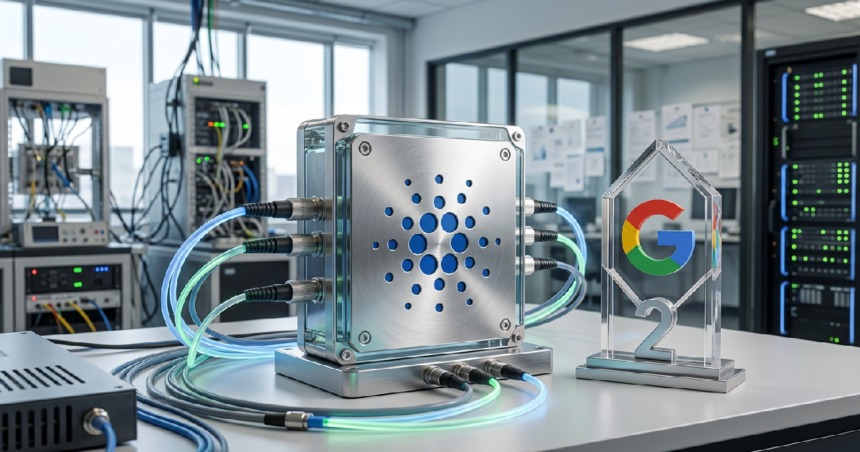
Google’s research into the long-term viability of distributed ledgers has identified Cardano as one of the few networks capable of surviving the eventual arrival of quantum computing. A recent assessment of blockchain infrastructure by the tech giant’s research arm reportedly ranks Cardano as the second-most “quantum-ready” network globally, trailing only behind a handful of experimental protocols specifically built for post-quantum security.
The threat of quantum computing has long been a “boogeyman” for the cryptocurrency sector. Standard cryptographic methods used by the majority of blockchains, including Bitcoin and Ethereum, rely on mathematical problems that would take traditional computers quadrillions of years to solve—but which a powerful quantum computer could potentially crack in minutes. Google’s recognition suggests that IOG (Input Output Global), the development team behind Cardano, has done some of the best foundational work to prevent this theoretical collapse.
The science behind the Google recognition
Google’s evaluation didn’t just look at current security, but at the underpinnings of how a network can be upgraded. Cardano’s architecture is famously built on peer-reviewed academic research, using a Haskell-based coding language and an EUTXO (Extended Unspent Transaction Output) model. These choices make the network more modular than its competitors.
The “quantum-ready” label stems largely from Cardano’s ability to integrate new cryptographic primitives without dismantling the entire chain. While most blockchains would require a chaotic “hard fork” to swap out their digital signature algorithms, Cardano’s “Hard Fork Combinator” (HFC) technology allows the network to transition smoothly to post-quantum signatures, such as Lamport or Winternitz signatures, which are resistant to Shor’s algorithm.
But it isn’t just about the code. It’s about the math. Cardano’s Ouroboros consensus protocol was designed with future-proofing in mind. By maintaining a highly formal approach to development, the network ensures that as soon as a standardized quantum-safe signature is finalized by bodies like NIST (National Institute of Standards and Technology), the Cardano governance system can systematically implement it.
Comparing the field: Why Cardano stands out
It’s no secret that the broader crypto market is currently grappling with a shift toward utility. Many older networks are struggling to adapt to modern demands, as noted in the latest analysis on the digital asset utility test. Cardano’s position in the top two reflects a different strategy: a “measure twice, cut once” philosophy that initially drew criticism for being too slow.
Bitcoin, by contrast, faces a much steeper climb. Its rigid architecture makes it incredibly secure today, but its lack of flexibility means its entire signature scheme would need a total overhaul to survive a quantum event. Ethereum is moving toward “account abstraction” to solve this, but Google’s findings suggest that Cardano’s existing infrastructure is already several steps ahead in the implementation timeline.
Governance and the road to 2026
The timing of this recognition coincides with Cardano’s push toward the “Voltaire” era of its roadmap, which focuses on decentralized governance. This is more than just a buzzword; a quantum-ready network needs a way to vote on significant security upgrades without central oversight.
If a quantum threat were detected today, most blockchains would have to rely on a small group of core developers to save them. Cardano’s on-chain voting system is meant to distribute that power. As the Cardano price outlook remains a topic of debate among traders, the network’s technical resilience provides a fundamental floor that many speculative assets lack.
And while the threat of quantum computers actually cracking keys might still be years away, Google’s nod serves as a validation for the scientific rigor IOG has applied. It shifts the narrative from “Cardano is slow” to “Cardano is ready.”
What this means for ADA holders
For investors, this news reinforces the long-term thesis rather than providing a short-term pump. Institutional players are increasingly looking for “survivability” as a key metric. If a sovereign nation or a global bank is looking to build on a ledger, they aren’t looking for the fastest network today—they’re looking for the one that won’t be obsolete by 2030.
The focus on security and academic validation remains the primary differentiator. While we are seeing a narrowing window for crypto utility across the board, Cardano seems to have secured a front-row seat for the next era of computing.
Frequently Asked Questions
What makes a blockchain “quantum-ready”?
A quantum-ready blockchain is one that either uses or can easily switch to “Post-Quantum Cryptography” (PQC). This involves using mathematical problems that quantum computers cannot solve faster than classical ones. It also requires a network structure that can handle the larger data sizes that these new security keys often require.
Is my ADA safe right now?
Yes. Commercial quantum computers powerful enough to break current encryption do not exist yet. Most experts believe we are at least 5 to 10 years away from a credible threat. However, the work Cardano is doing now ensures that when that day comes, your funds will be migrating to a safer standard before the threat is live.
Why did Google rank Cardano so high?
Google’s researchers likely focused on the flexibility of Cardano’s Ouroboros protocol and its ability to handle “pluggable” signatures. Because Cardano is built in a modular way using formal methods, it is significantly easier to update its security layers than it is for networks with older, more monolithic codebases.


