

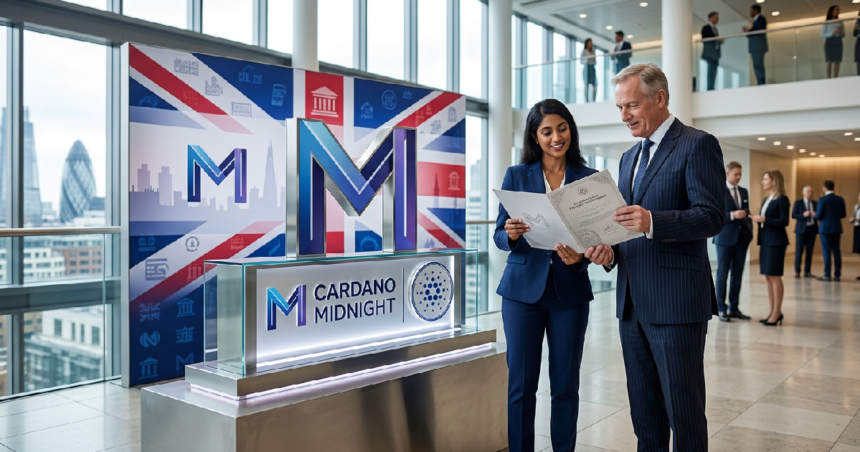
Cardano’s vision for a privacy-focused sidechain moved from theoretical concept to industrial reality today. Midnight, the data-protection platform developed by IOG (Input Output Global), has reportedly finalized a £250 million partnership with a major UK-based clearing bank. The deal represents one of the largest single integrations of privacy-preserving blockchain technology within the traditional British financial sector to date.
The agreement focuses on Midnight’s ability to handle sensitive metadata without exposing the underlying private information of customers. While the identity of the specific banking institution remains under embargo for final regulatory clearance, the scale of the £250 million commitment suggests a multi-year infrastructure overhaul rather than a simple pilot program. For Cardano, this isn’t just about another partnership; it’s a stress test for its zk-SNARKs implementation in a live, high-stakes environment.
Beyond the Hype of Zero-Knowledge Proofs
Privacy has long been the “holy grail” for institutional blockchain adoption. Banks are legally required to keep customer data private, yet they struggle with the transparency required by public ledgers. This is the friction point where Midnight intends to live. By using zero-knowledge proofs (ZKPs), Midnight allows the UK bank to prove a transaction is valid and meets compliance standards without broadcasting the account balances or identities of the parties involved to the entire world.
The £250 million figure is directed toward developing a custom permissioned-to-public bridge. This will allow the bank to settle internal liquidities on a private ledger while utilizing the security and finality of the Cardano mainnet. It’s a hybrid approach that many in the City of London have been calling for as the regulatory environment for digital assets becomes more rigid.
Unlike previous “enterprise blockchains” that were essentially just private databases, this deal leverages the public Cardano network for decentralized security. This suggests that the bank is betting on the long-term resilience of ADA as a settlement layer, even if the primary data processing happens on the Midnight sidechain.
The Regulatory Push in the UK
The timing of this £250 million deal isn’t accidental. British regulators have been tightening the screws on “clean” data and anti-money laundering (AML) protocols. The UK bank in question likely sees Midnight’s “selective disclosure” feature as a way to automate compliance. In this system, a bank can provide a viewing key to a regulator if an audit is triggered, but the data remains encrypted for everyone else.
This “regulation-friendly privacy” has been a core selling point for Charles Hoskinson and the IOG team since Midnight was first announced. For years, critics argued that privacy coins would be regulated out of existence. But the UK’s willingness to embrace a £250 million integration suggests that the narrative is shifting toward “programmable confidentiality” rather than total anonymity.
And it’s not just about the money. The technical integration will likely require a significant hiring surge for Haskell and Rust developers within the UK’s fintech corridor. This move puts Cardano in direct competition with Hyperledger and R3’s Corda, which have traditionally dominated the banking space but lack the decentralized security of a public parent chain.
Can Midnight Bridge the Gap?
The biggest hurdle remains the technical complexity of the integration. Transitioning legacy banking systems to a sidechain architecture is notoriously difficult. The £250 million budget is expected to cover a three-year rollout, including the creation of specialized “midnight-dApps” for domestic interbank settlement.
But the market response has been pragmatic. While Cardano enthusiasts see this as a validation of the network’s slow-and-steady research approach, institutional analysts are watching the throughput. If Midnight can handle the transaction volume of a major UK clearing bank without the latency issues that plagued earlier blockchain experiments, it could trigger a domino effect across European finance.
The deal also highlights a shift in the 2026 crypto market, where the focus has moved away from speculative trading and toward massive infrastructure contracts. This is no longer about “flipping” tokens; it’s about which protocol manages the plumbing of the global financial system.
Frequently Asked Questions
What exactly is Cardano Midnight?
Midnight is a sidechain built on Cardano that focuses on data protection and privacy. It uses zero-knowledge technology to allow users to share proof of information (like “I am over 18” or “I have enough money for this trade”) without actually revealing the private data itself.
Why did a UK bank choose Midnight over Bitcoin or Ethereum?
Banks generally cannot use Ethereum or Bitcoin for customer transactions because those ledgers are entirely public. Any competitor could see their trade volumes and customer flows. Midnight offers a “private-by-default” setting that still allows the bank to prove it is following the law, which is essential for regulated institutions.
Does this £250M deal affect the price of ADA?
While the deal is denominated in British pounds for the bank’s investment and infrastructure costs, the Midnight sidechain is secured by the Cardano mainnet. This usually means increased utility and demand for the Cardano ecosystem as a whole, though direct price movements depend on broader market conditions.


