

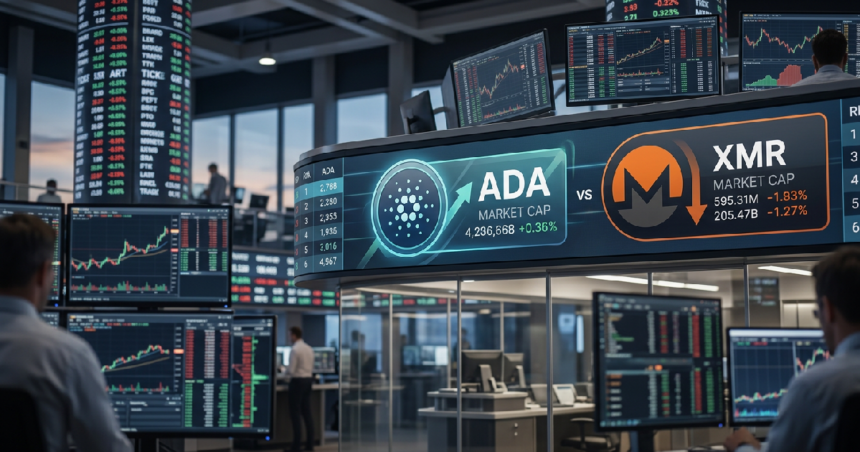
The middle weights of the cryptocurrency market are currently locked in a tightening race for dominance. Cardano and Monero have found themselves in a frequent exchange of positions within the top tier of digital assets by market capitalization. While both projects have survived multiple market cycles, the current struggle highlights a fundamental split in what investors value: the transparent, smart-contract-driven ecosystem of ADA versus the privacy-centric, utilitarian focus of XMR.
This isn’t just a battle of numbers on a dashboard. It represents a broader philosophical divide in the industry. Cardano, led by Input Output Global (IOG), is pushing toward full decentralized governance with the Chang hard fork aftermath, while Monero continues to defend its territory as the premier tool for financial anonymity, despite a relentless wave of exchange delistings and regulatory pressure.
Cardano Scales Up with Governance Milestones
For Cardano, the focus has shifted from purely technical upgrades to the “Voltaire” era of governance. The network’s ability to maintain its ranking depends heavily on whether its community-driven model can drive actual on-chain activity. Unlike many of its peers, ADA has resisted the temptaton of “move fast and break things,” opting instead for a peer-reviewed approach that has occasionally drawn criticism for being too slow.
But that slow-and-steady approach has built one of the most loyal holder bases in the industry. Recent data suggests that Cardano’s decentralized finance (DeFi) ecosystem is finding its footing, with Total Value Locked (TVL) showing resilience even during broader market drawdowns. The push for the return to the dollar mark is a psychological hurdle that many ADA supporters believe is achievable if the current roadmap holds steady.
And yet, the competition is stiff. The market is increasingly demanding more than just “scientific rigor.” It wants liquidity and high-speed applications. If Cardano can prove that its Liquid Democracy model works, it may secure its spot in the top ten permanently, leaving privacy coins like Monero to fend for themselves in a different niche.
Monero Defies the Regulatory Crackdown
Monero is the asset that refuses to go away. By every traditional metric of the “compliant” crypto world, XMR should be struggling. It has been purged from major centralized exchanges across Europe and North America as regulators tighten the screws on “Privacy Enhancing Technologies.”
However, XMR has a different kind of value proposition. It is one of the few cryptocurrencies used extensively as a medium of exchange rather than just a speculative vehicle. While ADA is bought for its future potential in smart contracts, Monero is bought because it works for private transactions today. This utility creates a floor for its market cap that isn’t easily shaken by the lack of “hype” or marketing departments.
The tussle between the two assets often comes down to market sentiment. When the market is in a “risk-on” phase, Cardano tends to outperform as investors chase the next big ecosystem explosion. When privacy concerns or regulatory overreach dominate the headlines, Monero often finds a bid as a hedge against the transparent nature of public ledgers like Bitcoin and Cardano.
The Impact of Global Liquidity
External factors are playing a massive role in who wins this ranking war. The broader market window for utility is closing. Projects can no longer survive on promises alone. They need to demonstrate an actual reason for existing beyond being a ticker on a screen.
Monero faces the “liquidity trap.” As it gets kicked off more exchanges, it becomes harder for large institutions to buy in, which naturally caps its market cap potential. Cardano doesn’t have this problem; it’s available on almost every major platform and is increasingly being looked at by institutional delegators who want a yield on a proof-of-stake asset. This institutional accessibility is perhaps the biggest advantage ADA holds in the long-term fight for a higher ranking.
But Monero has survived for over a decade. Its resilience is its brand. Every time a new “surveillance” law is passed, XMR gains a new set of users who value their financial privacy over exchange convenience. So, while ADA might have the higher ceiling in a bull market, XMR likely has the sturdier floor during a bear market.
Cardano or Monero in the Long Run
As we look at the charts today, the gap between the two is razor-thin. Cardano is betting on being the “financial operating system of the world,” a goal that requires cooperation with regulators and mass adoption. Monero is betting that the world will always need a digital version of cash that can’t be tracked, regardless of what the authorities say.
Expect this flip-flopping in the rankings to continue as the industry moves toward its final test for global utility. The winner won’t necessarily be the “better” technology, but the one that proves indispensable to its specific user base.
Frequently Asked Questions
Is Cardano a better investment than Monero?
It depends on what you are looking for. Cardano offers ecosystem growth, smart contract utility, and staking rewards, making it more attractive for those looking at DeFi. Monero is a specialized tool for privacy. Investors usually see ADA as a high-growth tech play and XMR as a utility-driven privacy hedge.
Why is Monero being delisted if it has utility?
Most exchanges delist Monero because of Anti-Money Laundering (AML) and Know Your Customer (KYC) regulations. Because Monero’s ledger is private, exchanges can’t track where the funds came from or where they are going after they leave the platform, which makes regulators nervous. But this delisting often reinforces its value to its core users who don’t want their transactions tracked.
Can Cardano’s governance model affect its price?
Yes, but not always immediately. Moving to a decentralized governance model means the community, not just a central company, decides the future of the network. If the community makes smart decisions regarding funding and development, it can lead to long-term trust and a higher valuation. However, it also introduces the risk of political infighting within the DAO structure.


