

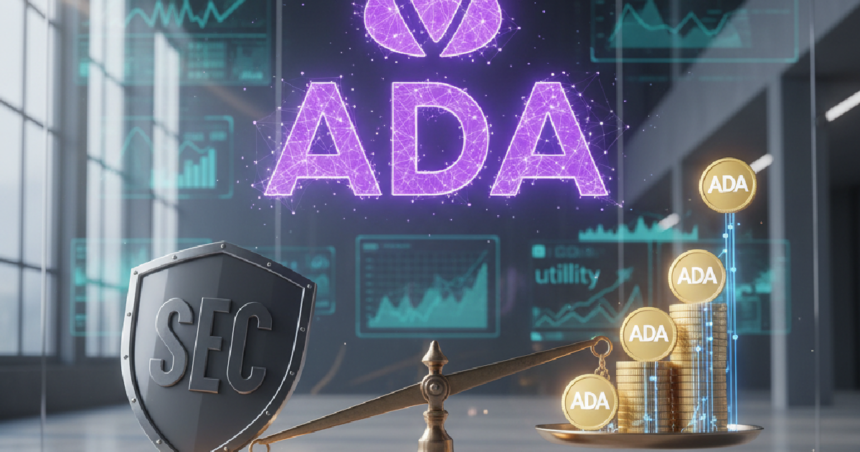
The regulatory clouds that have loomed over the Cardano ecosystem for nearly three years are finally beginning to part. In a development that has major implications for the broader altcoin market, the Securities and Exchange Commission (SEC) has reportedly signaled a pivot in its stance regarding the classification of ADA as a security. While the legal nuances are still being parsed by compliance teams in New York and Washington, the market’s response has been one of cautious optimism.
For Cardano holders, this represents more than just a legal victory; it is a clearing of the path. Since the SEC first labeled ADA an unregistered security in its 2023 lawsuits against major exchanges, the asset has suffered from a “liquidity discount.” Large-scale institutional Desks and retail platforms were forced to treat the token with a level of radioactive caution. But with this recent regulatory “break,” the narrative is shifting from courtroom defense to ecosystem development.
De-risking the ADA Investment Thesis
The core of the SEC’s previous contention was that the way Cardano was marketed and sold constituted an investment contract. By backing away from this aggressive labeling, the regulator is effectively removing the “Scarlet Letter” that prevented several major U.S.-based brokerages from offering the token to their clients. If you have $500 sitting in a brokerage account today, the math on Cardano looks significantly different than it did six months ago.
Without the constant threat of a delisting or a massive fine hanging over Input Output Global (IOG), the focus returns to the network’s fundamentals. Cardano has stayed the course with its peer-reviewed development roadmap, recently pushing forward with its “Chang” hard fork and the transition into the Voltaire era of decentralized governance. For a $500 investor, you aren’t just buying a token; you’re buying into a network that is finally being allowed to compete on a level playing field with Ethereum and Solana.
Calculating the ROI on a Five Hundred Dollar Bet
Investors often ask if $500 is “enough” to make a difference. In the world of high-market-cap assets like Cardano, a $500 position won’t turn you into a millionaire overnight, but it does offer a substantial foothold if the asset returns to its previous valuation peaks. When the regulatory pressure was at its highest, ADA’s price reflected a “risk premium”—investors were staying away because of the SEC, not the tech.
As that premium evaporates, we typically see a period of “mean reversion.” This is where the price adjusts to reflect the actual utility and adoption of the network rather than legal fears. Currently, Cardano’s Total Value Locked (TVL) in its DeFi protocols has remained resilient, and its stablecoin ecosystem is maturing. Taking a $500 stake now is essentially a bet that the “regulatory low” is behind us and that the market will now price Cardano based on its 2026 roadmap.
The Road Ahead for the Cardano Foundation
Legal wins are important, but they don’t build decentralized applications. The challenge for Charles Hoskinson and the Cardano Foundation now is to capitalize on this breathing room. The network has often been criticized for its “slow and steady” approach, which some traders find boring compared to the high-speed, high-meme environment of Solana.
However, the SEC’s shift might actually favor Cardano’s methodical nature. Institutions looking for a “safe” harbor in the crypto space tend to prefer networks that prioritize security and formal verification over “move fast and break things.” If the SEC is no longer an immediate antagonist, Cardano becomes a much easier sell to the conservative capital that is currently flowing into Bitcoin and Ethereum ETFs.
And while the market remains volatile—as highlighted by recent [Bitcoin technical patterns indicating a volatility squeeze](/bitcoin-technical-pattern-volatility-squeeze-analysis-2026)—Cardano’s relative stability during this regulatory pivot suggests a firming floor for the price. The next few months will likely see a push for more U.S.-based institutional products centered around ADA, now that the “security” label is being erased from the conversation.
Frequently Asked Questions
Does this mean the SEC can never sue Cardano again?
In the legal world, nothing is ever truly “never.” However, the reported shift indicates the SEC is dropping these specific claims in their current form. It provides a much higher level of legal certainty for exchanges and holders, even if it doesn’t offer total permanent immunity from future rule-making.
What happens to my ADA if I buy it on a U.S. exchange?
For most retail users, this is excellent news. It means the risk of your exchange suddenly “darkening” the trade or forcing you to sell your ADA due to regulatory pressure has dropped significantly. It makes ADA a much more liquid and accessible asset for the average investor.
Is $500 a good starting point for a crypto portfolio?
Absolutely. Many experienced traders recommend starting with a manageable amount like $500 to understand market cycles and wallet security. Given Cardano’s current price point and the recent news, it allows you to accumulate a significant number of tokens compared to buying fractional “sats” of Bitcoin, giving you more exposure to potential percentage gains.


