

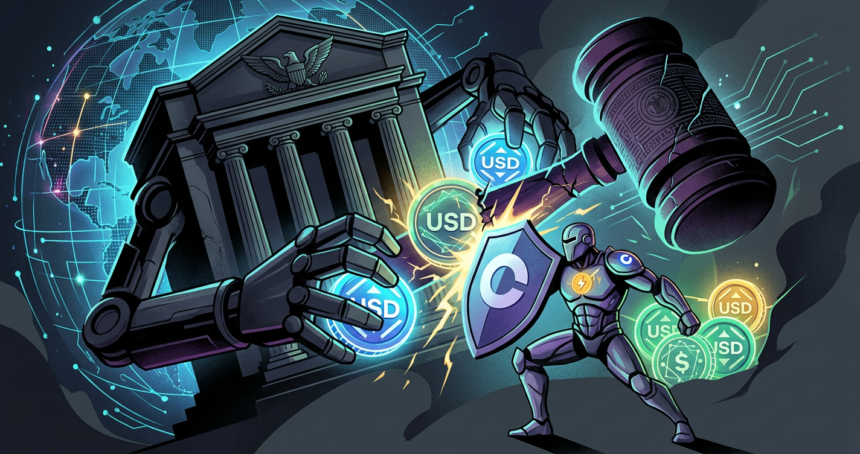
Coinbase is reportedly pushing back against a proposed legislative compromise on stablecoin regulation, marking a significant rift between the largest U.S. crypto exchange and lawmakers who have spent months attempting to bring order to the $150 billion sector. The dispute centers on the balance of power between federal and state regulators, as well as the strictness of reserve requirements that would govern assets like USDC.
For months, Washington has been inching toward a bipartisan deal that would finally provide a federal framework for stablecoins. But sources familiar with the matter suggest that Coinbase, a key stakeholder through its partnership in the Centre Consortium and its heavy reliance on stablecoin liquidity, believes the current draft yields too much ground to banking regulators. The firm’s opposition could complicate the bill’s path through a divided Congress, where every industry endorsement—or lack thereof—is magnified.
The State vs. Federal Power Struggle
The core of the disagreement reportedly lies in who gets to hand out the licenses. The current compromise under fire suggests a dual-pathway system: one where the Federal Reserve oversees non-bank issuers, and another where state regulators maintain some authority. Coinbase and several advocacy groups have long championed a “state-first” model, arguing that the New York Department of Financial Services (NYDFS) has already proven it can regulate the sector effectively.
By shifting more power to the Federal Reserve, Coinbase reportedly fears that stablecoin issuers will be treated like traditional banks. This would subject them to capital requirements and oversight that might be incompatible with the fast-moving nature of decentralized finance (DeFi). If the Fed is granted “veto power” over state-approved issuers, the industry argues it will stifle innovation and push American companies offshore.
This legislative friction comes at a delicate time. As noted in recent analysis of the New Clarity Act’s impact on stablecoin yields, the government is already looking at ways to limit how these digital assets are used as interest-bearing vehicles. For Coinbase, the stakes are existential; stablecoins are the “on-ramp” for almost every trade on their platform.
Reserve Requirements and the Yield Debate
Beyond the jurisdictional turf war, there is the matter of what actually backs a stablecoin. The compromise bill reportedly mandates that reserves be held in highly liquid assets like short-term Treasuries and cash. While this sounds prudent, the fine print regarding how these reserves are audited and where they can be held is a sticking point.
Coinbase has historically positioned USDC as the “compliant” alternative to offshore rivals like Tether. However, if the new bill imposes bank-like leverage constraints, the profitability of the stablecoin model shifts overnight. For an exchange that has seen trading volumes fluctuate significantly, stablecoin interest income has become a vital revenue stream. Losing the ability to manage those reserves with some degree of flexibility would be a blow to the bottom line.
The timing is also tough for the broader market. With market signals cooling and institutional investors showing signs of hesitation, the last thing the industry needs is a fractured regulatory front. If Coinbase remains at odds with the primary stablecoin bill, it is unlikely to pass before the upcoming election cycle takes full priority.
The Ripple Effect Across Digital Assets
The outcome of this stablecoin fight will set the tone for all other crypto legislation. If the government can’t agree on how to regulate a dollar-pegged token, there is little hope for more complex assets. We are already seeing the window for utility-driven growth narrowing as 2026 progresses. Investors are looking for certainty, and this latest reported clash suggests that certainty is still months, if not years, away.
And then there is the XRP factor. While the Coinbase fight is about dollars, the broader community is watching how legal definitions of “payment stablecoins” might bleed into other assets. Some analysts looking toward 2030 believe that a clear stablecoin law is the first domino needed for XRP and other bridge currencies to find their permanent place in the global financial stack.
What Happens Next on Capitol Hill
Lawmakers behind the bill face a choice: dilute the Federal Reserve’s authority to win back Coinbase and its peers, or forge ahead and risk a “no” vote from a vocal part of the industry. For Coinbase CEO Brian Armstrong, the move is consistent with his “save crypto” mantra, even if it means playing the role of the obstructionist in the short term. The exchange has shown it is more than willing to go to court or lobby intensely when it feels the industry’s fundamental structure is threatened.
But time is running out. As the industry faces its final test for global utility, the lack of a clear U.S. framework is becoming a competitive disadvantage. Europe’s MiCA regulation is already in full swing, and Asian hubs are clearing the way for their own regulated stablecoins. If the U.S. remains stuck in a jurisdictional battle between the Fed and state capitals, the “digital dollar” might end up being minted everywhere except America.
Frequently Asked Questions
Why is Coinbase specifically fighting this compromise?
Coinbase is reportedly concerned that the bill gives the Federal Reserve too much power over state-regulated entities. They argue this would subject tech companies to outdated banking rules, making it harder to innovate and more expensive to operate stablecoins like USDC.
Will this stop the stablecoin bill from passing?
It certainly makes it harder. Without the support of a major player like Coinbase, the bill loses its “industry-backed” status, which gives cover to moderate politicians who want to support crypto but fear being seen as anti-regulation.
How does this affect the average crypto user?
In the short term, not much. But in the long run, if a bill passes that Coinbase finds restrictive, it could lead to higher fees or fewer stablecoin-based products (like high-yield savings) for U.S. users. It might also mean more companies moving their stablecoin operations outside the United States.


