

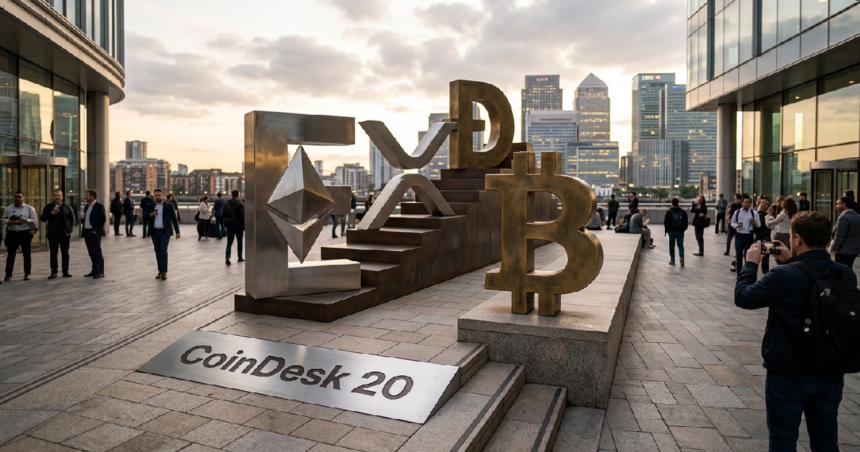
The standard correlation between Bitcoin and the broader digital asset market showed signs of fracture on Saturday as the CoinDesk 20 Index moved higher despite a stagnant performance from the market leader. While Bitcoin (BTC) spent the morning oscillating within a narrow range, several prominent altcoins began carving out independent paths, suggesting a shift in trader focus toward high-utility tokens.
The divergence comes at a critical juncture for the market. Historically, when Bitcoin moves sideways, liquidity tends to cycle into altcoins with strong fundamental catalysts. This “rotation” was on full display today as decentralized physical infrastructure (DePIN) and AI-related assets led the charge, outperforming the benchmark index and highlighting a growing appetite for risk-on assets outside the immediate shadow of the world’s largest cryptocurrency.
Diverging paths for the CoinDesk 20
The CoinDesk 20 Index, which tracks the twenty largest and most liquid digital assets excluding stablecoins, has seen its basket of altcoins provide the majority of the day’s momentum. Bitcoin’s inability to break through recent resistance levels has seemingly cooled the fervor for BTC-spot ETFs momentarily, leaving a vacuum that smaller-cap assets are rushing to fill.
Data indicates that Ethereum and several layer-1 competitors are seeing renewed interest as the Ether enters rare accumulation phase. This trend is mirrored across the CoinDesk 20, where assets like Solana and Avalanche are maintaining steady support levels even as Bitcoin’s price action remains uninspired. This typically suggests that long-term holders are looking for yield or growth opportunities that Bitcoin’s current consolidation cannot provide.
The AI and DePIN influence on altcoin gains
Perhaps the most significant contributors to the index’s climb are the tokens tied to artificial intelligence and decentralized computing. As decentralized GPU networks pivot toward AI compute needs, tokens in this sector have decoupled from the general market trend. Investors are increasingly viewing these assets not just as “crypto,” but as a decentralized bet on the productivity of the AI sector.
And it isn’t just theory. Trading volumes for these specific high-utility tokens within the CoinDesk 20 have spiked in the last six hours, contrasting sharply with the dwindling volume seen on Bitcoin pairs at major exchanges. Traders are betting on the idea that the “utility window” is finally opening, where the merits of a project’s technology outweigh the macro sentiment surrounding Bitcoin.
Watching the volatility squeeze
Despite the optimism in the altcoin space, the broader market remains on high alert. Bitcoin’s current flat trading often serves as a precursor to a volatile breakout. Technical indicators suggest a narrow range signals an impending volatility spike, which could potentially pull altcoins back into Bitcoin’s orbit if the eventual move is sharp and to the downside.
However, the resilience of the CoinDesk 20 today suggests that the “altcoin season” narrative might have more legs than in previous cycles. The market is maturing, and the distinction between a store-of-value asset like BTC and a utility-focused asset like a decentralized GPU network is becoming clearer to institutional and retail investors alike.
Frequently Asked Questions
Why are altcoins rising while Bitcoin stays flat?
This often happens during a period of “capital rotation.” When Bitcoin’s price consolidation wears on, traders move their profits or capital into altcoins that have higher growth potential in the short term. It usually signals that market participants have a high appetite for risk despite Bitcoin’s lack of movement.
What is the CoinDesk 20 Index?
The CoinDesk 20 is a weighted index that tracks the performance of the top 20 digital assets by market capitalization and liquidity. It is designed to give a broader picture of the crypto market’s health beyond just looking at Bitcoin’s price action.
Is this the start of a permanent decoupling?
It’s early to say. While we see brief periods where altcoins move independently, a major price swing in Bitcoin — either up or down — still tends to drag the rest of the market with it. True decoupling would require these assets to maintain their gains even during a significant Bitcoin sell-off.


