

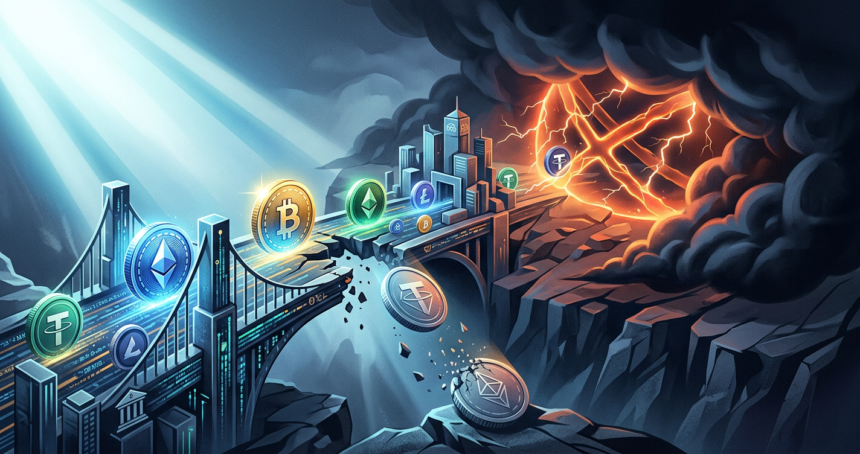
The grace period is over. For the better part of a decade, crypto developers and speculative investors lived in a world where “potential” was a valid currency. But as we move into the second quarter of 2026, the market has reached a definitive crossroads. The long-promised expectations of institutional adoption and technical scaling have largely been met, yet this success has brought a new, far more demanding set of pressures.
Industry analysts are now pointing to a narrowing window for digital assets. The days of launching a token based on a whitepaper and a prayer are gone. As the global utility test begins in earnest, the industry is no longer being graded on its aspirations, but on its balance sheets and daily active users.
The Shift from Speculation to Sovereign Utility
For years, the “killer app” for blockchain was always just six months away. That narrative doesn’t work anymore because the infrastructure has finally caught up. With Layer 2 solutions now handling the bulk of retail traffic and institutional-grade custody becoming the norm, the “plumbing” of the crypto world is essentially finished.
We are seeing a massive pivot in where capital is flowing. It’s no longer enough to be a faster version of Ethereum or a more private version of Bitcoin. The market is rewarding projects that solve specific, boring, and highly profitable problems. One of the most visible shifts is the move of decentralized GPU networks toward AI compute needs. By repurposing idle hardware for machine learning, these networks have found a revenue stream that doesn’t depend on crypto market cycles.
But this maturity comes with a trade-off. Regulation, once a distant cloud on the horizon, has made landfall. The recent legislative environment has forced a rethink of how these assets function, particularly regarding yield and passive income.
Regulatory Reality Bites the Stablecoin Market
The honeymoon phase for high-yield digital dollars ended abruptly this year. The implementation of the New Clarity Act has fundamentally reshaped the stablecoin sector by blocking interest payments on these assets. For many retail investors, this stripped away the primary incentive for holding “wrapped” or “staked” versions of fiat.
This regulation wasn’t just a hurdle; it was a signal that the window for “shadow banking” in the crypto space has closed. While this has cooled some of the speculative heat in decentralized finance (DeFi), it has also forced a migration toward assets with clearer long-term value propositions. Some investors are looking toward legacy stores of value, as seen in the recent rally in silver and gold, while others are doubling down on the “Blue Chips” of the digital space.
Bitcoin and Ethereum at a Standstill
Despite the institutional infrastructure being in place, the price action for the market leaders has been surprisingly muted. Bitcoin has been trapped in a sideways grind that has tested the patience of even the most hardened “HODLers.” This prolonged narrow range usually precedes a violent move, but the direction remains a subject of intense debate among traders.
Ethereum, meanwhile, has entered what some are calling a rare accumulation phase. With the network’s burn rate stabilizing and institutional staking becoming a standard part of corporate treasuries, the “supply shock” narrative is being tested. However, the lack of a fresh retail “mania” means these assets are behaving more like tech stocks and less like the volatile moonshots of 2021.
The Final Window for Altcoin Survival
If you’re looking for the high-risk, high-reward environment that used to define this space, you have to look at the fringe—but even that fringe is narrowing. The market is currently undergoing a brutal culling process. Projects that cannot demonstrate a path to profitability or clear network utility are seeing their liquidity vanish as market windows close.
We are seeing a divergence in how specific assets are viewed over the long term. For instance, the discourse surrounding XRP has shifted from its legal battles with the SEC to its actual integration into cross-border payment rails. While some projections for XRP’s 2030 value vary wildly, the underlying sentiment is clear: either it becomes a global standard for settlement, or it fades into irrelevance. There is no middle ground left.
This “all or nothing” phase is the final stage of the market’s evolution. The technology has met its expectations; now the business models must do the same.
Frequently Asked Questions
Why is the “window” for crypto supposedly closing?
The “window” refers to the period where a project could survive on hype and venture capital without having a working product or revenue. With stricter regulations like the Clarity Act and the entry of institutional players who demand traditional financial reporting, the room for speculative, non-functional projects has almost entirely disappeared.
Is Bitcoin still a good hedge against global instability?
It remains a complex relationship. While we’ve seen Bitcoin edge higher during geopolitical pauses, it also remains sensitive to global liquidity and interest rates. It hasn’t entirely decoupled from the traditional financial markets, making it a “risk-on” asset that occasionally behaves like digital gold.
What happens to DeFi if stablecoin yields are banned?
DeFi is currently reinventing itself. Since the ban on interest payments for many stablecoins, developers are shifting focus toward real-world assets (RWAs). This means using blockchain to trade things like tokenized real estate, private credit, or manufacturing invoices. The industry is moving away from “circular” yield—where you earn crypto by lending crypto—and toward yields generated by actual economic activity.


