

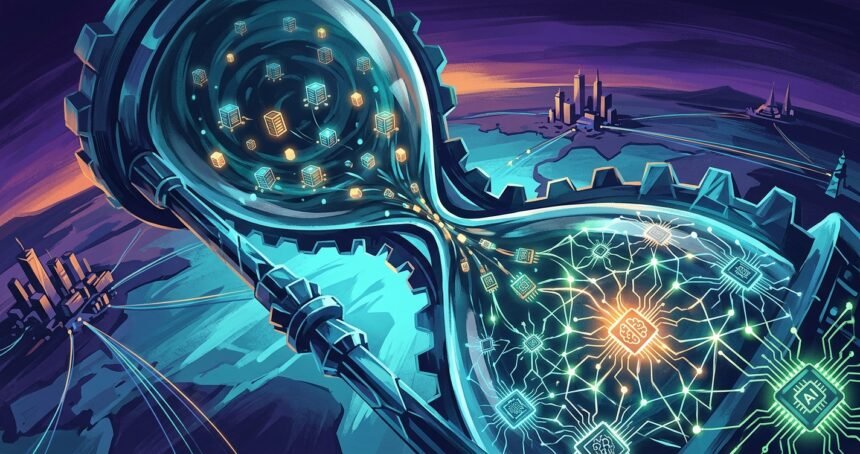
The honeymoon phase for digital assets is over. For years, the cryptocurrency sector operated as a sort of wild frontier, where the lack of rules was seen by many as a feature, not a bug. But as we move through March 2026, a consensus is forming among developers, venture capitalists, and institutional traders: the window for experimentation without consequences has slammed shut.
What remains is a narrow, high-stakes corridor where the industry must prove it serves a purpose beyond speculative trading. It is no longer enough to be “decentralized” or “immutable.” The market is now demanding utility that can be measured on a balance sheet. Those who follow the space closely call this the final test for global utility.
The Regulatory Squeeze and the End of “Wild West” Stablecoins
The most immediate pressure comes from Washington. The recent implementation of the New Clarity Act has fundamentally altered the math for stablecoin issuers. By blocking interest payments on stablecoin holdings, lawmakers have effectively stripped away the “passive income” lure that kept billions in the ecosystem. This wasn’t just a minor rule change; it was a targeted strike at the business models of several major players.
And it’s not just about the yield. The SEC and other global regulators have shifted from a reactive stance to a proactive one. We’re seeing a push to categorize almost every major asset as a formal financial instrument. This has pushed investors toward projects with clear regulatory standing. It’s why XRP recently hit 1.41, buoyed by the hope that its long-running legal battles have finally provided it with the “safe harbor” status that others are now scrambling to find.
But while some assets find footing, others are stumbling. Bitcoin, long considered the bedrock of the market, has shown signs of fatigue. After a period of relative calm, technical patterns suggest a volatility spike is imminent, and not everyone is convinced the move will be upward. Institutional players who entered during the 2024-2025 cycle are proving to have much thinner patience than the “HODLers” of old.
The Pivot to AI and Real-World Infrastructure
Behind the scenes, the money is moving. If you talk to the lead developers at major protocols, they aren’t talking about “the moon” anymore. They are talking about compute power. There is a massive shift toward decentralized GPU networks designed to feed the insatiable hunger of AI training models. This is where the “last window” of opportunity looks most promising.
The logic is simple: the world has a shortage of high-end chips. If crypto networks can successfully coordinate global hardware to solve that shortage, the industry moves from a “maybe” to a “must-have.” This transition is happening in real-time. We’re seeing projects that once focused on gaming or Metaverse land now pivoting entirely to AI compute and data verification.
However, this pivot comes at a cost. Many of the “community-led” aspects of these projects are being sidelined in favor of corporate partnerships. It’s a trade-off that many original proponents of the technology find hard to stomach, but it may be the only way to survive a market that is increasingly skeptical of anything that doesn’t produce immediate value.
Wall Street’s Cooling Enthusiasm
The vibe in Manhattan’s boardrooms has shifted. While 2025 saw a rush to launch every possible crypto-linked ETF, the mood in early 2026 is far more cautious. Analysts are starting to warn investors about crypto-linked stocks, noting that the correlation between Bitcoin’s price and companies like Coinbase or MicroStrategy is becoming a double-edged sword. When the market signals cool, the exit door gets crowded very quickly.
We are also seeing a change in how “safe haven” assets are viewed. For years, Bitcoin was touted as “digital gold,” but with precious metals like silver rallying and hitting long-term targets, the narrative is being tested. Investors are looking at their portfolios and asking why they should hold a volatile digital token when physical commodities are performing with much lower risk. This doesn’t mean Bitcoin is going to zero, but it does mean the “store of value” argument requires fresh evidence.
What Happens When the Window Closes?
So, where does this leave the average participant? We are likely entering a period of consolidation that will make previous bear markets look tame. The projects that survive won’t necessarily be the ones with the best memes or the most vocal Twitter followers. They will be the ones that integrated into the plumbing of the global economy—whether through cross-border payments, AI infrastructure, or supply chain tracking.
The window for “getting rich quick” on a random token launch is almost certainly shut. The window for building a multi-decade financial infrastructure is still open, but the requirements for entry have never been higher. As the utility deadline looms, the industry has to decide what it wants to be: a permanent fixture of global finance, or a footnote in economic history.
Common Questions About the Market Shift
Is Bitcoin still a safe investment in 2026?
Safe is a relative term. While Bitcoin remains the most liquid and recognized digital asset, it currently faces significant volatility risks. Institutional interest is more fickle than it used to be, and macro factors—like high interest rates and regulatory shifts—mean Bitcoin is no longer the “guaranteed” hedge some claimed it to be in 2021.
Why is the government banning stablecoin interest?
The New Clarity Act aims to distinguish between “payment tools” and “investment vehicles.” By stopping stablecoin issuers from paying interest, regulators want to prevent these assets from acting like unregulated bank accounts, which they believe poses a systemic risk to the traditional financial system.
Which sectors of crypto have the most potential right now?
Most analysts are looking at Decentralized Physical Infrastructure Networks (DePIN), particularly those focused on AI compute and energy. These projects offer a tangible service that exists outside of the crypto bubble, giving them a better chance of surviving regulatory crackdowns and market downturns.


