

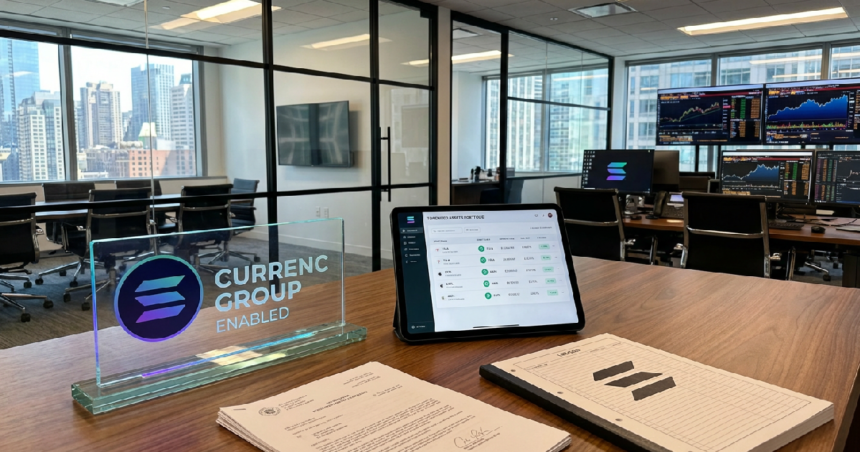
Currenc Group has moved toward merging traditional equity markets with decentralized finance by enabling the tokenization of its ordinary shares. In a recent announcement, the company confirmed that shareholders can now transition their holdings into digital tokens for on-chain trading, utilizing the Solana and Ethereum blockchains.
The initiative, reportedly launched in partnership with digital asset infrastructure provider Securitize, marks a shift for the Solana ecosystem. While the network has frequently been associated with retail-driven activity, the entry of entities listed on major exchanges like the Nasdaq suggests an increasing focus on institutional and regulated use cases. Solana has increasingly positioned itself as a hub for Real World Asset (RWA) tokenization, citing its transaction speeds as a primary advantage for financial instruments.
Bridging TradFi and Digital Assets
A primary challenge for tokenized securities involves the legal connection between a digital token and a corporate share. Reports indicate that Currenc Group is addressing this by ensuring that the tokenized versions of its shares carry the same weight as their traditional counterparts. This reportedly includes parity in ownership, voting rights, and participation in corporate actions.
By using an established infrastructure provider as a co-transfer agent, the company maintains a presence in both traditional and digital markets. For the Solana community, this provides a high-profile example of the network’s capacity to handle the technical and compliance demands of regulated financial assets. This development arrives as blockchain wins a role as core financial infrastructure, moving beyond speculative trading and into the fundamental operations of capital markets.
Market Dynamics and Network Utility
Despite the technological transition, the company is navigating complex market conditions. Some analysts have remained cautious regarding the firm’s broader market performance, occasionally maintaining localized sell ratings based on financial evaluations. However, the pivot to on-chain trading is often viewed as a strategic attempt to enhance liquidity, particularly for companies that may seek greater visibility than what is provided by traditional exchange hours.
Solana’s role in this transition is noteworthy given the network’s recent efforts to diversify its utility. As decentralized GPU networks pivot toward AI compute needs and other tangible applications, the introduction of tokenized public equities adds another layer to the assets moving through the Solana pipeline. The network’s ability to handle high throughput remains a central selling point for firms looking to move traditional assets onto a ledger.
Outlook for Tokenized Securities
This push by Currenc Group is unfolding as global markets weigh the benefits of 24/7 tradable assets against the need for rigorous oversight. While institutional shifts define 2026 crypto investment goals, the appetite for high-transparency assets with constant price discovery appears to be a growing trend among tech-forward firms.
Industry observers are likely to watch this development closely to see if tokenization leads to improved market efficiency without sparking regulatory friction. If successful, this could encourage other mid-cap companies to consider similar blockchain integrations. For now, the move serves as a real-world test for how Solana can support the infrastructure requirements of the modern financial era.


