

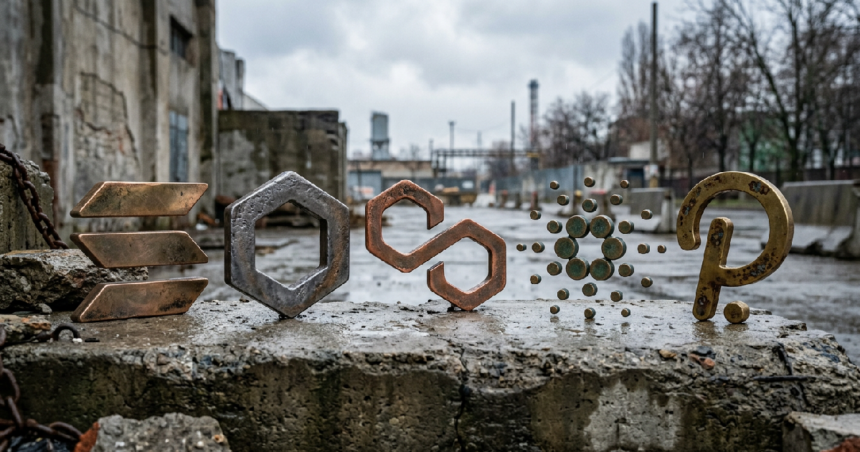
The current downturn in the digital asset market has left most retail portfolios in the red, but institutional desks are beginning to identify a select group of projects that appear decoupled from the broader trend. While Bitcoin remains stuck in a narrow range, several altcoins are flashing signals that historical data suggests often precede significant vertical moves.
Market cycles are getting shorter and more aggressive. Investors who survived the previous winters know that the best entries aren’t found during the height of a bull run, but rather when the “death of crypto” narrative starts to dominate the headlines. With the recent shift toward utility-driven value, the following five assets are being watched closely by analysts for their 10x potential.
Solana Faces Infrastructure Growth Despite Volatility
Solana continues to be the primary challenger to Ethereum’s dominance, largely due to its transaction speeds and a developer ecosystem that has refused to migrate during the bear trend. The network has overcome its earlier stability issues, and the focus has shifted toward high-throughput applications that require low latency. Analysts suggest that if the network can maintain its current growth in active addresses, it remains a primary candidate for a massive recovery once liquidity returns to the ecosystem.
Unlike previous cycles where “Ethereum killers” would disappear during a crash, Solana has built a moat through its mobile integration and deep-seated ties with institutional payment processors. It isn’t just a platform for speculative tokens anymore; it’s a functioning layer of financial infrastructure.
Render Network and the AI Compute Pivot
One of the most distinct trends of 2026 has been the convergence of decentralized finance and artificial intelligence. The Render Network has successfully survived the market cooling by pivoting toward AI compute needs. As the global demand for GPUs continues to outstrip supply, decentralized networks that can provide rendering and processing power are seeing a surge in actual usage.
This isn’t a speculative play based on hype. It’s a supply-demand equation. When tech companies can’t get hardware from traditional manufacturers, they turn to decentralized alternatives. This narrative has kept Render’s development activity high even as its price action remains suppressed by the wider bear market.
Chainlink Remains the Industry Standard for Connectivity
It is difficult to find a major blockchain project that does not rely on Chainlink for off-chain data. In 2026, the focus has moved toward the Cross-Chain Interoperability Protocol (CCIP). As traditional banks look to tokenize real-world assets (RWAs), they need a secure bridge to move that value across different private and public ledgers. Chainlink is essentially the “plumbing” for this entire movement.
While the token price has historically been slow to move, the 10x thesis rests on the “value capture” mechanism of CCIP. If Chainlink becomes the standard for global bank settlements, the current valuation may look remarkably low in retrospect.
Stacks and the Evolution of Bitcoin Programmability
Bitcoin’s role in the market is changing. It is no longer just a digital gold or a store of value. With the rise of Layer 2 solutions, Bitcoin is becoming a programmable network. Stacks is at the forefront of this transition. By allowing smart contracts to settle on the Bitcoin blockchain, Stacks offers the security of the most decentralized network in the world with the flexibility of a modern dApp platform.
But the road isn’t without hurdles. Bitcoin’s recent narrow range has kept the entire ecosystem in a holding pattern. However, for those looking for an “asymmetric bet,” the ability to build DeFi directly on top of Bitcoin serves as a powerful long-term catalyst.
Ondos Focus on Real World Assets
The final asset on the list represents the newest frontier in the 2026 market: Real World Assets (RWA). Ondo Finance has been leadng the charge in bringing US Treasuries and other institutional-grade products on-chain. In a high-interest-rate environment, the demand for yield-bearing assets that are also liquid and transparent is massive.
The recent regulatory shifts, including the New Clarity Act, have created a vacuum that projects like Ondo are designed to fill. By working within regulatory frameworks rather than against them, they are positioning themselves to be the primary entry point for the “trillions” of dollars in traditional capital that have yet to enter the crypto space.
What Investors Should Watch Next
The window for these 10x setups is not indefinite. Market utility is starting to dictate winners and losers more than social media hype ever did. Investors should closely monitor network activity and developer retention over the coming quarter. While the macro environment remains uncertain, the technical setups for these five assets are showing signs of exhaustion in the selling pressure, often a precursor to a trend reversal.
Frequently Asked Questions
Will these altcoins recover if Bitcoin continues to drop?
It is very rare for any altcoin to sustain a solo rally if Bitcoin enters a severe correction. However, these specific tokens have shown higher “beta” during relief rallies, meaning they tend to go up faster than BTC when the market finds its footing. You should always watch the BTC dominance chart for clues.
Is a 10x return still realistic in 2026?
The days of “everything goes up” are likely over. A 10x return is now reserved for projects that solve a specific technical or financial problem. The assets mentioned above have significant institutional interest, which provides the liquidity necessary for such a move.
What are the biggest risks to these setups?
Regulatory changes remain the biggest “black swan” risk. Even if a project is technically sound, a sudden change in how the SEC or global regulators view a token can wipe out gains overnight. Always diversify and never commit more than you can afford to lose in these high-volatility setups.


