

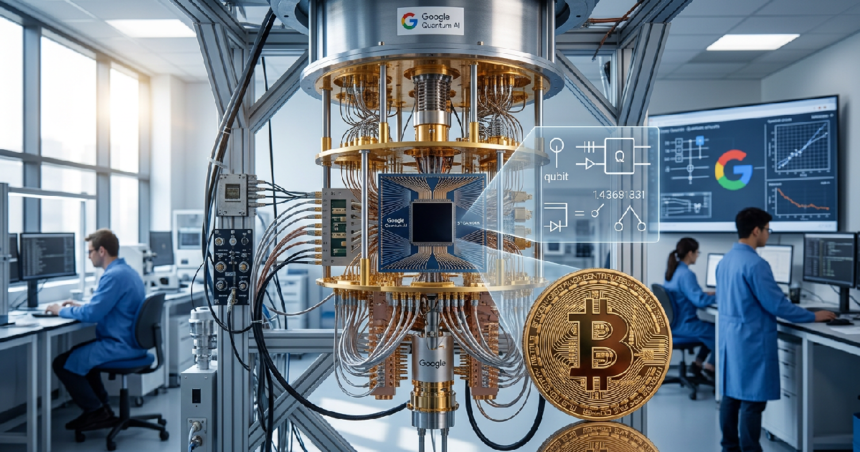
Google researchers have drastically revised the timeline for when quantum computers might realistically challenge Bitcoin’s cryptographic defenses. A new technical paper from the company’s dedicated quantum lab suggests that the number of qubits required to crack the Elliptic Curve Digital Signature Algorithm (ECDSA)—the framework securing every bitcoin in existence—is roughly 80% lower than previously thought.
For years, the consensus among cryptographers was that an attacker would need roughly 317 million physical qubits to break Bitcoin’s security within a single day. This astronomical number provided a sense of safety, as today’s most advanced quantum processors, including Google’s own Bristlecone and Sycamore hardware, operate with fewer than 1,000 qubits. But the new findings indicate that through more efficient algorithms and improved error correction, that requirement has plummeted to around 60 million.
The vanishing buffer of quantum safety
Bitcoin relies on public-key cryptography to ensure that only the rightful owner of a private key can authorize a transaction. This security rests on the mathematical difficulty of solving discrete logarithm problems. While classical computers find this task nearly impossible, Shor’s algorithm has long been known to solve it efficiently on a quantum machine.
Until now, the bottleneck has been the “noise” and error rates inherent in quantum hardware. Google’s latest research focuses on optimizing the way quantum gates are arranged and how information is distilled. By streamlining these processes, the researchers demonstrated that a machine could potentially extract a private key from a public address with far less computational “heavy lifting” than 2024-era models predicted.
This isn’t just a theoretical problem for the distant future. In the bitcoin ecosystem, many older addresses have their public keys exposed on the blockchain, particularly those created before the widespread adoption of Pay-to-Script-Hash (P2SH). If a quantum computer of sufficient scale is built, these “legacy” funds would be the first at risk.
And while 60 million qubits is still a massive leap from where we are today, the 80% reduction in difficulty suggests that the “Quantum Sunset” for current encryption standards is approaching faster than many anticipated. It effectively moves the goalposts, potentially bringing the threat forward by a decade or more.
The race toward post-quantum Bitcoin
The Bitcoin developer community has not been idle. Discussions regarding “Quantum Resistance” are a staple of technical mailing lists, though implementing a fix is far from simple. To protect the network, Bitcoin would likely need a “soft fork” or “hard fork” to introduce new signature schemes, such as Lamport signatures or other lattice-based cryptographic methods.
But the transition is fraught with logistical hurdles. Every user would need to move their funds to a new, quantum-secure address type. For the millions of bitcoins held in “lost” wallets or by those who do not follow technical updates, the arrival of a Google-scale quantum computer would mean a permanent loss of funds to whoever controls the machine first.
The industry is already seeing a tightening of the window for digital assets to prove their long-term utility. As noted in recent analysis on utility shifts dictating the 2026 market, the pressure to evolve beyond speculative assets into resilient financial infrastructure is mounting.
Hardware reality vs mathematical theory
It is important to separate the breakthrough in mathematics from the reality of hardware engineering. Building a stable system with 60 million qubits remains one of the greatest engineering challenges in human history. Quantum bits are notoriously finicky; even a slight change in temperature or a stray electromagnetic wave can cause “decoherence,” essentially crashing the calculation.
Google’s research doesn’t mean Bitcoin is broken today. It means the blueprints for the “bridge-burner” have become significantly more efficient. The hardware still needs to catch up to the math, but the math just took a massive leap forward. For the Bitcoin network, the news serves as a loud wake-up call that the 2030s may look very different for digital privacy.
Frequently Asked Questions
Does this mean my Bitcoin is unsafe right now?
No. Even with this 80% reduction in requirements, no quantum computer currently in existence comes close to the 60 million qubits needed to execute this attack. Your funds are secure under current NIST-approved standards, but the long-term outlook requires the network to eventually upgrade its code.
Can Bitcoin be updated to stop quantum computers?
Yes, developers can introduce new cryptographic signatures that are “quantum-resistant.” This would involve a network upgrade where users move their bitcoin to a new type of wallet. The challenge is ensuring that inactive or lost wallets don’t get drained by the first person to build a high-qubit machine.
Why is Google the one releasing this research?
Google is a leader in quantum supremacy research. Their Quantum AI lab consistently looks for ways to make quantum algorithms more efficient. By publishing these findings, they are providing the broader cryptographic community—including Bitcoin developers—a clearer roadmap of what types of threats to prepare for as hardware matures.


