

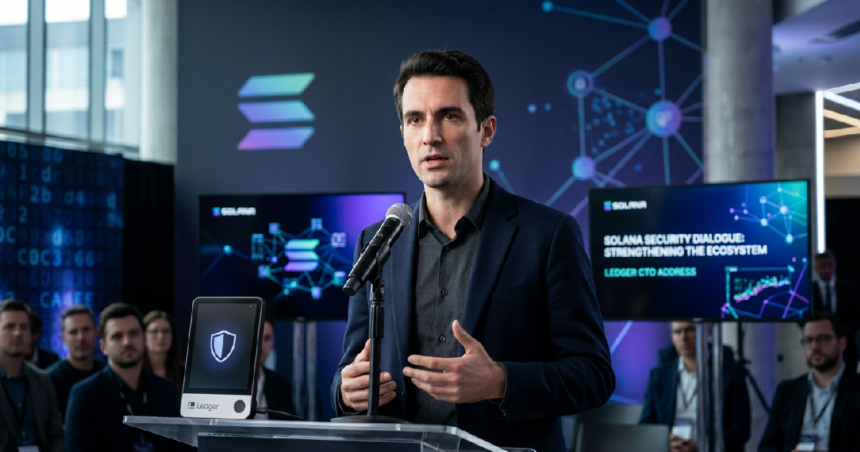
Security remains the Achilles’ heel of the decentralized finance (DeFi) ecosystem, a reality reinforced this week following a high-profile exploit on a Solana-based decentralized exchange (DEX). In the wake of the breach, Ledger’s Chief Technology Officer Charles Guillemet has issued a blunt warning to the crypto community: the era of “near enough” security must come to an end if self-custody is to survive as a viable alternative to traditional banking.
The latest incident targeted a prominent DEX on the Solana network, where attackers reportedly drained several million dollars in assets by exploiting a vulnerability in the smart contract logic. While the Solana blockchain itself remained operational, the ease with which the funds were siphoned has reignited a fierce debate over the safety of browser-based wallets and the growing sophistication of on-chain heists.
Hardware over Hot Wallets
Guillemet’s intervention isn’t just about corporate positioning; it’s a response to a recurring pattern of failure. Most users interacting with Solana’s high-speed ecosystem rely on “hot wallets”—applications connected directly to the internet. While convenient for rapid-fire trading, they leave private keys vulnerable to phishing and local machine compromises.
“Software wallets are a bridge, not a vault,” an industry sentiment Guillemet has echoed frequently. He suggests that the recent DEX hack could have had a significantly lower impact on individual users had more of them utilized hardware-based signing. When keys remain offline, even a compromised decentralized application (dApp) interface usually fails to trick a user who is required to physically verify a transaction on a separate device.
But the problem goes deeper than just where keys are stored. The Ledger CTO pointed out that users are often signing “blind” transactions. When a Solana DEX asks for permission to swap tokens, many users approve the transaction without truly understanding what the smart contract is authorized to do. This “blind signing” is exactly what the latest hackers exploited, tricking investors into granting permissions that allowed for the total drainage of their liquidity pools.
Solana Infrastructure Under the Microscope
Solana’s rapid growth has been a double-edged sword. Its low latency and negligible fees have attracted a massive wave of retail liquidity, but that same speed makes it an attractive playground for exploiters. Once a vulnerability is found, an attacker can drain a pool in seconds—long before a project’s developers have the chance to pause a contract or issue a patch.
The recent DEX breach has also highlighted a lack of rigorous, public auditing for many of the newer protocols launched during the current market upswing. Developers are racing to capture market share, often at the expense of defensive programming. Guillemet’s message to the community is clear: if the protocol hasn’t been battle-tested, the burden of security falls entirely on the individual. This isn’t a new lesson, but in the context of evolving market utility, it is becoming a critical one.
The Path to Better Defenses
Moving forward, the industry is looking toward “Clear Signing” as the next standard. This technical shift ensures that when a user interacts with a Solana DEX, their hardware wallet displays a human-readable summary of the transaction—telling them exactly what is leaving their wallet and what is coming back in—rather than an unintelligible string of hexadecimal code.
For now, the Solana community is left to pick up the pieces. Some projects have suggested “insurance funds” to reimburse victims of smart contract failures, but these are often undercapitalized and slow to payout. The real solution, as suggested by security leaders, is a shift in user behavior. This includes using burner wallets for experimental protocols and keeping the bulk of one’s portfolio in deep cold storage.
And as the narrowing window for crypto utility puts pressure on the sector to prove its reliability, these security lapses are more than just financial losses; they are reputational setbacks that provide ammunition for skeptical regulators. If the “World Computer” can’t keep its users’ funds safe, the transition to a decentralized future will remain perpetually out of reach.
Frequently Asked Questions
Does this hack mean the Solana network is unsafe?
No, the Solana blockchain itself was not compromised. The exploit happened at the application layer—specifically, the code of a decentralized exchange running on top of the network. Think of it like a bank robbery; the road leading to the bank is fine, but the vault’s lock was faulty.
Why didn’t my antivirus software stop the DEX exploit?
Antivirus software protects your computer from malicious files, but it cannot see “inside” a smart contract transaction. When you interact with a DEX, you are interacting with code on the blockchain. If you give that code permission to take your funds, your computer sees it as a legitimate action you authorized.
What is the safest way to trade on Solana now?
The safest approach is to use a hardware wallet for all transactions and to avoid “blind signing.” Only interact with protocols that have undergone multiple third-party audits. Additionally, never keep more funds in a hot wallet than you are prepared to lose in a single day.


