

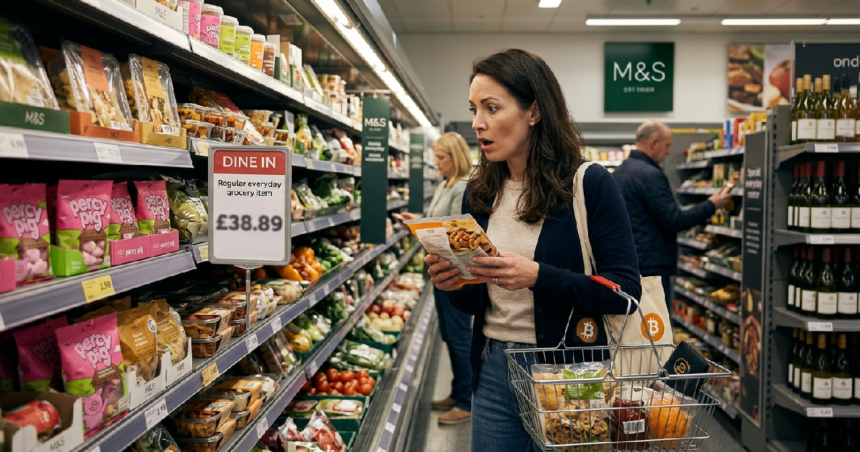
A routine grocery trip to Marks & Spencer (M&G) has become the latest focal point for the online debate over UK inflation, after a shopper’s social media post detailing the cost of basic household goods went viral. The post, which captured a “double-take” moment over the price of everyday essentials, has struck a chord with a public increasingly sensitive to the diverging paths of traditional fiat currency and digital assets.
The viral reaction highlights a growing disconnect between official inflation figures and the “shelf-shock” experienced by consumers. While the Bank of England and Treasury officials have pointed to a gradual stabilization in the Consumer Price Index (CPI), the reality on the ground at premium retailers like M&S tells a more complicated story about the eroding purchasing power of the Pound Sterling.
The M&S Price Shock and the Fiat Dilemma
The incident began when a customer shared an image of a standard household item—reportedly part of a weekly shop—noting that the price had climbed significantly since their last visit. This isn’t just a story about high-end groceries; it’s a symptom of the broader economic pressures forcing consumers to reconsider how they store their wealth. In the crypto community, these “double-take” moments are frequently cited as the primary catalyst for “orange-pilling”—the process of converting skeptics into Bitcoin holders.
As the cost of living remains stubbornly high, the narrative around Bitcoin as a hedge against currency debasement is gaining renewed traction. When a pint of milk or a box of laundry detergent feels like a luxury purchase, the technical arguments for decentralized, hard-cap assets move from the theoretical to the practical. For many, the M&S receipt is becoming a more relatable economic indicator than a spreadsheet from a central bank.
Why the Grocery Aisle Matters for Crypto Markets
It might seem like a stretch to connect a premium supermarket’s pricing to the volatility of the blockchain, but the psychological link is undeniable. We are currently seeing a shift where utility shifts dictate the 2026 market. Investors are no longer looking at crypto solely for speculative gains; they are looking for an exit ramp from a fiat system that appears to be losing its grip on price stability.
The M&S price hike serves as a visceral reminder of the “stealth tax” of inflation. While Bitcoin has faced its own challenges with sharp correction risks and market signals cooling, it remains one of the few assets with a fixed supply that cannot be manipulated by government policy. For the disgruntled shopper, the volatility of a digital coin often starts to look more appealing than the guaranteed, slow-motion devaluation of the currency in their savings account.
Beyond the Checkout Counter
The timing of this social media flare-up coincides with significant legislative changes in the financial sector. The recently introduced New Clarity Act, which blocks interest payments on certain stablecoins, has complicated the landscape for those seeking yield. However, it hasn’t dampened the demand for assets that exist outside the traditional banking infrastructure.
And it’s not just Bitcoin. We are seeing a broader trend where the digital asset industry faces a final test for global utility. If tokens can’t provide a solve for the real-world problem of diminishing purchasing power, they risk obsolescence. The fact that a grocery receipt can trigger a national conversation about economic value suggests that the window for crypto to prove its worth as a “Store of Value” is wide open.
The Road Ahead for Consumer Sentiment
Retailers like M&S are in a difficult position, caught between rising supply chain costs and a consumer base that is reaching its breaking point. But for the crypto industry, these moments of friction are an opportunity. Every time a consumer does a double-take at a price tag, the case for an alternative financial system gets stronger.
We are likely to see more of these comparisons as the year progresses. Whether it’s the cost of a luxury sandwich or the price of a liter of petrol, the “M&S Effect” is driving a new generation of users toward decentralized finance. They aren’t necessarily looking to get rich quick; they’re just looking to ensure that their hard-earned money buys the same amount of bread next week as it does today.
Frequently Asked Questions
Why does a supermarket price increase affect the crypto market?
When people lose faith in the purchasing power of their local currency (fiat), they often look for “hard assets” like Bitcoin or gold. High prices at the grocery store act as a psychological trigger for investors to diversify into assets that aren’t controlled by central banks.
Is Bitcoin actually a good hedge against grocery inflation?
In the long term, Bitcoin has historically outperformed the rate of inflation, but in the short term, it is much more volatile than the Pound. You won’t see Bitcoin prices move in lockstep with the price of eggs, but the overall trend of currency debasement is what drives many people toward crypto.
What should I look for next in the markets?
Watch for how retail spending habits change. If consumers continue to complain about “price gouging” or inflation at major retailers, expect to see a corresponding increase in retail interest for decentralized assets and stablecoins that offer a way to opt-out of the traditional banking loop.


