

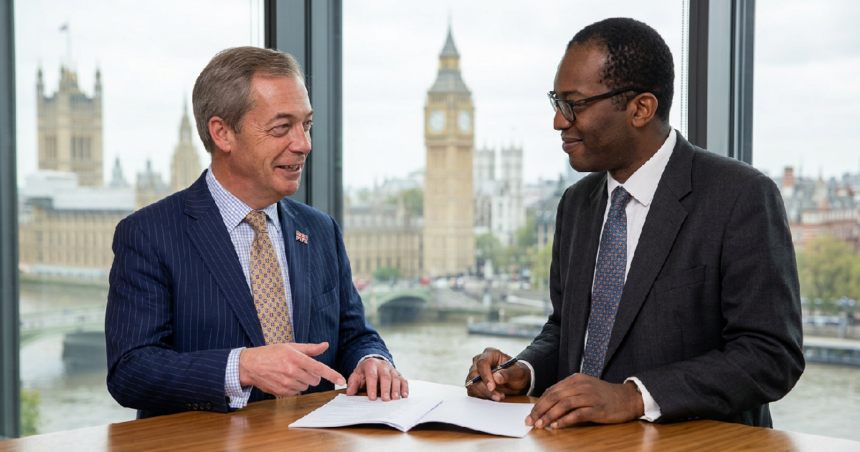
The intersection of British politics and digital finance took a sharp turn this week as Nigel Farage, former leader of the Reform Party and Brexit figurehead, reportedly committed a £215,000 investment into a venture spearheaded by former Chancellor of the Exchequer Kwasi Kwarteng. The move signals a tightening of ties between some of the UK’s most recognizable political names and the burgeoning decentralized finance arena.
Kwarteng, whose brief tenure as Chancellor under Liz Truss remains a flashpoint in UK economic history, has pivoted toward the private sector with a focus on blockchain-based infrastructure. The firm in question, while operating in a competitive and often volatile climate, aims to bridge traditional institutional finance with decentralized protocols. For Farage, the investment is more than a simple portfolio diversification; it represents a public vote of confidence in a colleague whose previous fiscal policies were often met with market friction.
High Stakes and Political Rebranding
The investment comes at a time when the UK’s regulatory framework for digital assets is under intense scrutiny. While the government has previously signaled its intent to make the country a “global hub” for crypto-asset technology, the reality on the ground has been more complicated. High-profile political figures moving into this space add a layer of personal and political reputation to an industry that is still fighting for mainstream legitimacy.
Farage’s decision to back Kwarteng’s firm suggests a belief that the “Kwarteng brand” still carries weight in certain investment circles, despite the fallout of the 2022 mini-budget. The £215,000 stake is substantial enough to be viewed as a signal to other private investors that the former Chancellor’s vision for financial technology has merit.
Critics of the move have pointed out the irony of two figures who championed national sovereignty and traditional economic levers now betting heavily on borderless, decentralized technology. But for supporters, this is a logical progression: an attempt to seize on the “global utility” that many believe will define the next decade of finance. You can read more about how this industry faces its final test for global utility as the window for mass adoption begins to narrow.
The Kwarteng Venture in Detail
While specific technical details of the firm’s product suite remain closely guarded, the overarching strategy appears focused on tokenized assets and cross-border settlement. By leveraging blockchain technology, the venture seeks to reduce the friction points that currently plague international banking—a problem Kwarteng often highlighted during his time in the Treasury.
The timing is also curious. The broader market is currently grappling with new legislative hurdles. For instance, the New Clarity Act has recently blocked interest payments on certain stablecoins, forcing firms to rethink their revenue models. Kwarteng’s firm will likely have to navigate these tightening rules if it hopes to attract more than just celebrity political backing.
Farage, for his part, has never been shy about his skepticism of central bank digital currencies (CBDCs), often referring to them as potential tools for state surveillance. By investing in a private, decentralized alternative, he is aligning his capital with his long-standing rhetorical stance against “the establishment” in banking.
The Road Ahead for Politically Backed Tech
The success of the Farage-Kwarteng alliance will likely depend on product delivery rather than personality. The crypto space is littered with “celebrity” projects that failed to survive their first bearish cycle. However, this venture differs in its focus on institutional architecture rather than retail-facing meme tokens or NFTs.
As the UK gears up for further electoral cycles, the business dealings of its most prominent commentators will remain under the microscope. If Kwarteng’s firm can deliver on its promise of efficient, decentralized settlement, it may provide him with a path to professional redemption. If it falters, it will serve as another piece of ammunition for those who argue that the intersection of “disruptive” politics and “disruptive” finance is built on shaky ground.
Investors are also watching how other assets are behaving during this period of political realignment. While Bitcoin remains the primary focus for many, others are looking toward long-term plays in different sectors. Some analysts project diverging paths for assets like XRP, suggesting that the era of “one size fits all” crypto investing is over.
Frequently Asked Questions
Is Nigel Farage the only high-profile investor in this firm?
While Farage is the most prominent name to emerge recently, the firm has reportedly attracted interest from several private equity individuals and former City of London executives who are looking to capitalize on the shift toward blockchain-based settlements.
What does this mean for the future of UK crypto regulation?
It puts more pressure on regulators to provide clear guidelines. When former senior government officials enter the fray as private owners, the line between policy and profit becomes thinner, necessitating more transparent rules of engagement for digital asset firms.
Has Kwasi Kwarteng commented on the investment?
Kwarteng has remained relatively quiet regarding individual investment figures but has consistently advocated for the UK to embrace the technological efficiencies that decentralized finance offers, framing it as a post-Brexit competitive advantage.


