

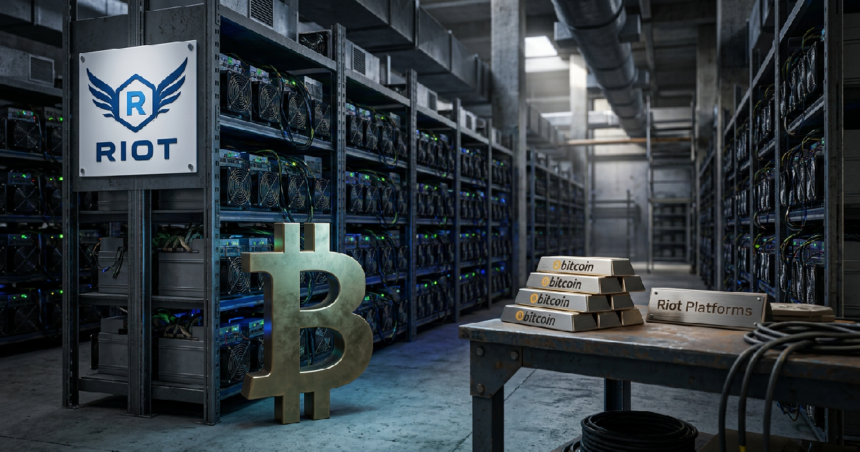
The economics of Bitcoin mining are entering a grueling new phase as the industry prepares for the upcoming halving event. Riot Platforms, one of the sector’s largest publicly traded players, has underscored this reality by offloading 3,778 BTC during the first quarter of 2024. The move signals a tactical shift as miners prioritize liquidity and operational efficiency over the “HODL” strategies that defined the previous bull cycle.
Riot’s decision to sell such a substantial portion of its holdings comes at a time when the network difficulty is hitting record highs. For industrial miners, the math is becoming increasingly complex: as the cost of electricity remains volatile and the reward for securing the network prepares to drop by 50%, the margin for error has effectively vanished. By liquidating nearly 3,800 Bitcoin, Riot has bolstered its cash position, presumably to fund the massive infrastructure build-outs required to stay competitive.
Capital Expenditures and the Race for Hashrate
Riot isn’t just selling to keep the lights on. The company is currently in the midst of a massive expansion at its Corsicana facility in Texas. Building out giant data centers requires an immense amount of upfront capital, and in a high-interest-rate environment, internal financing through asset sales is often more attractive than taking on expensive debt or diluting shareholders further through equity offerings.
The company’s strategy reflects a broader trend among “Tier 1” miners. They are locked in an arms race to acquire the latest generation of ASIC (Application-Specific Integrated Circuit) miners. These machines are more energy-efficient, meaning they produce more hashes per watt of electricity. In a post-halving world, miners using older, less efficient hardware will likely find themselves operating at a loss, forcing them to shut down entirely.
But Riot’s treasury management also serves as a hedge. While Bitcoin’s price has shown resilience recently—fluctuating as geopolitical tensions influence market sentiment—the certainty of cash on the balance sheet provides a safety net that volatile digital assets cannot offer during a construction cycle.
The Halving Shadow and Power Credits
Beyond simple sales, Riot’s profitability is uniquely tied to its relationship with the Texas power grid, ERCOT. The company has pioneered a “power credit” model, where it curtails its mining operations during periods of peak demand in exchange for credits. This secondary revenue stream has often made Riot a low-cost leader in the space, but even these credits are not always enough to offset the sheer overhead of a multi-state mining operation when Bitcoin’s “block subsidy” is about to be slashed.
Market observers are closely watching how this selling pressure impacts the broader market. When a major institutional miner dumps thousands of coins, it creates a supply overhang that the market must absorb. So far, the appetite from spot Bitcoin ETFs has largely soaked up this selling pressure, but the dynamic could shift if institutional inflows begin to stall.
Infrastructure as the New Competitive Moat
The era of mining Bitcoin in a garage or a small warehouse is long gone. Today, the industry is about “rack space” and “megawatts.” Riot’s Q1 sales indicate that the company views its physical infrastructure—the buildings, the cooling systems, and the power contracts—as its primary value proposition, rather than just the coins on its balance sheet.
As we head into the summer months, the focus will shift to how many of Riot’s newly purchased miners are actually plugged in and hashing. If the company can successfully transition to its new hardware while maintaining a healthy cash reserve, it may emerge from the halving with a larger share of the total network hashrate. However, the path to that goal is paved with the liquidation of the very assets they are working so hard to produce.
Frequently Asked Questions
Why did Riot sell its Bitcoin instead of holding it?
Mining is a capital-intensive business. Riot sold 3,778 BTC primarily to generate the cash needed for operational expenses and to fund the expansion of its mining facilities, such as the Corsicana site. It’s often cheaper for a company to sell its own assets than to borrow money at high interest rates.
Does this mean Riot is bearish on Bitcoin?
Not necessarily. While a sale of this size looks significant, it’s a standard treasury management move for a public company. By liquidating some holdings, Riot ensures it can survive and expand during periods of high difficulty or price volatility, ensuring they stay in business for the long term.
How does the Bitcoin halving affect miners like Riot?
The halving cuts the amount of Bitcoin earned for mining a block in half. This effectively doubles the production cost per Bitcoin. To remain profitable, companies like Riot must either hope the price of Bitcoin doubles or, more realistically, upgrade to much more efficient mining hardware to lower their electricity costs per hash.


