

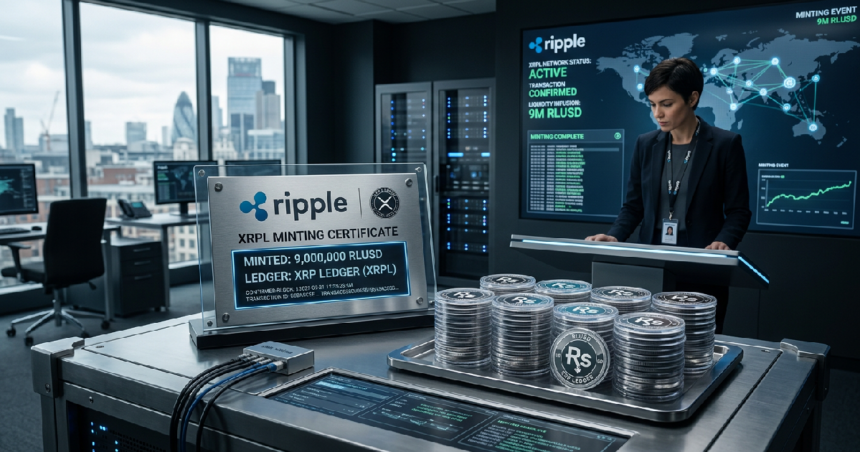
The XRP Ledger just registered a substantial liquidity injection as Ripple minted 9 million units of its RLUSD stablecoin. This latest minting event, tracked by on-chain data monitors, signals that the San Francisco-based fintech firm is rapidly scaling the infrastructure for its dollar-pegged asset ahead of a broader commercial rollout.
The 9 million RLUSD tokens appeared in a flurry of activity on the ledger, marking one of the largest single-batch creations of the stablecoin to date. While RLUSD has been in a testing phase for several months, the increasing frequency and volume of these mints suggest that Ripple is moving beyond internal sandbox trials and toward live institutional settlements.
The Mechanics of Ripple’s Stablecoin Ambition
Unlike many algorithmic stablecoins that have collapsed under market pressure in recent years, RLUSD is designed to be a “high-compliance” asset. Ripple has consistently stated that the token is backed 1:1 by a reserve of US dollar deposits, short-term US treasuries, and other cash equivalents. The 9 million RLUSD minted this week serves as a stress test for the XRP Ledger’s ability to handle high-value, compliant transactions without the volatility often associated with native digital assets.
For Ripple, the goal isn’t necessarily to compete with retail giants like Tether (USDT). Instead, they are positioning RLUSD as a tool for financial institutions that require the speed of blockchain but the stability of the dollar. By housing the asset on the XRP Ledger, Ripple can offer simultaneous settlement and lower fees than traditional corridors like SWIFT.
But the timing of this mint is also conspicuous. It comes as US regulators continue to debate the Clarity Act, which could reshape how stablecoin issuers pay out interest or manage their reserves. Ripple is clearly betting that a transparent, audit-ready stablecoin will be the preferred vehicle for banks moving into the 2026 fiscal year.
Strategic Alignment with the XRP Ledger
The injection of 9 million RLUSD doesn’t just benefit Ripple; it provides a much-needed liquidity layer for the XRP Ledger itself. For years, the ledger has relied primarily on XRP as its bridge currency. While XRP is excellent for rapid transfers, its price fluctuations can be a deterrent for corporate treasurers who need to move millions of dollars without worrying about a 2% price swing mid-transaction.
By introducing a native stablecoin, Ripple allows users to toggle between XRP for high-speed liquidity and RLUSD for value preservation. This “dual-asset” strategy is likely the “Final Proof” many analysts have been looking for regarding the global utility of digital assets. If Ripple can prove that RLUSD works seamlessly alongside XRP, it could silence critics who argue that the ledger lacks real-world enterprise application.
What This Means for the 2026 Roadmap
The minting of 9 million tokens is a drop in the bucket compared to the billions held in USDT or USDC, but it’s the velocity of growth that matters here. Reports suggest that Ripple is onboarding a select group of exchange partners and market makers to provide deep order books for RLUSD. These partners will be essential if Ripple hopes to capture a slice of the cross-border payment market currently dominated by traditional banking rails.
Industry observers are now watching for “burn” events. In a healthy stablecoin ecosystem, tokens are minted and burned in response to demand. If we see these 9 million tokens circulate and then get redeemed for fiat, it proves the plumbing works. If they sit stagnant, it may suggest that institutional appetite is still lagging behind the technological capability.
So far, the markets have reacted with cautious optimism. While the XRP price remains sensitive to broader volatility spikes in the Bitcoin market, the expansion of the RLUSD supply provides a fundamental floor for the ecosystem’s activity levels.
RLUSD and the XRP Ledger FAQ
Is RLUSD replacing XRP?
No, the two assets serve different functions. XRP is a bridge currency used for rapid liquidity across different fiat pairs, while RLUSD provides a stable dollar-denominated value on the ledger. They are meant to work together to give institutions more choices in how they settle payments.
Why did Ripple mint exactly 9 million tokens?
While Ripple hasn’t disclosed the specific reason for this exact figure, large mints of this nature are typically used to supply liquidity to partner exchanges or to facilitate a specific pilot program with a financial institution. It indicates a move from testing toward “production-ready” liquidity.
Can retail investors buy RLUSD right now?
RLUSD is primarily aimed at institutional use cases and enterprise clients of Ripple. While it may eventually be available on secondary exchanges for retail traders, its main purpose is to facilitate back-end financial infrastructure rather than acting as a retail trading pair like USDT.


