

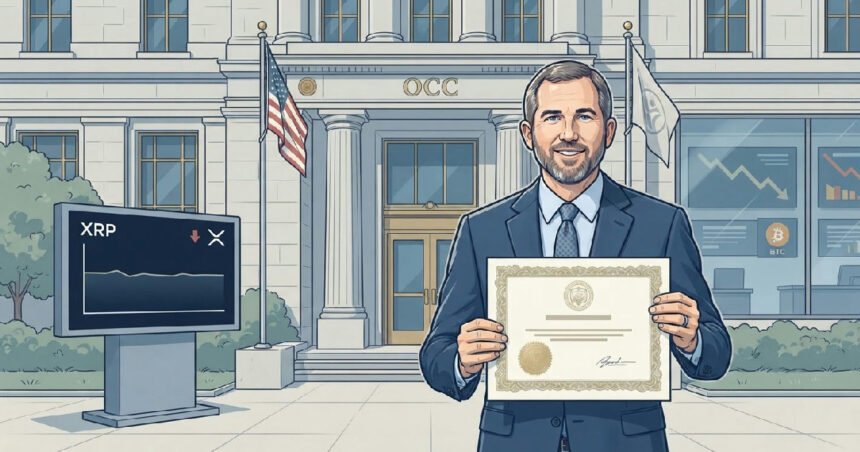
Ripple has secured a major regulatory victory, receiving final approval to launch its own national trust bank, yet the news has failed to ignite a rally for its associated token, XRP. The fintech firm received the go-ahead from the U.S.
Office of the Comptroller of the Currency (OCC) on October 26, 2026, but the XRP price has remained listless, even slipping 0.5% since midnight UTC as the broader cryptocurrency market shows signs of strain.
Ripple secures final regulatory win meets a cold market shoulder
This muted reaction stands in stark contrast to the market’s previous responses to Ripple’s legal successes and highlights a cautious sentiment currently pervading the digital asset space.
The entire market is feeling the pressure from its leader, Bitcoin (BTC), which is flashing technical warning signs as it trades below the key $80,000 level, leaving altcoins like XRP with little room to capitalize on company-specific good news.
The approval from the OCC marks a significant milestone for Ripple, transforming a conditional permit from late 2025 into a full federal charter for its Ripple National Trust Bank (RNTB). Based in New York, the bank is poised to provide critical infrastructure for institutional crypto adoption.
This transition took approximately ten and a half months, moving from a conditional step in December 2025 to final approval in late October 2026, signaling the OCC’s evolving stance on digital-asset charters.
Its mandate includes managing segregated reserves for Ripple’s stablecoin, RLUSD, serving as a collateral trustee for its holders, and offering fiduciary digital-asset custody services. The market capitalization of RLUSD has already grown to approximately $2.5 billion since its launch in December 2024, underlining the potential scale of RNTB’s operations.
Ripple CEO Brad Garlinghouse celebrated the news, stating, “For years, we’ve said crypto and banks work better together.” The approval conveniently precedes Ripple’s Swell 2026 conference in New York City, an event typically used to showcase the company’s progress and partnerships. Despite the strategic importance and positive framing, the market’s reception has been decidedly lukewarm.
The price pressure on XRP appears disconnected from the company’s operational advancements.
As of October 27, XRP’s price hovered around $1.32. Analysts at Marex provided a blunt assessment of the market’s indifference, noting, “The charter itself creates no requirement to buy XRP.”
This distinction gets to the heart of the matter: while the bank strengthens Ripple’s institutional framework and the ecosystem around its stablecoin, it doesn’t create direct demand for the XRP token itself, which is a crucial factor for traders focused on short-term price action.
Bitcoin flashes warning signs for the broader market
While Ripple’s news was specific, the overarching narrative is being written by Bitcoin’s sluggish performance. The largest cryptocurrency has dipped below its 50-day moving average and is struggling to hold the psychological $80,000 support zone. According to Alex Kuptsikevich, chief market analyst at FxPro, “Technical indicators suggest the downtrend is set to continue, as the market sinks further below its 50-day moving average.”
Secure Digital Markets, an Ontario-based firm, echoed this concern in a daily note, identifying $80,000 as the critical line in the sand. “A break below that could open the door to $75,000, then $73,000,” the firm warned. Bitcoin had spent two weeks trading between $80,000 and $86,000, but has narrowed its price since June 2026 to a range of approximately $60,000–$65,000.
This bearish outlook is compounded by a significant compression in volatility. Bitcoin’s 30-day trading range has tightened from 13% down to just 6%, a type of “volatility squeeze” that technical analysts say often precedes a sharp, decisive price move.
Macroeconomic indicators are also being closely watched ahead of a Federal Reserve meeting this week, with options traders on decentralized platform Derive pricing in a 3% move in either direction by Friday’s expiry.
Trading volumes further paint a picture of waning enthusiasm. According to K33 research, average daily spot trading volume for Bitcoin has slumped to $2.2 billion over the past month, a steep decline from the roughly $5 billion seen at the start of 2026.
This indicates that while the price is holding a range, fewer participants are actively trading, suggesting a lack of conviction from both bulls and bears. Open interest on CME futures has also fluctuated between 95,000 and 102,000 BTC, levels last observed in 2023.
The long shadow of the SEC lawsuit
To understand the current apathy towards XRP’s news, one must look back to the explosive reaction following a key legal ruling in its long-running battle with the U.S. Securities and Exchange Commission (SEC). On July 13, 2023, U.S. District Judge Analisa Torres of the U.S.
District Court for the Southern District of New York delivered a landmark decision that was widely seen as a major victory for Ripple and the broader crypto industry.
Judge Torres ruled that while Ripple’s direct sales of XRP to institutional investors, totaling $728 million, constituted unregistered securities offerings, its “Programmatic Sales” to retail investors on digital asset exchanges, and “Other Distributions” for grants and team allocations, did not.
This distinction was crucial: the court found that programmatic sales did not satisfy the Howey test’s third prong because buyers could not reasonably expect Ripple to use sale proceeds to improve the XRP ecosystem and increase its price.
The immediate market response in 2023 was dramatic. The price of XRP surged by more than 70% on July 13 alone, and major exchanges like Coinbase quickly re-listed the token.
Ripple CEO Brad Garlinghouse publicly stated on July 14, 2023, that Ripple was “on the right side of the law, and will be on the right side of history,” characterizing the SEC as a “bully.”
The SEC, however, filed an appeal on January 15, 2025, challenging the July 2023 ruling regarding retail sales, leaving a degree of legal uncertainty still lingering.
XRP’s critical support levels under scrutiny
Despite the recent corporate achievement, XRP’s current trading activity suggests a market more focused on immediate technical indicators than long-term strategic wins. The cryptocurrency is currently hovering near $1.25, a price point that has consistently acted as a major support level since mid-September. This repeatedly indicates that buyers have stepped in at this valuation to prevent further declines.
If XRP manages to hold above $1.25, it could signal that selling pressure is waning, potentially paving the way for an upward movement. However, a decisive break below this critical level would be a significant warning sign, suggesting that buyers are no longer defending the floor and could lead to a deeper slide.
Analysts had recently predicted XRP could reach $1.50 if it cleared $1.40, with DailyCoin listing a higher daily target of $1.67 to $1.71 for October 2026, alongside a $1.27 floor.
Institutional embrace and RNTB’s broader impact
The approval for Ripple National Trust Bank extends far beyond a simple corporate win; it represents a significant step towards greater institutional acceptance and integration of digital assets within the traditional financial system.
RNTB’s capacity to offer fiduciary digital-asset custody services, alongside managing reserves for RLUSD, addresses a critical need for security and compliance that has long deterred mainstream financial institutions from deeper engagement with crypto.
Ripple CEO Brad Garlinghouse’s emphasis on crypto and banks working together underscores a strategic vision for interoperability.
This perspective is bolstered by a study released on October 21, 2026, by Ripple and Boston Consulting Group, which suggested that a regional bank with $200 billion to $300 billion in assets could significantly boost its profitability by up to $100 million annually simply by holding crypto for clients.
While Ripple hasn’t given a start date for RNTB operations, its establishment hints at a future where institutions may broadly adopt tokenized deposit offering and digital asset services. This regulatory clarity for RNTB creates a blueprint for how other digital asset firms might navigate the complex U.S. banking landscape.