

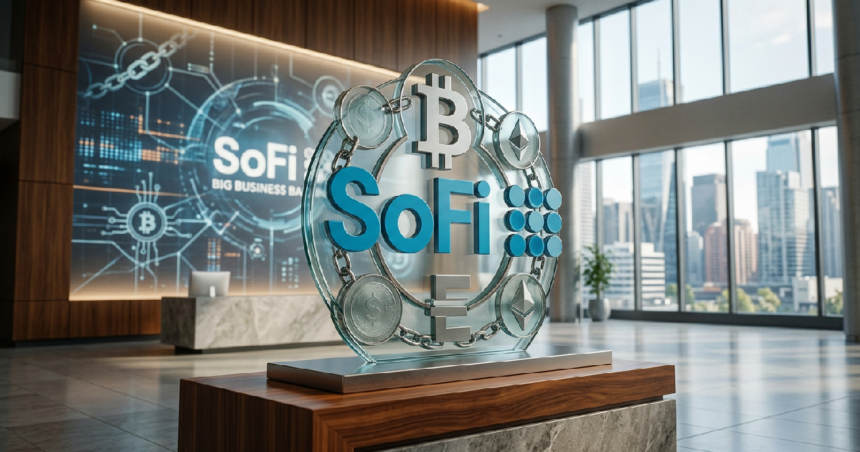
Fintech heavyweight SoFi is making a decisive play for the corporate sector with the launch of “Big Business Banking,” a unified suite of services that brings digital asset management directly into the treasury departments of major firms. The rollout, reported by Cointelegraph, marks a shift for a company that has traditionally dominated the retail banking and student loan refinancing markets.
By integrating cryptocurrency support into a corporate financial framework, SoFi is attempting to solve a logistical headache that has plagued companies holding digital assets. Until now, most businesses have been forced to juggle a fragmented web of traditional banks for payroll, specialized custodians for crypto storage, and third-party exchanges for liquidity. SoFi’s new platform promises to house these functions under one roof, providing a single regulatory environment for fiat and crypto alike.
Consolidating the Corporate Treasury
The core appeal of the Big Business Banking initiative lies in its streamlined architecture. For the modern CFO, managing a balance sheet that includes stablecoins or Bitcoin has often meant dealing with siloed data and complex reporting requirements. SoFi’s integration allows for deposits, fund transfers, and payments to be managed through a single interface.
This move comes at a time when the boundary between traditional finance and the digital asset economy is increasingly porous. While some institutions have remained cautious, SoFi appears to be betting on the idea that corporations want the same ease of use for their crypto holdings that they expect from their dollar-denominated accounts. The platform is built to handle high-volume transactions and enterprise-level fund movements without the friction of moving capital between disparate service providers.
And it’s not just about convenience. By offering these services within its established regulatory framework, SoFi provides a level of institutional “safety net” that smaller, crypto-native startups often struggle to match. This could be particularly attractive to mid-sized firms that have exposure to digital assets but lack the massive internal infrastructure to manage complex custody arrangements.
The Regulatory Edge in a Crowded Market
SoFi’s timing is notable. The crypto industry is currently moving through a period where utility is being prioritized over pure speculation. As noted in recent market analysis regarding the closing window for digital asset utility, firms that fail to provide practical, real-world applications are being left behind. By positioning itself as a “one-stop shop” for business finance, SoFi is moving beyond the “retail app” label and entering the ring with global banking giants.
The platform’s design focuses heavily on the “Big Business” aspect, catering to entities that require high-speed transfers and deep liquidity. However, the regulatory piece remains the most significant hurdle and the most valuable asset. By operating as a licensed bank, SoFi can offer a level of oversight and compliance that mitigates the perceived risks of corporate crypto adoption.
A Competitive Landscape in Shift
SoFi isn’t the only player eyeing this space, but they are among the most aggressive in their cross-over approach. We have seen other major institutions like Morgan Stanley expand access to Bitcoin for their clients, but that has largely focused on wealth management rather than active corporate banking operations. SoFi is moving further down the stack, aiming to become the primary operating system for a company’s daily financial life.
The success of the Big Business Banking launch will likely depend on how well SoFi can handle the volatility characteristic of the crypto markets while maintaining the stability required for corporate payroll and vendor payments. If they succeed, it could serve as a blueprint for how other fintech firms bridge the gap between legacy systems and the blockchain.
Looking ahead, the integration of these services suggests that the “altcoin” or “crypto” silo is disappearing. Instead, digital assets are simply becoming another line item in a standard corporate budget, handled by the same person who signs off on the office rent and the employee health insurance plan.
Frequently Asked Questions
What makes SoFi Big Business Banking different from a regular business account?
Unlike a standard business account that deals exclusively in fiat currency, SoFi’s new service allows companies to manage both US dollars and cryptocurrency in one place. It eliminates the need for a separate crypto custodian or exchange, bringing everything into a single, regulated banking environment.
Who is the target audience for this new service?
The name “Big Business Banking” says it all. SoFi is targeting larger corporate entities that have complex financial needs, including those that may hold digital assets on their balance sheets or need to make payments using crypto-native rails.
Does this move signal a larger trend in the banking industry?
Yes. We are seeing a gradual shift where traditional fintech platforms and banks are no longer treating crypto as a fringe asset. By integrating it into corporate banking, SoFi is acknowledging that digital assets are becoming a permanent fixture of the global financial system.


