

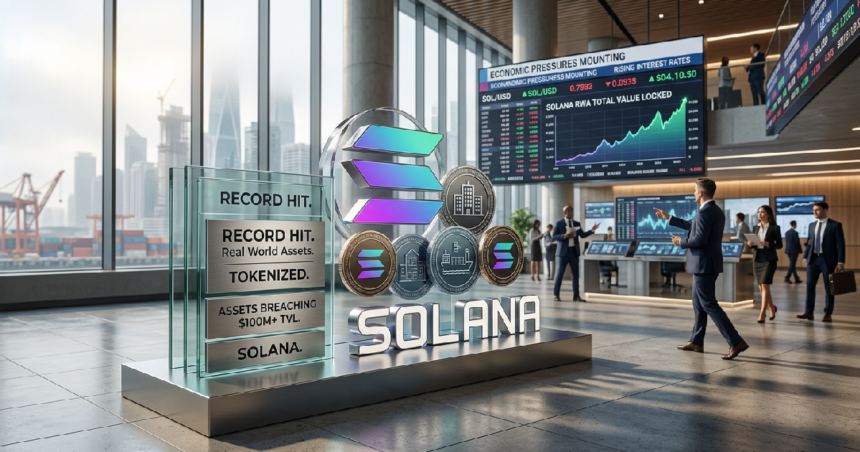
Solana’s push to lead the real-world asset (RWA) space reached a significant on-chain milestone early Sunday, but the victory lap is being cut short by a darkening macroeconomic outlook. While the network successfully processed its highest volume of tokenized credit and treasury transactions to date, the broader market’s cooling appetite for risk is putting the sustainability of these inflows to a rigorous test.
The achievement marks a turning point for the ecosystem. For months, developers have pitched Solana as the logical home for RWA projects, citing its high throughput and low fees compared to Ethereum. But as the gap between decentralized finance (DeFi) yields and traditional interest rates narrows, the “Solana RWA” narrative is shifting from technical capability to economic survival.
The struggle for yield in a shifting market
The core of the pressure lies in the tightening spread between on-chain returns and “risk-free” government debt. When Solana-based RWA platforms first began gaining traction, the value proposition was clear: access to high-yielding private credit or US Treasury products with the efficiency of blockchain rails. Now, with global central banks keeping rates elevated and the institutional pullback seen in late March affecting all digital assets, the liquidity flowing into these tokenized pools has slowed.
Industry observers note that while Solana remains a technical powerhouse, it isn’t immune to the “gravity” of the dollar. Most RWA protocols on the network rely on stablecoin liquidity. High borrow rates for assets like USDC on DeFi lending markets are currently eating into the net returns for investors who want to buy tokenized treasuries. If it costs 6% to borrow dollars to earn 5% on a tokenized T-bill, the math simply stops working for institutional desks.
Infrastructure vs. Economics
It’s a frustrating moment for the Solana Foundation and its partner protocols. Technically, the network has never performed better. The hardware requirements that once served as a barrier to entry have secured a network capable of handling the complex, frequent price updates required for real-world asset tracking. We aren’t seeing the outages that plagued the network in years past, but we are seeing a “utility versus macro” conflict.
And yet, some projects are finding ways to pivot. We’ve seen a rise in “yield-composite” products that attempt to layer Solana’s native staking rewards on top of RWA yields. It’s a clever bit of financial engineering, but it introduces smart contract risks that many conservative fund managers are still hesitant to embrace. As the 2026 utility deadline looms, the pressure to prove that these assets can provide more than just a mirrored version of a brokerage account is mounting.
The Institutional Waiting Game
For the big players, the appeal of Solana’s RWA ecosystem was always about settlement speed. Being able to move millions in assets and settle the transaction in sub-seconds is a massive upgrade over the T+2 settlement cycles of traditional finance. However, those efficiency gains are currently being offset by the regulatory ghost in the room. New legislative frameworks, such as the New Clarity Act, have started to complicate how interest is paid out on stablecoins—the lifeblood of the RWA trade.
Without a clear way to distribute yields without falling into “security” buckets, many Solana projects are operating in a gray area. They have the bridge built, but the cargo is sitting at the border waiting for paperwork.
What lies ahead for Solana RWA projects
The next quarter will be the true “stress test” for this sector. If Solana can maintain its current TVL (Total Value Locked) in tokenized assets despite a potential downturn in the wider crypto market, it will prove that RWAs are a decoupled, resilient use case. But if investors continue to flee to the safety of cash and traditional accounts, the recent milestone might look more like a local peak than a launchpad.
The community is watching closely to see if a major Wall Street partner will move beyond “pilot” phases and actually deploy capital at scale on-chain. Until that happens, the RWA space on Solana will remain a high-functioning laboratory—technically perfect, but still searching for its breakthrough economic moment.
Frequently Asked Questions
Why is Solana preferred for RWA over other blockchains?
Solana’s primary advantage is its “parallel execution” capability and low latency. Real-world assets involve constant price feeds and high-frequency updates. Doing this on a slower chain often results in high gas fees that eat into the investment’s yield. On Solana, those costs are negligible.
How do economic pressures affect tokenized assets?
When interest rates in the real world are high, investors demand higher returns from crypto-based products to justify the extra risk. If a tokenized treasury bond on Solana pays the same as a bank account but carries “smart contract risk,” investors usually choose the bank, leading to decreased liquidity on-chain.
Is the RWA milestone a sign of a new bull market?
Not necessarily. It is a sign of “infrastructure maturity.” It shows the pipes work and can handle the load. However, a true bull market in the RWA space requires a favorable interest rate environment and more regulatory certainty than we currently have in 2026.


