

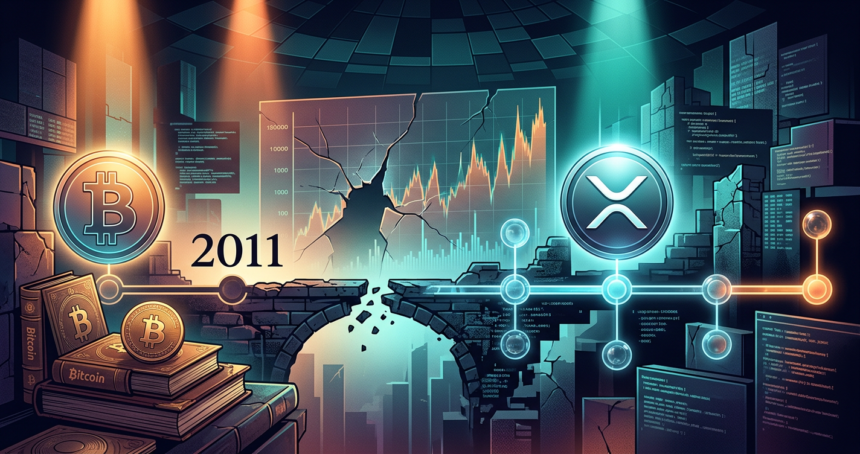
Looking at the current digital asset market, it’s easy to forget how empty the room was just fifteen years ago. In 2011, Bitcoin was a fledgling experiment struggling to stay above the price of a cheap lunch, and XRP—the token that would eventually fuel the Ripple ledger—didn’t even exist in a tradable form. For investors today, comparing the two requires more than just looking at a price chart; it requires an understanding of how the industry’s focus shifted from a peer-to-peer cash system to a global liquidity network.
\n\n
While Bitcoin price holds at 87,420 today, its 2011 performance was a masterclass in early-stage volatility. Bitcoin started that year at $0.30 and famously spiked to $31.00 in June before crashing back down to $2.00 by year’s end. It was the “Wild West” era of the Mt. Gox exchange and Bitcointalk forums. XRP, meanwhile, was still on the drawing board. It wasn’t until late 2012 that Ripple (then OpenCoin) began its journey, meaning any “XRP price” from 2011 is effectively zero.
\n\n
The 2011 Bitcoin rally and the birth of an alternative
\n
In 2011, Bitcoin was the only game in town that mattered. It was the year of “parity”—the moment in February when one BTC finally equaled one US dollar. This psychological milestone sparked a gold rush that defined early crypto culture. But while Bitcoin was making headlines, developers Arthur Britto, Jed McCaleb, and David Schwartz were already identifying what they saw as fundamental flaws in the Bitcoin code: its energy consumption and slow transaction finality.
\n\n
Their work in 2011 eventually led to the launch of the XRP Ledger. Unlike Bitcoin, which required miners to solve complex puzzles, their new system relied on a consensus mechanism. This technical divergence is why XRP never followed Bitcoin’s price trajectory in those early days. While Bitcoin was building a brand as “digital gold,” the architects of XRP were building a high-speed plumbing system for banks.
\n\n
Why 2011 is the wrong benchmark for XRP
\n
If you’re searching for XRP price data from April 2011, you won’t find it. The first recorded prices for XRP don’t show up on major tracking sites until 2013, where it debuted at roughly $0.005. The comparison is less about price and more about the evolution of the asset classes. Bitcoin was established as a decentralized sovereign currency, while XRP was designed as a bridge asset for institutional settlement.
\n\n
The lack of a 2011 XRP price highlights the massive “first mover” advantage Bitcoin enjoyed. By the time XRP entered the market, Bitcoin had already been through two major boom-and-bust cycles. This head start is a major reason why Bitcoin commands a multi-trillion dollar market cap today, while XRP continues to await clarity in the face of ongoing regulatory scrutiny.
\n\n
Market dynamics then and now
\n
The crypto world of 2026 bears little resemblance to the landscape of 2011. Today, we see institutional giants like Ryde moving corporate reserves into Bitcoin, a move that would have seen a CEO fired fifteen years ago. The industry has matured, but the ideological divide between Bitcoin and XRP remains. Bitcoiners still preach decentralization and censorship resistance, while the XRP community focuses on utility and partnerships with the legacy financial system.
\n\n
Recent market movements suggest that this divide is only deepening. As the Fed holds rates steady, Bitcoin has reacted like a traditional macro asset, competing with gold and silver for “store of value” status. XRP, however, remains decoupled from these macro trends, often moving instead on news related to its legal standing or new banking corridors.
\n\n
The regulatory shadow over historic comparisons
\n
It’s impossible to talk about XRP’s history without mentioning the legal battles that have defined its recent years. While Bitcoin was eventually deemed a commodity by US regulators, XRP’s status as a security or non-security has been the subject of a multi-year legal saga. This has fundamentally suppressed its price action compared to Bitcoin’s relatively unencumbered rise.
\n\n
Looking back at 2011, it is clear that Bitcoin was the pioneer that took the initial cultural and regulatory arrows. XRP entered a world that was already beginning to ask questions about how these assets should be governed. This different entry point into history explains why their price charts look so drastically different today.
\n\n
Frequently Asked Questions
\n\n
What was the price of XRP in 2011?
\nXRP did not have a price in 2011 because it hadn’t been launched yet. The ledger and the token were developed during 2011 and 2012, but public trading didn’t start until 2013. If someone tells you they bought XRP in 2011, they’re likely misremembering or confusing it with Bitcoin.
\n\n
How much was Bitcoin worth when XRP launched?
\nBy the time XRP became tradable in early 2013, Bitcoin was already trading between $13 and $100. Bitcoin had a significant head start in terms of network effect and price discovery, which it has maintained ever since.
\n\n
Why didn’t XRP copy Bitcoin’s mining model?
\nThe creators of XRP wanted to solve the “waste” problem. They felt Bitcoin’s Proof of Work was too energy-intensive and too slow for real-time banking payments. They opted for a consensus protocol that allowed for three-second settlements, which is significantly faster than Bitcoin’s ten-minute block times.
“,focus_keyword:


