

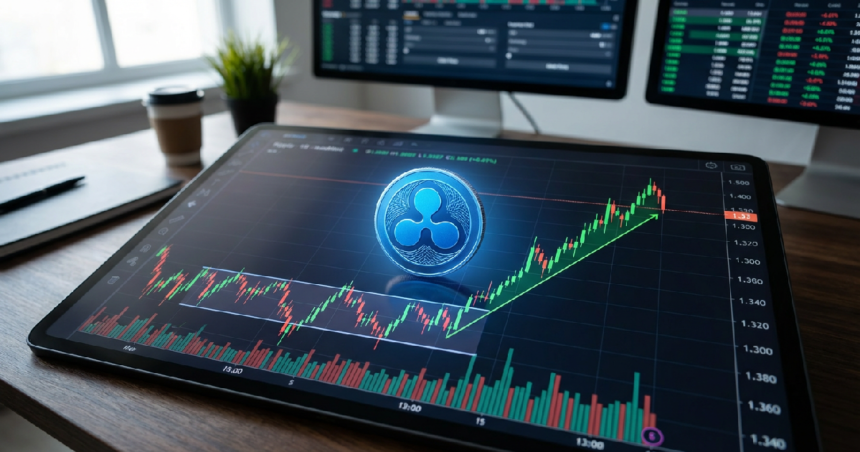
XRP moved cautiously higher in early trading on Monday, reaching the $1.33 level as market participants look for a direction in a month that has seen the token struggle to break out of a narrowing corridor. While the slight uptick provides some relief to holders, the broader technical picture suggests that the asset remains stuck in a range-bound pattern that has defined much of late March and early April.
The movement comes at a time when the wider digital asset market is grappling with a shift toward utility and proof-of-work relevance. For XRP, the struggle isn’t necessarily a lack of interest, but rather a standoff between long-term bulls eyeing a breakout and a cautious institutional floor that seems content to wait for further regulatory finality before committing to a major push higher.
The $1.33 Pivot and Resistance Barriers
Reaching $1.33 represents a minor victory for XRP, but it sits dangerously close to the mid-point of its recent trading range. Traders have noted that similar surges over the past fortnight have been met with swift selling pressure near the $1.40 mark. This “ceiling” has become a psychological barrier that the community is finding difficult to crack without a fresh fundamental catalyst.
And while the price is drifting upward, the volume accompanying the move remains relatively thin. In transparent markets, price increases on low volume often signal a lack of conviction. Without a significant surge in trading activity, this climb to $1.33 could easily be erased if Bitcoin or Ethereum face sudden volatility. Market observers are closely watching the $1.25 support level; as long as XRP stays above that, the narrative of a gradual recovery remains alive, even if it feels sluggish.
Regulatory Fog and the Utility Question
Part of the reason for this stagnant phase is the changing landscape of crypto regulation and the emergence of new legislative frameworks. The recent introduction of the New Clarity Act, which impacts how stablecoins and interest-bearing assets are handled, has naturally bled into the sentiment surrounding Ripple and XRP. Investors are weighing how these new rules will affect liquidity on the XRPL (XRP Ledger) and whether the coin’s primary use case—cross-border settlements—will gain or lose friction under the new regime.
There is also the matter of the “utility window.” As the market matures in 2026, the era of speculation is slowly giving way to a period where assets must prove their worth. XRP has long been touted as the “bridge currency” for global finance, but as the industry faces its final test for global utility, the pressure is on Ripple to demonstrate actual adoption by banking institutions beyond pilots and trials. This fundamental tension is likely what is keeping the price in this tight holding pattern.
Network Activity vs Price Action
Despite the “boring” price action, on-chain data shows that the XRP Ledger remains one of the more active protocols. Wallet creations have ticked up slightly this quarter, and the deployment of new automated market maker (AMM) features has improved deep liquidity on-chain. However, there is a clear disconnect between network health and market price.
But the market isn’t just looking at the ledger’s health; it’s looking at the competition. With decentralized GPU networks and AI-focused infrastructure coins capturing the current trend, older utility tokens like XRP often take a backseat in terms of capital rotation. Until there is a shift in narrative—perhaps a major partnership announcement or a definitive legal victory that clears all remaining hurdles—XRP appears destined to continue its drift between established support and resistance lines.
What to Watch in the Coming Weeks
For the remainder of the week, the focus will stay on whether XRP can flip $1.35 from resistance into support. If it manages to close a daily candle above that level, a run toward $1.48 becomes the most likely scenario. Conversely, a failure to hold $1.30 could signal a retest of the $1.15 zone, which acted as a springboard during the market rally earlier this year.
Potential buyers should also keep an eye on macro factors. With the White House currently focused on geopolitical tensions and fiscal policy shifts, the broader crypto market is sensitive to any changes in dollar strength. XRP, given its international focus, is often more sensitive to these shifts than other domestic-focused altcoins. For now, the story is one of persistence over performance: XRP is staying afloat, but it isn’t ready to swim to the deep end just yet.
Frequently Asked Questions
Why is XRP stuck in such a tight trading range?
Market analysts point to a lack of new fundamental news and high “sell walls” around the $1.40 level. While there is steady demand, it hasn’t been enough to overwhelm the traders who are taking profits every time the price sees a 5-10% gain. Additionally, many investors are waiting to see how new stablecoin and clarity laws fully play out before making large moves.
Is the $1.33 level significant for long-term holders?
It’s more of a short-term psychological level than a long-term structural one. For the long-term trend to turn decisively bullish, most technical analysts want to see XRP close and hold above $1.50. Moving to $1.33 is a positive sign that buyers are still active, but it doesn’t change the neutral outlook that has persisted for several weeks.
How could the New Clarity Act affect XRP’s future?
The act primarily focuses on stablecoins and interest-bearing assets, but its broader implications for “digital payment assets” could affect how XRP is categorized by US exchanges. While XRP has its own unique legal standing, any tightening of the rules for the digital asset space generally leads to a period of consolidation as the market adjusts to the new compliance requirements.


