

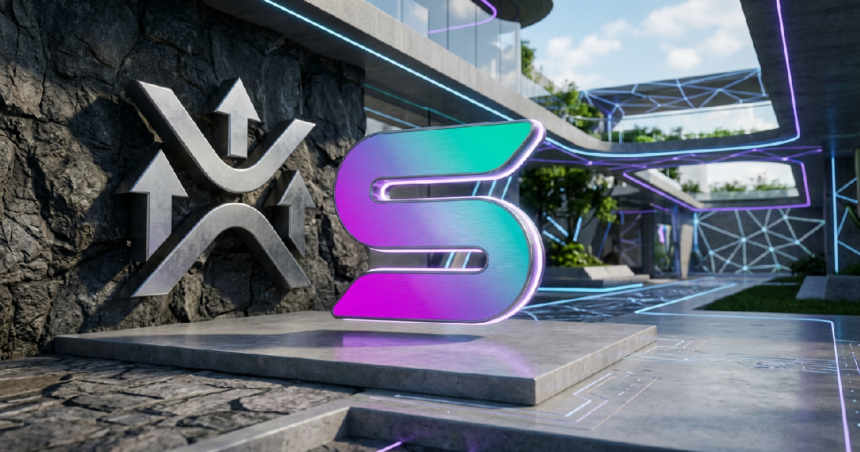
Choosing where to park $2,000 for the next ten years requires a shift in perspective. In the fast-moving world of digital assets, a decade is an eternity. Investors weigh the established institutional rails of XRP against the high-velocity ecosystem of Solana, two networks that have survived multiple market cycles but offer vastly different visions for the future of finance.
The Case for Solana’s On-Chain Economy
Solana has spent the last year shedding its reputation for technical instability, emerging as the primary destination for retail activity and decentralized finance (DeFi). For an investor looking at a ten-year horizon, Solana’s strength lies in its “monolithic” architecture. By handling everything on a single layer, it avoids the complexities of fragmenting liquidity across multiple sub-networks.
If the next decade is defined by the tokenization of everything—from stocks to real estate—Solana is currently best positioned to host that volume. Its speed isn’t just a gimmick; it’s a requirement for high-frequency trading and consumer-facing applications. We’ve already seen the network handle millions of daily active users during periods of high congestion, a feat that would cripple many other blockchains. But the risk remains: can it maintain its security as it scales to meet global demand?
And then there is the developer mindshare. Solana has cultivated a culture that feels more like Silicon Valley than Wall Street. This grassroots innovation is what creates long-term value. When you buy Solana, you aren’t just buying a currency; you’re betting on the continued growth of a digital economy where SOL is the required gas for every transaction.
XRP and the Architecture of Global Settlements
XRP represents a different bet entirely. Ripple, the company most closely associated with the token, has spent years building a regulatory-compliant bridge for international payments. Unlike Solana, which thrives on the chaos of the open market, XRP’s value proposition is tied to the movement of “old money.”
The core argument for holding XRP for a decade is the eventual integration of the XRP Ledger into the plumbing of global banking. If it becomes a standard for Cross-Border Settlement, the demand for XRP as a bridge currency could theoretically decouple it from the general volatility of the crypto market. Recent legal developments have provided a level of regulatory clarity that few other assets possess, a factor that institutional investors value above almost all else.
But the road has been long and the competition is heating up. Stablecoins are increasingly performing the tasks Ripple once claimed as its exclusive domain. For XRP to justify a ten-year hold, it must move beyond being a “potential” solution and become a daily utility for central banks and large financial institutions. Recent analysis on XRP value projections into 2030 suggests that while the floor may be solid, the ceiling depends entirely on global adoption of the RippleNet protocol.
Evaluating the Risks of a Decade-Long Hold
A $2,000 investment is a significant commitment, and both assets face different existential threats. For Solana, the challenge is maintaining its technical edge. If a more efficient “Solana killer” emerges or if the network suffers another multi-hour outage, the capital could flee to more stable environments. The narrowing window for utility means Solana has to prove it is the permanent home for decentralized apps, not just a passing trend.
For XRP, the risk is obsolescence. The financial world moves slowly, but it does move. If the world’s central banks decide to build their own proprietary inter-ledger systems that don’t require a neutral bridge asset like XRP, the token’s primary use case evaporates. XRP holders are essentially betting on Ripple’s ability to out-negotiate the world’s largest banks.
Which Asset Wins the 2036 Outlook?
If you are looking for an asset that captures the growth of the internet and consumer finance, Solana holds the edge. It is a productive asset; you can stake it to earn yield, use it to buy assets, or participate in governance. It is the “active” choice for an investor who believes the future of finance will be built from the bottom up.
If you prefer a defensive play that bets on the legacy financial system being upgraded rather than replaced, XRP is the more logical choice. It is a “passive” bet on institutional change. However, keep in mind that the testing period for global utility is reaching a climax. By 2030, we will likely know if XRP has won its seat at the table or if it has been relegated to the sidelines of history.
Frequently Asked Questions
Which is better for a passive long-term investor?
XRP is often viewed as more suitable for passive holders because its value is tied to institutional adoption, which takes years to play out. Solana requires more attention, as its ecosystem evolves rapidly and staking is necessary to avoid inflation diluting your holdings.
Can Solana and XRP coexist in the future?
Yes, because they target different niches. Solana is building an on-chain economy for apps and users, while XRP is focused on being the plumbing for banks. They aren’t necessarily competing for the same dollar.
Is $2,000 enough to see significant returns in ten years?
In the crypto world, $2,000 has historically been a transformative amount, but both Solana and XRP are now multi-billion dollar projects. While “moon shots” are less likely than in their early days, a decade-long hold allows for the compounding of network effects and wider market adoption.


