

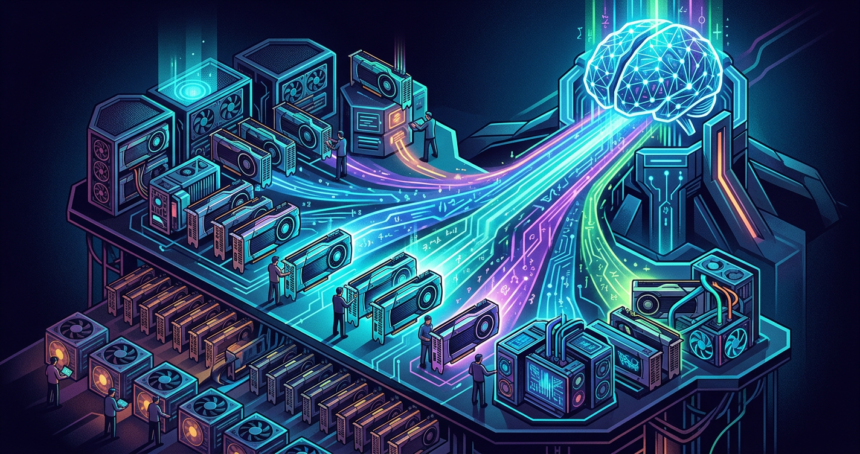
The decentralized computing sector is undergoing a quiet but fundamental shift as GPU-heavy networks transition from experimental playthings to essential infrastructure. At the heart of this movement is Render (RNDR), a project that has spent the last year shedding its reputation as just a tool for digital artists. Today, it stands as a backbone for the burgeoning intersection of blockchain and artificial intelligence.
For those watching the markets this morning, the narrative around Render has moved past simple price speculation. We are seeing a maturation of the “DePIN” (Decentralized Physical Infrastructure Networks) sector, where the focus is now on the actual throughput of the network rather than just the tokenomics. As demand for high-end rendering and AI training clusters outstrips the immediate supply from centralized providers like AWS, decentralized alternatives are finally finding their footing.
The Shift from Animation to Artificial Intelligence
Originally, the platform was built to democratize the way Hollywood-level 3D graphics were processed. By tapping into the idle GPUs of gamers and mining farms globally, it offered a cheaper, faster way to render frames. But 2026 has seen a pivot toward the more lucrative AI sector. Large language models and generative video tools require immense computational power, and the logistics of securing that power through traditional data centers have become a bottleneck.
Recent activity suggests that the network is increasingly being utilized for specialized tasks beyond simple cinematic frames. Developers are leveraging the distributed nature of the network to run parallel processing tasks that would be prohibitively expensive on centralized clouds. This isn’t just about saving money; it’s about redundancy and access. As institutional shifts define 2026 crypto investment goals, the move toward “work-to-earn” utility tokens like Render is becoming a dominant theme.
Infrastructure Resilience Amid Market Volatility
The broader crypto market has been a mixed bag lately. While we’ve seen Bitcoin slide as inflation data cools institutional fervor, projects with tangible hardware requirements often exhibit different price floor dynamics. Investors are beginning to treat these assets more like utility stocks than purely speculative digital gold.
There is a growing realization that if the AI boom continues at its current pace, the hardware layer will be the biggest beneficiary. Critics often point out that decentralized hardware can be slower due to latency issues, but for asynchronous tasks—like training a model or rendering a complex 3D environment—those milliseconds of delay don’t matter as much as the sheer volume of available FLOPS (Floating Point Operations per Second).
Integration and the Technical Road Ahead
Technologically, the migration to more scalable foundations has been a major tailwind. Following the lead of other major protocols, Render’s move to faster networks has reduced the friction for node operators to claim rewards. This technical efficiency is attracting a higher tier of professional hardware providers who were previously wary of high transaction fees eating into their margins.
We are also seeing an increased focus on security. As sensitive data is processed across a decentralized web of nodes, the implementation of “Trusted Execution Environments” is no longer optional. This mirrors broader trends where Ethereum is refocusing on scaling and AI security needs to protect users from data leaks during the compute process. The goal is to make a decentralized GPU cluster indistinguishable from a private server in terms of reliability.
What to Watch in the Coming Months
The immediate future for Render and its peers will likely be defined by “Compute-as-a-Service” (CaaS) contracts. We should expect to see more partnerships between decentralized networks and mid-sized AI startups that have been priced out of the Tier-1 cloud market. If these networks can prove they can handle mission-critical workloads without downtime, the valuation gap between “crypto projects” and “infrastructure companies” will continue to narrow.
However, risks remain. Regulatory scrutiny over how decentralized compute power is used—particularly regarding deepfakes or malicious AI—could lead to new compliance requirements for node operators. For now, the momentum is clearly on the side of those providing the “shovels” in this digital gold rush.
Common Questions Regarding Decentralized Compute
Is Render solely for 3D artists anymore?
No. While its roots are in 3D rendering for film and games, the majority of the growth and technical development is now aimed at AI model training and general-purpose GPU compute tasks. It has evolved into a general compute marketplace.
How does it differ from traditional cloud providers like AWS?
The main difference is ownership and pricing. Instead of a single company owning the servers, Render connects people who need power with people who have it. This typically results in lower costs for the user and a way for hardware owners to monetize their equipment when they aren’t using it.
Why is the DePIN sector gaining traction now?
The hardware shortage in the AI industry has created a “perfect storm.” When people can’t buy GPUs or rent them from traditional sources, they look for alternatives. This real-world demand is proving that blockchain technology can solve physical supply chain issues, not just move digital money around.