

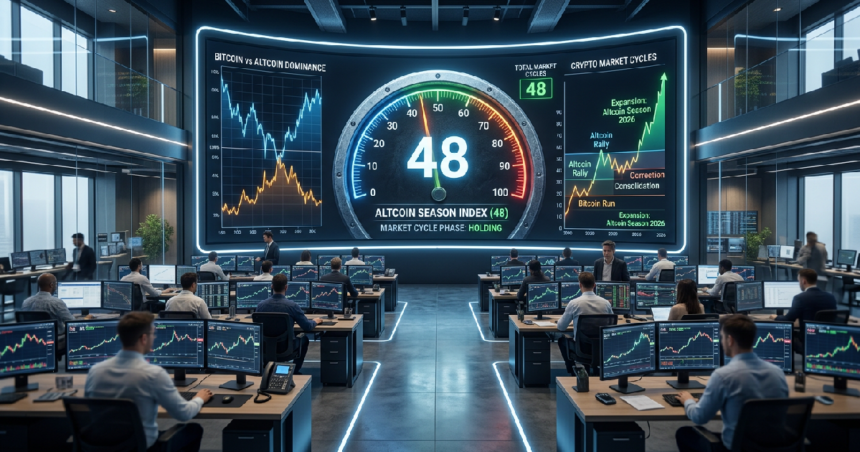
The much-anticipated shift from Bitcoin dominance to a broader altcoin rally remains on ice as the Altcoin Season Index holds steady at 48 today. For traders looking for a signal that capital is finally rotating into smaller-cap digital assets, the current reading suggests the market is stuck in a neutral zone—neither a Bitcoin-led breakout nor an altcoin explosion.
To qualify as a “true” altcoin season, at least 75% of the top 50 coins must outperform Bitcoin over a 90-day period. With the index sitting just below the halfway mark, the data confirms what many retail investors have felt over the last few weeks: while individual projects occasionally pump on specific news, the broad market is failing to keep pace with the largest cryptocurrency by market capitalization.
The Middle Ground Fatigue
Movement in the Altcoin Season Index has been sluggish throughout the first quarter of 2026. A reading of 48 is particularly frustrating for market participants because it represents a lack of clear direction. When the index climbs above 75, we see the parabolic moves in tokens like Solana, Ether, and various meme coins that characterize a “season.” Conversely, a drop below 25 signals that Bitcoin is vacuuming up all the liquidity in the room.
Currently, we are seeing a fragmented market. While specific sectors—notably Decentralized GPU Networks shifting toward AI compute—have shown resilience, they haven’t been enough to drag the rest of the top 50 into a coordinated rally. The index has effectively been flatlining, reflecting a cautious institutional sentiment that favors the “safety” of Bitcoin amid global macroeconomic shifts.
Bitcoin Dominance Still Tightens the Noose
The stubbornness of the index at 48 can be largely attributed to Bitcoin’s iron grip on market share. Despite various altcoins showing technological progress, they are struggling to decouple from Bitcoin’s price action. We recently saw Bitcoin enter a narrow range, a volatility squeeze that typically precedes a massive move. Historically, altcoins suffer during these periods as traders move back into BTC to hedge against potential downside or to capture the initial leg of an upside breakout.
The “wealth effect” usually triggers an altcoin season: Bitcoin hits a local peak, investors take profits, and that capital trickles down into Ether and eventually further down the risk curve. But in the current cycle, that capital seems to be staying put or exiting the ecosystem entirely into traditional safe havens. The result is an index that refuses to budge from the high 40s.
The Institutional Shadow Over Altcoins
Another factor keeping the index suppressed is the changing nature of crypto buyers. In 2021, retail FOMO drove altcoin seasons. In 2026, the market is increasingly driven by institutional desks and ETFs. These players have a significantly higher hurdle for “utility” before they diversify away from Bitcoin and Ethereum.
As noted in recent industry analysis, the window for pure speculation is closing. Investors are now looking for proof of delivery rather than whitepaper promises. This fundamental shift means the Altcoin Season Index may not move as fluidly as it did in previous years. We aren’t just waiting for a change in price, but a change in the market’s underlying logic.
What to Watch for a Breakout
For the Altcoin Season Index to climb toward the 75-mark, we need to see a sustained period where Ethereum outperforms Bitcoin. As the primary “gateway” for altcoin liquidity, Ether’s health is the most reliable leading indicator. Currently, Ether is in an accumulation phase, and until it breaks its local resistance levels, the broader altcoin market is likely to remain stagnant.
Keep a close eye on the 45-55 range. If the index breaks below 45, it could signal a “Bitcoin Summer” where the primary asset climbs while the rest of the market bleeds. If it manages to clear 60, it might finally be time to look back at the mid-caps for high-beta returns.
Frequently Asked Questions
What does a reading of 48 actually mean?
It means the market is perfectly balanced between Bitcoin and altcoins. Roughly half of the top 50 altcoins are performing better than Bitcoin over the last 90 days, while the other half are performing worse. It’s the definition of a “wait-and-see” market.
How long does an Altcoin Season usually last?
Historically, true altcoin seasons are intense but relatively short, often lasting between four to eight weeks. They usually occur at the tail end of a major Bitcoin bull run when investors are looking for higher risk and higher rewards.
Which altcoins are currently dragging the index down?
The drag is coming mostly from older “legacy” tokens and certain DeFi protocols that have struggled to find new users. While newer AI-focused tokens and layer-1 challengers are doing well, their gains are being offset by the sluggish performance of the older guard in the top 50.