

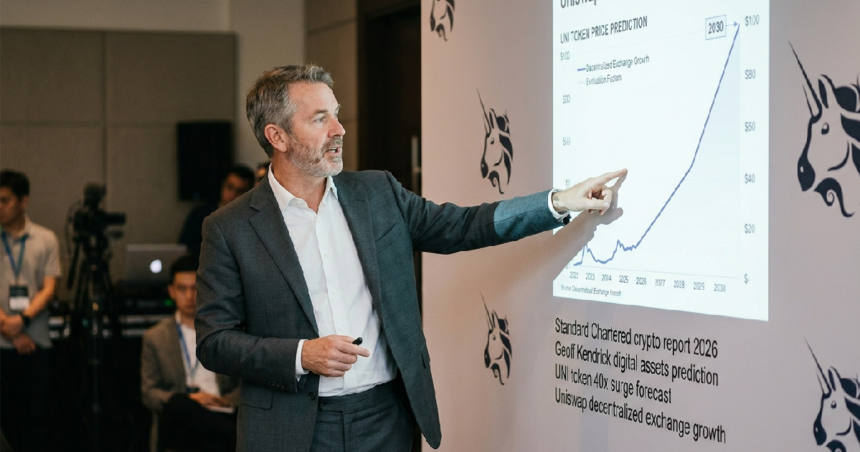
Standard Chartered Bank’s Global Head of Digital Assets Research, Geoff Kendrick, issued a massive valuation update on June 15, 2026, predicting that Uniswap’s UNI token will reach $100 by the end of 2030. This projection represents a 40-fold increase from current levels, which currently fluctuate between $2.50 and $2.70.
The report suggests that the decentralized exchange (DEX) is entering a phase of intergenerational wealth creation as traditional finance begins to migrate onto blockchain networks.
The bank’s forecast places Uniswap at the center of a rapidly evolving digital asset landscape where utility-driven protocols are expected to outpace market leaders. Geoff Kendrick expects UNI to outperform both Bitcoin (BTC) and Ethereum (ETH) throughout the remainder of the decade. This aggressive target is rooted in the belief that Uniswap will become the primary trading hub for tokenized real-world assets (RWAs).
Standard Chartered’s analysis highlights a significant shift in the DeFi sector, suggesting that total assets locked in these protocols could reach $2.7 trillion by 2030. This growth would be fueled by an explosion in on-chain tokenized assets, which the bank believes will expand from $340 billion today to $4 trillion by late 2028.
This shift represents a narrowing window for investors to capture value before dominance is established.
DeFi growth targets and tokenized asset expansion
Geoff Kendrick and his research team base their $100 price target on the massive expansion of on-chain liquidity. They estimate that the share of tokenized assets active within DeFi will jump from a modest 3.5% today to 30% by the end of 2030. Such a move would provide Uniswap’s liquidity pools with approximately 37 times more trading capital than is currently available.
Uniswap’s primary advantage lies in its automated market maker (AMM) model, which allows it to dominate trades for highly correlated pairs and smaller “long tail” assets. Standard Chartered argues that this model provides a lower cost of capital compared to traditional order-book exchanges. As financial institutions look for efficiency, Uniswap’s existing infrastructure offers a ready-made solution for high-volume trading.
Projected price trajectory for the UNI token
The bank did not just provide a final destination but outlined a clear year-by-year path for UNI’s appreciation. According to the report, the token should reach $6.50 by the end of 2026 before climbing to $20 in 2027. This steady climb suggests that the market will gradually price in the protocol’s expanding role in global finance.
By 2028, Standard Chartered forecasts a price of $40, followed by a surge to $65 in 2029. The final jump to the $100 mark in 2030 would coincide with the maturity of the tokenized asset market. This long-term outlook aligns with the bank’s broader crypto predictions, which see Bitcoin reaching $500,000 and Ethereum hitting $40,000 in the same timeframe.
Impact of the UNIfication upgrade and fee burning
A critical pillar of the $100 valuation is the “UNIfication” upgrade that took place in December 2025. This technical overhaul enabled protocol fees and directed them into a programmatic burn mechanism. Since this switch, Uniswap has already generated roughly $21 million in fees, leading to the destruction of 5 million tokens.
This deflationary pressure is essential for long-term price appreciation as the total supply continues to shrink. Currently, 895 million UNI tokens exist out of an original 1 billion, following a massive one-time burn of 100 million tokens. With an annualized burn rate near 1%, the circulating supply of 622 million is expected to tighten further as trading volume grows.
The transition from a pure governance token to a fee-generating asset has changed the fundamental utility of digital assets like UNI. Standard Chartered believes this shift toward commercialization and potential partnerships with legacy finance firms will be the primary driver of value. By reducing supply while increasing organic demand, the protocol creates a classic scarcity model that benefits long-term holders.
Competitive landscape and future market positioning
While the bank remains bullish on the entire sector, it specifically notes that UNI has a stronger growth multiple than its larger peers. Many investors have seen Ether enter an accumulation phase recently, but Standard Chartered suggests that the “next wave” of wealth will come from the application layer rather than just the base layer.
The report underscores that Uniswap’s status as the largest decentralized exchange gives it “direct exposure” to the growth of decentralized trading markets. As legacy institutions move assets into blockchain environments, they are likely to gravitate toward established liquidity hubs with proven track records. Uniswap’s dominance in the DEX space positions it as the natural beneficiary of this institutional migration.
With more than four years of data to support the bank’s thesis, the focus now shifts to whether Uniswap can maintain its technical lead. If the bank’s projections for a 37-fold increase in DeFi total value locked prove accurate, the exchange will be handling trillions in volume annually.
Such a scenario would make the $100 price target a reflection of the protocol’s role as the backbone of the new digital economy.