

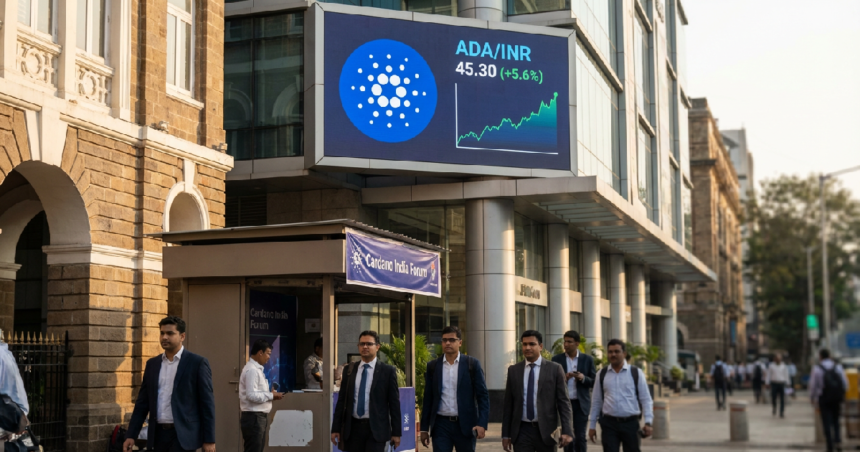
The Cardano ecosystem is facing a period of renewed scrutiny as the native ADA token shows signs of divergence across global markets. While broader crypto sentiment remains tied to the whims of institutional giants, the specific movement of ADA against the Indian Rupee (INR) has caught the eye of regional traders navigating a complex regulatory and tax landscape.
For months, Cardano has occupied a precarious position in the market rankings. Despite constant development updates from IOHK and the ongoing refinement of the Voltaire governance era, the price action hasn’t always reflected the technical progress. In the Indian market particularly, where high transaction taxes have thinned out liquid order books, ADA’s performance is being watched as a litmus test for the “utility phase” of the current market cycle.
Monetary Policy and the ADA INR Dynamic
Trading ADA in the Indian market involves a different set of hurdles compared to US or European exchanges. With the 1% Tax Deducted at Source (TDS) and a flat 30% tax on gains, Indian investors have become increasingly selective. They aren’t just looking for memes; they are looking for assets with long-term structural viability. This is where Cardano’s slow-and-steady academic approach usually wins points, but the current price lag is testing even the most patient “ADA Army” members.
And yet, the network hasn’t sat idle. Staking participation remains high, with a large percentage of the circulating supply locked in pools. This suggests that while price volatility creates headlines, the core community is more interested in the yield and governance rights than flipping tokens for a quick profit. But as we’ve seen in recent weeks, high staking ratios can be a double-edged sword when the broader market enters a cooling phase.
Pressure Points on the Cardano Roadmap
The transition toward full decentralization is a marathon, not a sprint. Cardano’s move toward the Chang hard fork and the establishment of the Interim Constitutional Committee represents a shift in how the network is managed. However, the market is currently demanding more than just governance milestones. There is an increasing need for Total Value Locked (TVL) in decentralized finance (DeFi) protocols to show significant growth to justify a return to the dollar mark.
Domestic exchanges in India have reported steady volume for the ADA INR pair, but it often lacks the explosive momentum seen in previous cycles. This stability is partly due to Cardano’s reputation as a “blue chip” altcoin, often grouped alongside Ethereum and Solana. But as other networks pivot toward AI compute and high-speed throughput, Cardano must prove that its EUTXO model can handle the next wave of retail demand without the congestion issues that have occasionally plagued its competitors.
The Road to Recovery
Looking ahead, the focus for ADA is clearly on the $1.00 psychological barrier. For Indian traders, this translates to a specific threshold in INR that has historically acted as a pivot point for massive entries and exits. If the network can successfully integrate more stablecoin liquidity—an area where it has historically lagged—the utility of the ADA token could see a fundamental shift.
The narrative is no longer just about “peer-reviewed” whitepapers. It is about execution. With the Cardano price outlook remaining a hot topic of debate, the coming months will determine if the network’s infrastructure can translate into sustained market value or if it will remain a favorite primarily for those focused on the theoretical benefits of blockchain governance.
Frequently Asked Questions
What is driving the ADA INR price right now?
The price is primarily influenced by global market trends and Bitcoin’s dominance, but locally in India, retail sentiment is heavily dictated by tax policy and the availability of liquidity on domestic exchanges. When liquidity is thin, small moves in the global dollar price can lead to exaggerated swings in the INR pair.
Is Cardano still considered a top-tier project?
Technically, yes. It remains one of the most developed blockchains in terms of GitHub commits and academic rigor. However, its market cap position is constantly challenged by newer networks that prioritize high speed and aggressive marketing over the methodical approach favored by Cardano founder Charles Hoskinson.
Can ADA reach its previous all-time high in 2026?
Market analysts are divided. While the infrastructure is arguably better than it was during the last bull run, the competition is significantly fiercer. A return to previous highs would likely require a massive influx of decentralized applications (dApps) and a significant increase in the network’s Total Value Locked.