

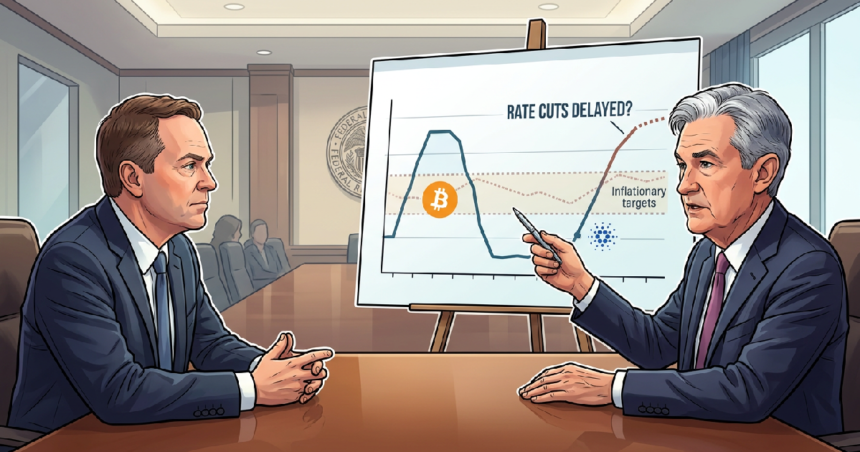
Kevin Hassett, a prominent economic advisor to the Trump administration, recently suggested that the potential reappointment of Federal Reserve Chair Jerome Powell could result in a more conservative approach to monetary policy, potentially delaying interest rate cuts. This perspective has specific implications for risk-sensitive assets, particularly the cryptocurrency market, which traditionally thrives on the availability of cheaper liquidity. Hassett indicated that a continuation of Powell’s leadership might emphasize a cautious approach to inflation over more aggressive growth stimulation.
The possibility of a hawkish Federal Reserve comes at a sensitive time for digital assets. For months, traders have positioned portfolios based on the assumption that central banks would move toward easing their restrictive stances. However, Hassett’s commentary suggests that political and economic stability under Powell could lead to a more patient strategy. This wait-and-see approach often supports the strength of the U.S. dollar, a move that typically creates a headwind for Bitcoin and other major tokens as the crypto market window for significant appreciation may be viewed as tightening.
The Monetary Policy Stall and Its Ripple Effects
Economic signals have been mixed throughout the early part of the year, and reports suggest that Powell remains focused on achieving long-term inflation targets. Hassett’s view is that a reappointment would effectively validate this current trajectory. If the Fed maintains current rates to ensure inflation does not reignite, the “cost of carry” for holding volatile assets remains high. Institutional investors are often less likely to rotate capital out of high-yield government bonds and into the digital asset sector if the yield gap does not begin to narrow.
But the market’s reaction to this potential delay in easing is palpable across various sub-sectors. While many believe the Cardano price outlook depends largely on its own ecosystem development, macro policy remains a significant driver of broader market liquidity. Without a clear signal that the Fed is ready to pivot, the “risk-off” sentiment that has influenced the start of the year could persist further into the coming months.
Market Liquidity and Asset Valuation
Liquidity is often described as the lifeblood of the crypto industry. When the Federal Reserve maintains elevated rates, it can reduce the attractiveness of speculative ventures. Hassett’s warning reflects a broader concern among some economists that a “higher for longer” rate environment could prevent a return to the explosive growth seen in previous cycles. This isn’t just a concern for Bitcoin participants; it impacts the entire financial spectrum, including traditional commodities like precious metals which face a tug-of-war between their status as a hedge and the pressure of high interest rates.
And yet, some analysts argue that the crypto market has matured enough to begin decoupling from traditional macro drivers. They point to the steady adoption of decentralized finance and real-world asset tokenization as independent growth engines. But Hassett’s point remains: as long as the dollar remains the dominant reserve currency and its interest rates stay high, the barrier for entry into more volatile utility tokens remains steep for many investors.
Watching the Federal Reserve’s Next Move
The upcoming federal committee meetings will be critical for determining whether Hassett’s predictions hold weight. If the Fed continues to emphasize data-dependency without offering a concrete timeline for cuts, volatility in the crypto markets is expected to remain high. Traders are already hedging their bets, looking for signs of either a breakout or a further breakdown in support levels for major altcoins.
So, the crypto community finds itself in a familiar position: waiting on the policy signals of a central banker. While the technology behind these assets aims to provide a decentralized alternative to traditional finance, the reality in 2026 is that digital assets are still heavily influenced by the Federal Reserve. Whether the chair moves toward a cut or heeds the cautious path suggested by Hassett will likely dictate the direction of the market for the foreseeable future.