

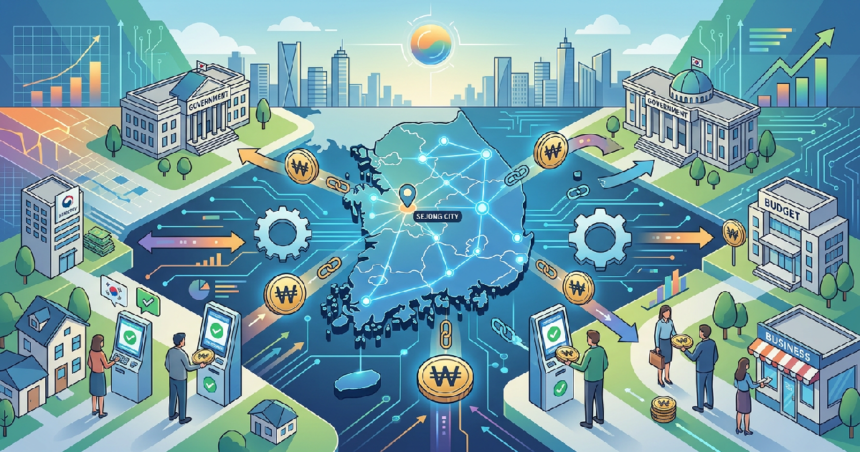
South Korea is preparing to overhaul the way it manages public finances by shifting from traditional credit cards to blockchain technology. The Ministry of Economy and Finance is reportedly moving forward with a pilot program aimed at testing deposit tokens for government spending, a move that could significantly reduce administrative overhead and improve transparency across state agencies.
The initiative, which is expected to operate under a regulatory sandbox, allows the government to bypass specific provisions of the Treasury Funds Management Act on a limited basis. Historically, this act has mandated that agency costs and business promotion expenses be processed via physical government purchasing cards. By shifting to tokenized deposits instead, officials appear to be betting on the “programmability” of digital assets to enforce budget rules automatically at the point of sale.
This development follows a period where global regulators, including the CFTC, have been closely watching how sovereign nations integrate digital assets into existing financial frameworks. For South Korea, the project is less about speculative digital assets and more about refining the granular control of the national purse to prevent waste and mismanagement.
Moving away from the legacy card system is expected to lower transaction fees, which could particularly benefit the small businesses that provide services to government agencies but have historically struggled with the processing costs associated with major card networks.
The pilot is expected to be centered in Sejong City, the administrative heart of the country, following a selection process for participating financial firms. If successful, the program may eventually expand across other government sectors, potentially making South Korea one of the first major economies to run a significant portion of its internal treasury operations on a blockchain ledger.
Programmable Spending and the End of Manual Audits
The primary appeal for the Ministry of Economy and Finance lies in the inherent programmability of deposit tokens. Unlike a standard credit card, which functions as a general line of credit up to a predefined limit, a blockchain-based token can be restricted through software code.
Reports suggest these payments could be hard-coded with specific spending limits or restricted to particular industries. For instance, tokens issued for office supplies could be restricted so they cannot be utilized at luxury retailers or for after-hours entertainment. This level of control is particularly useful for managing business promotion expenses, which have frequently presented challenges for government auditors.
By enforcing these rules at the protocol level, the need for manual, retroactive audits is significantly reduced. The system is designed to prevent the improper use of funds before it happens, rather than flagging it weeks or months later in a spreadsheet. This push for functional efficiency mirrors broader trends where utility shifts are dictating the crypto market as organizations move past speculation toward practical use cases.
Building on Preliminary Testing in the Green Sector
The upcoming pilot phase is not South Korea’s first excursion into tokenized treasury funds. The ministry reportedly conducted a smaller-scale test involving subsidies for electric vehicle (EV) charging infrastructure. That earlier effort provided the baseline data necessary to justify a broader rollout for general administrative costs.
The EV pilot suggested that deposit tokens could handle complex subsidy distributions with fewer errors than manual processing. It also highlighted the potential for faster settlement. In the current card-based system, various intermediaries, including banks and card processors, sit between the government and the vendor. By streamlining these layers, the government can settle payments much closer to real-time, which improves cash flow for vendors and reduces the “float” that financial institutions have traditionally relied upon.
Regulatory Framework and the Sandbox Approach
The use of a regulatory sandbox is a tactical choice by South Korean lawmakers. By isolating the trial within a controlled environment, the government can test the boundaries of digital finance without needing to immediately rewrite the entirety of national treasury laws. It provides a testing ground to identify technical glitches or security vulnerabilities before the system scales to a national level.
While the focus remains on internal government operations, the implications for the wider digital asset market are increasingly clear. As governments begin to issue their own tokenized versions of fiat currency, the window for purely speculative assets without utility may continue to narrow. The South Korean model suggests a future where the most successful digital assets are those that solve specific friction points in traditional finance, such as public fund management or cross-border settlements.
Economic Impact on Small Businesses and Intermediaries
One of the more understated goals of the Sejong City pilot is the reduction of merchant fees. Small businesses often face a financial burden when accepting government cards due to the fees charged by major credit networks. By using a direct blockchain ledger for deposit tokens, the Ministry of Economy and Finance aims to bypass these networks, allowing more of the public funds to stay with the service provider.
For a small contractor or a local merchant in Sejong City that frequently handles government business, this change could represent a measurable improvement in profit margins. It also signals a potential shift in the power dynamic between traditional financial institutions and the state. If the government no longer relies entirely on commercial banks to facilitate its spending infrastructure, the role of those banks may shift toward custody and verification rather than transaction processing.
The ministry has indicated that if the trial demonstrates both stronger fiscal control and clear cost savings, a roadmap for broader implementation could follow the conclusion of the testing phase. For now, the financial world will be watching Sejong City to see if blockchain can manage a nation’s budget more effectively than the traditional credit card.