

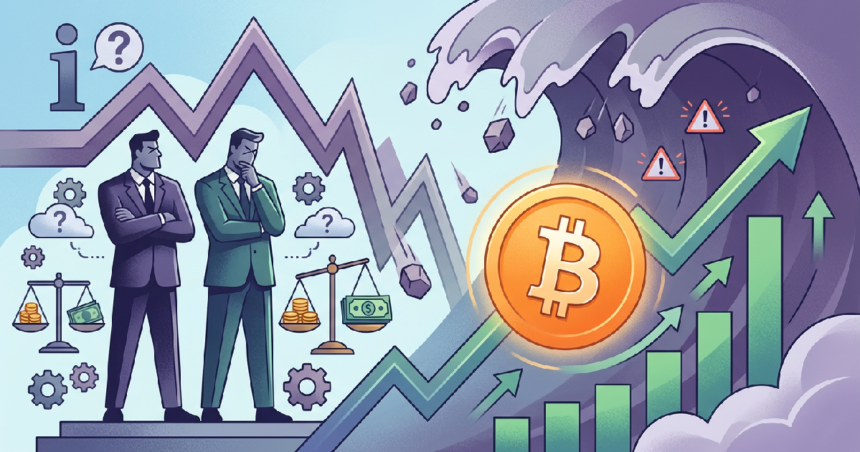
Bitcoin has staged a surprising rally this month, pushing higher despite a backdrop of mixed economic signals and shifting global sentiment. But while retail interest appears to be leaning toward optimism, a closer look at institutional trends and exchange flows suggests that the largest market participants remain unconvinced. This divergence between price action and “whale” sentiment has many market observers bracing for potential volatility in the coming days.
The current price action feels like a tug-of-war. On one side, we see a steady climb that has caught some short-sellers off-guard. On the other, the volume accompanying this move is not showing the classic signs of a sustained institutional breakout. It is a setup that often precedes a period of heightened uncertainty, where the market climbs on thin liquidity only to face a rejection once the larger sellers step back into the fray.
Institutional Skepticism Dampens Bullish Momentum
There is a growing sense of caution among high-net-worth investors and fund managers. While the spot price of Bitcoin has ticked upward, underlying metrics suggest that many sophisticated players are either waiting for clearer signals or are actively hedging their positions. Reports indicate that exchange inflows have been noted at several major trading hubs, which some analysts interpret as a sign that certain holders are looking for exit windows rather than new entry points.
This wariness is not happening in a vacuum. Market signals suggest that Bitcoin faces sharp correction risk if the broader macroeconomic environment shifts or if institutional participation fails to materialize. The disconnect between price and conviction is a primary concern for those hoping for sustained growth. In past cycles, when the largest holders do not support a “pump,” the floor has proven to be thinner than retail traders anticipated.
Market Microstructure and Liquidations
Part of the current strength can be attributed to moves within the leveraged trading market. Many traders had reportedly been betting on a downward move, and as Bitcoin began its ascent, those short positions were forced to close. This dynamic creates an illusion of organic demand that can evaporate the moment the liquidation fuel runs out. It is a mechanic often seen in markets where the move is driven more by positioning than by new capital entering the ecosystem.
And it is not just Bitcoin seeing these defensive shifts. General market trends, where Bitcoin holds support while Ether and XRP face selling pressure, suggest a flight to relative safety within the digital asset space. Investors are not necessarily pouring massive amounts of new cash into the market; instead, they appear to be rotating out of more volatile assets and into the market leader. Historically, this rotation is seen as a defensive posture rather than a signal of a broad-based bull market.
Waiting for Potential Volatility Shifts
Technical observers are pointing to a “coiling” effect on the charts. Bitcoin has been moving within a narrowing range for several sessions, a pattern that often precedes a directional break. Periods of suppressed price movement are frequently the calm before more aggressive price action. Whether that move is to the upside or the downside will largely depend on whether institutional entities decide to support this rally or use the liquidity to reduce their exposure.
Historical patterns suggest that when large investors are conspicuously absent during a price rise, the subsequent adjustments can be swift. We have seen instances earlier this year where retail-driven rallies were met by institutional sell-blocks, leading to rapid price reversals. The current Bitcoin narrow range signals that this period of indecision is likely nearing a resolution.
The External Impact of Policy and Finance
External factors are also playing a role in this cautious atmosphere. While the crypto world watches the charts, traditional finance giants are still formalizing their entry points. For instance, the news that major firms are expanding access for wealth management clients provides a long-term bullish narrative, but those institutional pipes often take time to influence daily price action. Until that capital truly starts flowing in earnest, the market remains at the mercy of short-term speculators and the larger entities who trade against them.
But the regulatory front remains a significant variable. With discussions ongoing regarding market oversight and the legal status of various digital assets, many institutions reportedly prefer to wait for more concrete legislative news before committing to large-scale buys at these levels. This “wait and see” approach is reflected in the lack of conviction behind this latest move, as participants weigh the risks of entering before the rules of the road are fully established.
The Road Ahead for Bitcoin Price Action
The most likely scenario in the near term is a test of overhead resistance that will serve as a moment of truth for the asset. If Bitcoin can break through with high volume, it might invalidate the bearishness currently seen in exchange flow data. However, if the volume continues to taper while the price rises, the risk of a “bull trap” remains the dominant concern for analysts.
Traders are keeping a close eye on the order books of the major exchanges, looking for large “buy walls” or sudden “iceberg orders” that would indicate the big players have finally decided to commit to the rally. For now, the sentiment remains cautious: the market is moving up, but the people who control the most significant capital are largely staying on the sidelines, waiting for a clearer signal of where the market is headed next.