

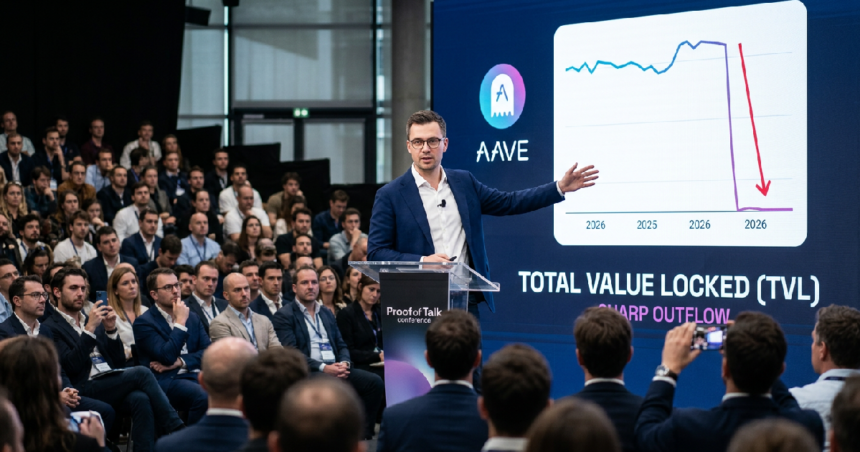
Aave founder Stani Kulechov defended the decentralized lending protocol during the Proof of Talk conference in Paris last week, addressing an $8.45 billion “deposit run” that shook the platform.
The liquidity shock followed a significant exploit of the KelpDAO LayerZero-powered bridge in April 2026, which triggered a massive wave of withdrawals within a 48-hour period. Despite the platform incurring an estimated $123.7 million in bad debt, Stani Kulechov maintained that the system’s core infrastructure proved its resilience under extreme stress.
The crisis originated from a $292 million vulnerability in KelpDAO’s bridge. Risk researchers at LlamaRisk discovered that attackers utilized RPC-spoofing and Distributed Denial of Service (DDoS) attacks against LayerZero verifier nodes. By manipulating these nodes, the attackers successfully minted worthless collateral that was subsequently deposited into Aave.
This allowed the exploiters to drain authentic wrapped Ether (wETH) before the security flaw could be mitigated, leaving the protocol with a significant hole in its balance sheet.
But the damage was not limited to the initial exploit. As news of the breach spread, panic set in among liquidators and depositors, leading to the departure of billions in capital. This event stands as one of the largest liquidity shocks in the history of decentralized finance (DeFi), drawing comparisons to traditional banking failures.
For many investors, it signaled that even established protocols remain vulnerable to complex cross-chain dependencies.
Stani Kulechov addresses Aave bank run and protocol stability
Speaking to attendees in Paris, Stani Kulechov emphasized that Aave V3 remained operational and solvent throughout the crisis. He argued that the protocol’s architecture and the community’s swift response prevented a total collapse. “Aave has been really resilient during really turbulent times,” Stani Kulechov said, noting that the system has now been battle-tested through multiple periods of high market volatility.
The survival of the protocol required a massive injection of emergency liquidity. The Aave DAO took the lead by committing 25,000 ETH to the recovery effort. Additionally, Stani Kulechov personally contributed 5,000 ETH, valued at roughly $8.4 million at the time of the transfer. This $300 million support package was instrumental in stabilizing the platform and preventing further cascading liquidations.
The incident has sparked a broader debate about the safety of decentralized assets. While some see the recovery as a success, others point to the massive bad debt as a warning sign. During these periods, com/ethereum-price-accumulation-generational-opportunity-2026/”>Ether enters rare accumulation phase as long-term holders weigh the risks of DeFi against the security of cold storage. The Aave team is now under pressure to ensure such a vulnerability cannot be exploited again.
Analyzing the KelpDAO exploit and risk architecture flaws
The Bank Policy Institute has since weighed in on the event, concluding that the Aave deposit run exposed critical deficiencies in DeFi insurance and risk modeling. In traditional finance, deposit insurance offers a backstop that was noticeably absent or insufficient here. The incident demonstrated how quickly large-scale withdrawals can create systemic pressure, even when a protocol is technically over-collateralized on paper.
LlamaRisk’s analysis highlighted the danger of “worthless collateral” entering the system. Because the bridge exploit allowed attackers to forge the value of their deposits, Aave’s internal risk sensors did not immediately trigger. By the time the protocol identified the anomaly, the attackers had already moved the funds.
This delay in detection is now a central focus for the Aave Labs development team as they look toward future iterations.
And while the focus remains on recovery, the broader market continues to deal with the fallout. High-end tokens often see a “flight to quality” when major protocols show signs of weakness. We have recently seen how Bitcoin holds steady as mid-cap tokens face selling wave, suggesting that institutional players are becoming more selective about where they park their capital during DeFi-specific shocks.
Future security upgrades and Aave V4 modular design
In response to the KelpDAO incident, Aave Labs is accelerating the development of Aave V4. This new version will introduce a modular hub-and-spoke design specifically intended to isolate systemic shocks. One of the key features will be “local risk auto-adjustment,” which allows the protocol to freeze specific collateral types automatically if suspicious activity or price discrepancies are detected.
Software engineers at Aave Labs are also working on refined collateral freezing mechanisms. These updates aim to address the architectural gaps that allowed the $123.7 million in bad debt to accumulate. By moves toward a more modular system, the team hopes to ensure that an exploit in an external bridge or a single asset cannot threaten the liquidity of the entire lending pool.
Beyond technical fixes, the organization is looking toward legal and regulatory safeguards. Aave Labs is currently pursuing expansion through UK Financial Conduct Authority (FCA) and European Markets in Crypto-Assets (MiCA) approvals. This shift toward a regulated stance could provide a more stable environment for institutional lenders who were spooked by the April bank run.
Market implications for decentralized lending protocols
The $8.45 billion withdrawal wave serves as a wake-up call for the entire Ethereum-based lending sector. It has forced other developers to reconsider how they value cross-chain assets and wrapped tokens. If a bridge can be compromised to produce “fake” value, the entire premise of trustless lending is called into question.
Security must now evolve from simple code audits to sophisticated live monitoring of interconnected nodes.
So, where does Aave go from here? The protocol remains the largest in its class, but its reputation has taken a hit. Investors are paying closer attention to the “safety module” and the actual capacity of the DAO to cover losses.
The successful deployment of Aave V4 will be the ultimate test of whether the platform can regain its status as an untouchable pillar of the DeFi ecosystem.