

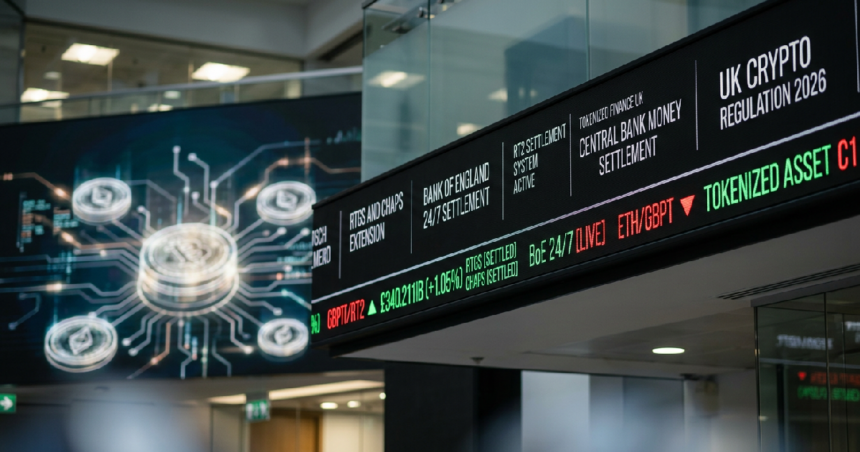
The Bank of England (BoE) launched a comprehensive consultation on May 18, 2026, to extend the operating hours of its core settlement infrastructure, Real-Time Gross Settlement (RTGS) and the Clearing House Automated Payment System (CHAPS), toward near-24/7 availability. This strategic move, coordinated with the Financial Conduct Authority (FCA) and the Prudential Regulation Authority (PRA), aims to integrate tokenized finance into the heart of the United Kingdom’s wholesale markets and modernize cross-border payment systems.
The proposal includes the addition of weekend and extended daily operating hours for these systemic rails, addressing the “always-on” nature of digital asset markets. By 2028, the central bank intends to launch a live synchronization service that will allow tokenized equivalents of eligible assets to be used as collateral. This shift ensures that as Ether enters rare accumulation phase and tokenized assets become more prevalent, the underlying settlement layer can keep pace with blockchain-based settlement speeds.
This initiative represents a fundamental pivot for the UK’s financial plumbing. For decades, the global financial system has been constrained by “banking hours,” creating friction and liquidity gaps during weekends and public holidays. By moving toward a 24/7 model, the BoE is acknowledging that the future of institutional finance likely rests on distributed ledger technology (DLT) and the seamless movement of value regardless of the calendar.
Modernizing UK settlement for a tokenized financial era
The core of the BoE’s plan involves a phased expansion of the CHAPS system. Starting in September 2027, the Bank has confirmed that CHAPS settlement will open at 01:30 Europe/London time, significantly earlier than the current 06:00 start. This earlier window is designed to better align with Asian trading hours and reduce the temporal risks associated with cross-border transactions.
And while the earlier start is a significant first step, the ultimate goal is near-continuous operation. The BoE’s consultation paper, for which public feedback is due by July 3, 2026, explicitly explores the technical and operational requirements for weekend functionality. This would allow banks to settle high-value payments and manage liquidity in real-time on Saturdays and Sundays, a necessity for supporting the 24/7 trading cycles typical of crypto-native platforms.
Regulatory alignment through the PRA and FCA
The infrastructure upgrade is being matched by a coordinated regulatory push. The Prudential Regulation Authority (PRA) recently issued updated guidance for bank CEOs regarding tokenized financial instruments. This new stance proposes that tokenized assets receive the same regulatory treatment as traditional equivalents when legal rights and risks are comparable, effectively replacing the more restrictive 2022 guidelines.
Simultaneously, the Financial Conduct Authority (FCA) is refining the rules through its own crypto regulatory regime consultation, launched on April 30, 2026. This broader framework focuses on the issuance, trading, and custody of stablecoins. As the New Clarity Act blocks interest on certain private stablecoins, the BoE’s focus on providing tokenized central bank money ensures that institutions have a “risk-free” alternative for on-chain settlement.
Synchronization and the role of RT2
A key component of this roadmap is the “RT2” service, the renewed RTGS platform that went live on April 28, 2025. This modernized system provides the foundation for the upcoming synchronization service scheduled for 2028. Synchronization allows the BoE’s ledger to communicate directly with external ledgers, such as those used for tokenized real-estate or securities.
This “atomic settlement” ensures that the transfer of an asset on a blockchain and the transfer of cash at the central bank happen simultaneously—or not at all. This eliminates the “herstatt risk” where one party pays but the other fails to deliver the asset. By providing these rails, the BoE is effectively building the bridge between the legacy banking world and the burgeoning tokenized economy.
Implications for market liquidity and cross-border trade
The shift to 24/7 settlement has profound implications for global liquidity management. Currently, banks must hold large “buffer” amounts of capital over weekends to cover potential obligations because they cannot move cash through central bank systems. If RTGS and CHAPS operate around the clock, these capital requirements could be reduced, freeing up billions for more productive use in the economy.
Furthermore, the BoE has established a new “omnibus” account within the RTGS system. This allows private DLT operators to pool funds and settle transactions using tokenized central bank money. This is a critical development for market structure, as it provides a safe, central-bank-backed settlement asset for private sector innovators without requiring the BoE to issue a retail CBDC immediately.
Katie Harries, the Head of Policy for Europe at Coinbase, has previously noted the importance of such infrastructure in providing the legal and operational certainty required for institutions to commit to on-chain finance. The BoE’s plan appears to be a direct response to this need for institutional-grade reliability in the digital asset space.
Public consultation and the 2028 roadmap
The BoE is not rushing this transition blindly. The current consultation serves as a feasibility study to understand how commercial banks will manage the staffing and technical costs of 24/7 operations. Following the July 3, 2026, deadline for public feedback, the Bank plans to publish a formal feedback statement in the summer of 2026.
Stakeholders have until August 10, 2026, to respond to specific questions regarding the extension of RTGS hours. These responses will shape the final technical specifications for the 2028 synchronization launch. This measured approach suggests the BoE is prioritizing stability over speed, ensuring the UK’s financial reputation remains intact while adopting “frontier” technologies.
Looking ahead, the PRA plans to follow up with a formal consultation on a full tokenization framework in 2028 at the earliest. This suggests that while the pipes are being laid today, the full regulatory maturation of the market will take several more years. For now, the focus remains on ensuring the UK’s core settlement machines are ready for a world that no longer sleeps.