

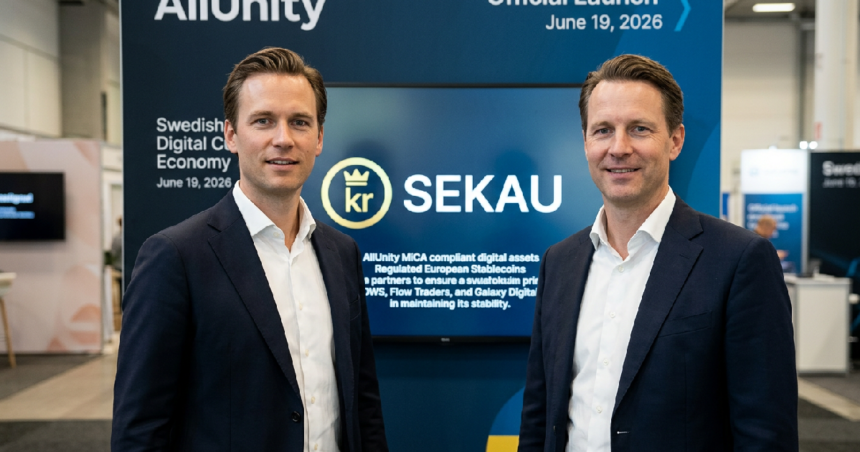
The Frankfurt-based fintech firm AllUnity has officially launched the Swedish krona stablecoin SEKAU today, June 19, 2026, marking a significant expansion of regulated digital assets in Northern Europe. Issued as a licensed e-money token (EMT) under the European Union’s Markets in Crypto-Assets Regulation (MiCA), the new asset is pegged 1:1 to the Swedish national currency.
CEO Alexander Höptner and COO Peter Grosskopf confirmed the deployment across five major blockchain networks, aiming to provide a secure alternative to the US dollar-denominated assets that currently dominate the market.
Backed by industry heavyweights DWS, Flow Traders, and Galaxy Digital, AllUnity developed SEKAU to bridge the gap between traditional Swedish finance and the growing digital economy. The stablecoin is fully reserved with segregated fiat holdings and offers holders a statutory right of redemption at par value, a core requirement of the MiCA framework.
Integration of the Swedish krona stablecoin SEKAU into digital markets
This launch follows the firm’s successful introduction of euro and Swiss franc-backed tokens, positioning the company as a primary issuer of European local-currency digital assets.
The timing of the launch aligns with Sweden’s established reputation as a pioneer in cashless payments. By providing a digital version of the krona that is globally accessible and interoperable, AllUnity targets a market currently starved for non-dollar options. While Bitcoin holds steady as the primary store of value in the broader market, the demand for stable, localized transaction layers is growing among European institutions.
AllUnity has ensured that SEKAU is available on a broad range of infrastructure providers from day one. The token is supported on Ethereum, Solana, Base, Tempo, and Polygon, allowing for immediate integration into decentralized finance (DeFi) protocols and institutional settlement systems. This multi-chain approach reduces the risk of network congestion and provides users with various cost and speed options for transacting in Swedish currency.
To maintain the 1:1 peg and meet strict regulatory standards set by Germany’s Federal Financial Supervisory Authority (BaFin), AllUnity has partnered with several banking entities. Banking Circle serves as the reserve and transaction bank, while Marginalen Bank provides additional supporting services. Digital asset infrastructure firm Trust Anchor Group assisted with the technical integration to ensure the token functions seamlessly across the various supported blockchains.
A strategic shift toward European currency sovereignty
The dominance of US dollar-pegged tokens is a well-documented phenomenon, with roughly 99% of the stablecoin market tied to the greenback. CEO Alexander Höptner noted that the launch of SEKAU gives the Swedish currency a “native place in the digital economy,” effectively challenging the status quo.
For Swedish enterprises, this means they can now manage treasury flows and settle cross-border payments without the inherent volatility or conversion costs of using US-centric assets.
The deployment of SEKAU is also designed to facilitate “agentic payments,” which COO Peter Grosskopf described as a way for businesses to operationalize automated, scaleable transactions. This functionality is particularly relevant in Sweden, where the transition away from physical cash is nearly complete. As com/crypto-market-forecast-2026-narrow-window-analysis/”>utility shifts dictate the direction of the market throughout 2026, the arrival of regulated, local-currency tokens may prove to be a deciding factor for corporate adoption.
Regulatory compliance under the MiCA framework
The legal backbone of SEKAU is the EU’s Markets in Crypto-Assets Regulation, which reached full implementation in late 2024. Unlike earlier, unregulated stablecoins that often lacked transparency regarding their reserves, SEKAU must adhere to strict liquidity and reporting mandates. AllUnity’s status as a licensed e-money institution (EMI) regulated by BaFin provides a layer of institutional trust that was previously missing from the Swedish crypto sector.
Under the MiCA rules, the issuer must maintain a 1:1 reserve in fiat currency, held in segregated accounts to protect users in the event of the company’s insolvency. This structure is intended to prevent the “bank run” scenarios seen in previous market cycles.
For users, the statutory right of redemption at par value provides a legal guarantee that their digital krona can always be exchanged back into physical bank deposits.
Future outlook for the AllUnity digital asset suite
AllUnity is likely to continue its expansion into other European currencies as the MiCA framework matures. While the Swedish krona is the latest addition, the firm’s existing portfolio already includes EURAU (euro) and CHFAU (Swiss franc). This growing suite of assets suggests a long-term strategy to provide a comprehensive, regulated digital currency layer for the entire European continent.
As institutional interest in blockchain-based settlement grows, SEKAU may find significant use cases in the Swedish bond and equity markets. By removing the need for traditional clearinghouses in certain transaction types, the stablecoin could drastically reduce settlement times from days to seconds. This shift toward com/crypto-utility-window-closing-2026-analysis/”>digital asset utility is expected to accelerate as more local-currency tokens enter the market, providing the necessary liquidity for truly global, decentralised finance.