

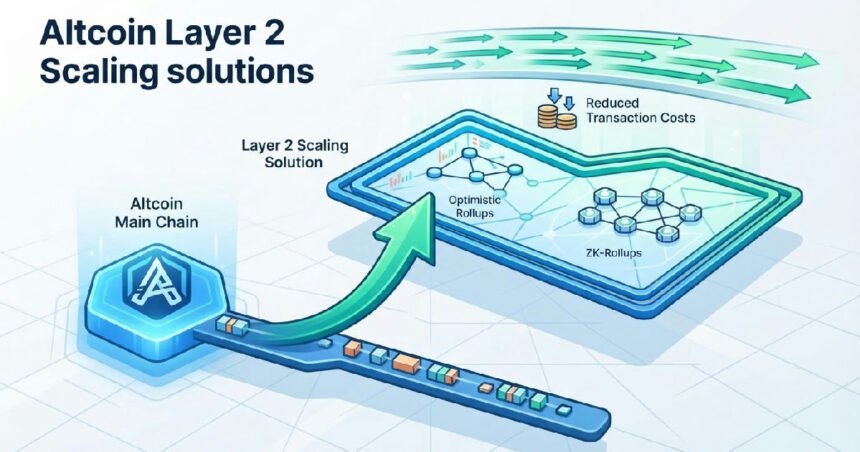
Altcoin Layer 2 scaling solutions represent architectural advancements aimed at significantly boosting the performance of cryptocurrencies beyond Bitcoin. These innovations increase transaction throughput and concurrently reduce associated costs, all while upholding the fundamental security and decentralization of the underlying Layer 1 blockchain.
Such solutions are crucial for altcoins, which often strive to offer improved features or address limitations found in Bitcoin. They provide a vital pathway for these digital assets to achieve broader adoption and functionality in the rapidly evolving crypto landscape.
Understanding altcoin Layer 2 scaling
The concept of the blockchain trilemma, famously popularized by Ethereum co-founder Vitalik Buterin, underlines an inherent challenge in blockchain design. It suggests that a blockchain can effectively optimize for only two of three core properties: decentralization, security, and scalability, typically at the expense of the third.
Decentralization involves distributing validation authority across numerous independent nodes. This structure is essential for preventing single points of control or censorship, ensuring network resilience and democratic operation.
Security refers to the network’s robust resistance against attacks and its capacity to safeguard against malicious activities. This is paramount for maintaining trust and the integrity of transactions within the blockchain ecosystem.
Scalability, on the other hand, measures a blockchain’s ability to handle an increasing volume of work. This is typically quantified in transactions per second (TPS), indicating its capacity to expand without experiencing performance degradation.
Layer 2 solutions directly address this trilemma. They aim to deliver enhanced scalability by shifting transaction processing off-chain, thereby preserving the core decentralization and security features of the primary Layer 1 blockchain.
Architectural Approaches to Layer 2 Scaling
Several primary architectural methods are currently deployed for Layer 2 scaling. These include various forms of Rollups, such as Optimistic and ZK-Rollups, as well as Sidechains. Less common, but still relevant, are State Channels and Plasma implementations.
These diverse approaches each offer distinct benefits and trade-offs. Their development underscores a continuous effort within the blockchain community to overcome intrinsic limitations and foster wider utility for digital assets. For understanding event-driven altcoin investment strategies, grasp of these underlying technologies is essential.
Rollups: Optimistic and ZK
Rollups execute transactions away from the main blockchain, or Layer 1. They then consolidate, or “roll up,” these numerous transactions into a single, compact batch. This batch is subsequently submitted to the Layer 1 for definitive finality, inheriting its robust security.
Understanding Optimistic Rollups
Optimistic Rollups are a type of Layer 2 protocol that processes transactions off the main chain. They post bundled transaction data back to the Layer 1, such as Ethereum, operating on the crucial assumption that all off-chain transactions are initially valid.
The mechanics involve off-chain execution on the Optimistic Rollup network, which operates separately from the Layer 1. A designated “sequencer” then collects and batches these off-chain transactions, submitting the batch with a compressed state root to a smart contract on the Layer 1.
Rather than upfront validation, Optimistic Rollups employ a “challenge window,” often around seven days, as seen with Optimism. During this period, any participant can submit a “fraud proof” if an invalid transaction within the batch is detected. Proving fraud leads to the invalid transaction’s reversion and penalties for the sequencer.
Finality is achieved once a batch completes the entire challenge window without a successful dispute. This mechanism allows Optimistic Rollups to significantly reduce gas costs and accelerate transaction speeds by moving computation off-chain.
Notable entities in this space include Optimism, which relies on Ethereum’s consensus for security, utilizing a single sequencer for L2 block production. Optimism’s Bedrock upgrade efficiently stores L2 blocks on Ethereum using a non-contract address (0xff00..0010) to minimize L1 gas expenses. Another prominent example is Arbitrum, also a leading Optimistic Rollup solution for Ethereum, further demonstrating the viability of this scaling method.
Exploring ZK-Rollups
ZK-Rollups, or Zero-Knowledge Rollups, offer another powerful Layer 2 scaling solution. These systems execute transactions off-chain, but unlike Optimistic Rollups, they generate cryptographic “validity proofs” to confirm the correctness of these off-chain computations from the outset.
These validity proofs often utilize advanced cryptographic techniques such as ZK-SNARKs (Zero-Knowledge Succinct Non-Interactive Argument of Knowledge) or ZK-STARKs (Zero-Knowledge Scalable Transparent Argument of Knowledge). The immediate proof generation means there is no lengthy challenge period required, leading to faster finality on the Layer 1 blockchain.
This method provides a high degree of security and efficiency. It allows for a substantial increase in transaction throughput without sacrificing the trustless nature of the underlying Layer 1. For investors looking to decode altcoin funding rates, understanding these technical underpinnings is vital.
Market Impact and Future Outlook
The proliferation of Layer 2 scaling solutions has profoundly impacted the altcoin market. These technologies are directly addressing the scalability bottleneck that has historically limited mainstream adoption of various blockchain networks. By reducing transaction fees and improving speeds, Layer 2s make altcoins more practical for everyday use and decentralized applications (dApps).
Enhanced performance translates into a more fluid user experience, which is critical for attracting new users and developers. This drives greater liquidity and utility across the altcoin ecosystem. The ability of Layer 2s to abstract complex transaction processes further lowers the barrier to entry for many users.
Looking ahead, the landscape of Layer 2 solutions is expected to continue its rapid evolution. Ongoing research and development are constantly refining existing technologies and exploring new approaches. This competition among scaling solutions benefits the broader altcoin market by fostering innovation and efficiency.
The continued growth and adoption of these solutions will likely shape the future of many altcoins, enabling them to realize their full potential in terms of transaction volume and network utility. As these technologies mature, they will play an increasingly central role in the broader cryptocurrency market’s expansion, attracting more investment and enhancing overall altcoin liquidity across platforms.