

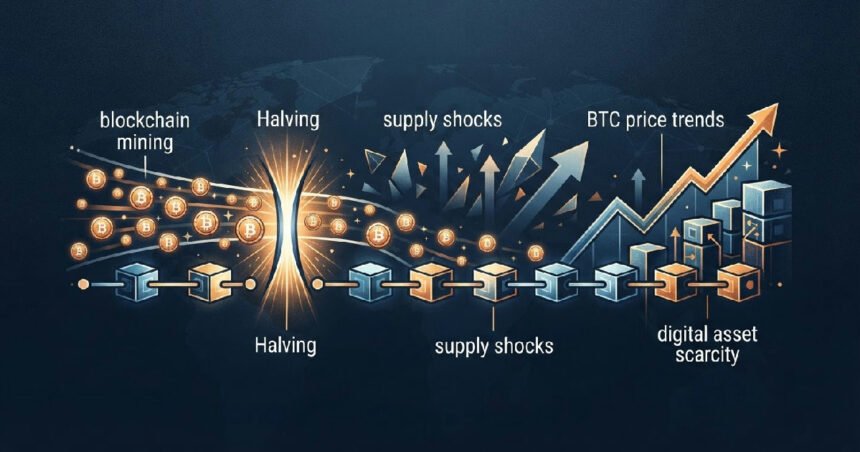
Bitcoin halving events are pivotal, pre-programmed reductions in the reward that miners receive for validating transactions. These events are designed to introduce predictable scarcity into the supply of new Bitcoin (BTC), profoundly influencing the cryptocurrency market.
While historically linked to significant price appreciation, their long-term impact involves complex dynamics of supply, demand, and network security that continue to evolve with the asset’s maturity.
Halving how supply shocks impact Bitcoin
A Bitcoin halving is a fundamental part of the cryptocurrency’s protocol, meticulously embedded by its pseudonymous creator, Satoshi Nakamoto. This mechanism dictates that approximately every four years, or after every 210,000 blocks are mined, the reward for adding a new block to the blockchain is cut in half.
The goal is to control Bitcoin’s total supply, capping it at 21 million coins, thereby mimicking the scarcity of precious metals like gold. This fixed schedule provides transparency and predictability, distinguishing Bitcoin from traditional fiat currencies subject to discretionary printing.
The block reward reduction process
The block reward, the amount of new Bitcoin issued to a miner for successfully adding a block, decreases by 50% at each halving. Initially, in 2009, miners received 50 BTC per block.
The first halving on November 28, 2012, reduced this to 25 BTC. Subsequent halvings in July 2016 and May 2020 brought the reward down to 12.5 BTC and 6.25 BTC, respectively.
Most recently, the fourth halving on April 20, 2024, further cut the reward to 3.125 BTC per block. This systematic reduction ensures that the rate of new Bitcoin entering circulation steadily declines.
Historical Impact on Price and Market Dynamics
Historically, Bitcoin halvings have often preceded substantial past Bitcoin price surges, acting as catalysts for new bullish cycles. The anticipation leading up to these events typically generates excitement among traders and investors, who expect the reduced supply to drive up demand.
However, it’s critical to look beyond immediate reactions and understand the broader implications for the broader crypto market.
Past halving cycles and price surges
After the 2012 halving, Bitcoin’s price rocketed from about $12 to over $1,000 in late 2013, an 8,858% increase within 12 months. Its inflation rate dropped significantly from 25.75% to 12%.
The 2016 halving saw the price climb from around $650 to nearly $20,000 by December 2017, marking a 294% gain. This period also witnessed a drop in the inflation rate from 8.7% to 4.1%.
Following the 2020 halving, Bitcoin surged from approximately $8,000 to an all-time high of about $69,000 by November 2021, a 540% increase. The annual inflation rate fell to approximately 1.8%.
The diminishing returns phenomenon
While each halving has consistently led to notable price appreciation, the percentage gains have shown a clear pattern of diminishing returns. This suggests that as Bitcoin’s market capitalization grows and the asset matures, the magnitude of percentage increases may become more modest.
This trend is a natural consequence of market maturation. A smaller asset experiences greater percentage swings, whereas a larger, more established asset requires significantly more capital inflow to achieve similar proportional growth.
Future Effects and Evolving Challenges
The impact of future halving events will undoubtedly continue to shape Bitcoin’s market dynamics, albeit with increasingly complex considerations. The systematic reduction in new supply remains a core tenet of Bitcoin’s economic model, but its influence interacts with a maturing ecosystem.
The most recent halving in April 2024 pushed Bitcoin’s inflation rate below one percent, further solidifying its disinflationary status compared to most traditional currencies.
Miner profitability and network security
Halvings directly reduce the block reward, impacting Bitcoin miners‘ primary revenue stream. This can lead to less efficient mining operations becoming unprofitable and potentially exiting the network, causing a temporary dip in the overall hashrate, which is the total computational power securing the network.
However, if Bitcoin’s price appreciates sufficiently post-halving, mining can remain profitable for many, and the hashrate typically recovers as technological advancements and increased efficiency are adopted. Miners will increasingly rely on transaction fees for their income as block rewards continue to diminish towards the estimated end of new Bitcoin issuance around 2140.
Reduced inflation and digital scarcity
Each successive halving further reduces Bitcoin’s inflation rate, reinforcing its design as a scarce digital asset. This controlled scarcity is a stark contrast to fiat currencies, which central banks can issue at will, leading to potential inflationary pressures.
Satoshi Nakamoto himself described the process as analogous to gold mining, where resources are expended to add a constant amount of new coins to circulation. This systematic approach underpins Bitcoin’s value proposition as a hedge against inflation.
The Enduring Design of Bitcoin
Bitcoin’s halving mechanism stands as a testament to its innovative economic design. By hard-coding scarcity and predictable supply shocks, its creator engineered a system aimed at fostering long-term value and inflation control.
While the percentage gains post-halving may exhibit diminishing returns as the asset matures, the fundamental impact of reduced supply on market dynamics remains a critical factor for investors and enthusiasts tracking the world’s leading cryptocurrency.