

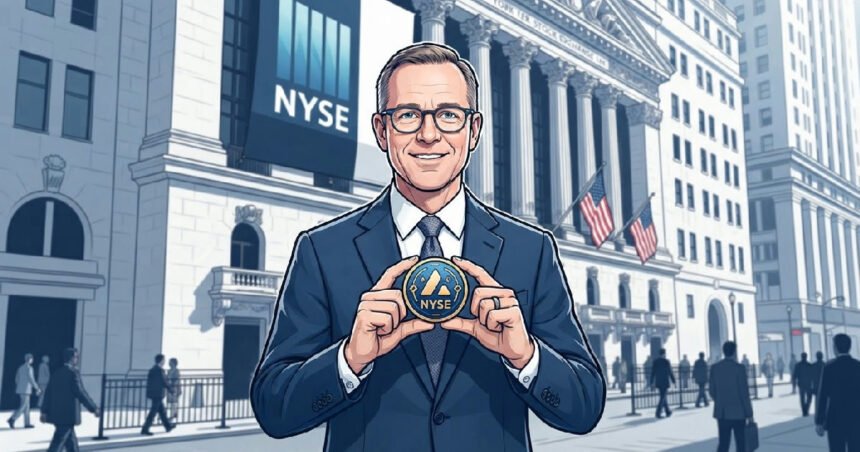
The New York Stock Exchange (NYSE) has spent the last year extensively testing the Avalanche blockchain, exploring its potential to power a new platform for Avalanche NYSE tokenization. The revelation came from Ava Labs President Charley Cooper, who described a deep and ongoing collaboration with the world’s largest stock exchange during an interview at the Avalanche Summit in New York on September 17.
Cooper’s comments provide the clearest indication yet of the technology underpinning the NYSE’s ambitions to bridge traditional finance with blockchain infrastructure. While he stopped short of confirming a final decision, the depth of the engagement suggests Avalanche is a leading contender for a project that could reshape Wall Street’s plumbing.
Avalanche NYSE tokenization due diligence at the stock exchange
Speaking at the summit, Cooper detailed a rigorous, year-long vetting process by the NYSE and its parent company, Intercontinental Exchange (ICE). The exchange’s teams went far beyond a superficial technical review, pressing Ava Labs on its economic model and business strategy to ensure the blockchain company could meet the demands of a highly regulated, mission-critical financial institution.
“I leave it to the NYSE guys to talk publicly about where they are in the whole process,” Cooper stated, maintaining a degree of official ambiguity. However, he characterized the engagement as a “close working relationship,” indicating a significant investment of time and resources from both sides. This extensive due diligence highlights the serious consideration legacy institutions are giving to public blockchains.
Further cementing the connection, ICE’s Head of Strategic Initiatives, Michael Blaugrund, joined Cooper on stage. Blaugrund affirmed that his firm was “very engaged” with the Ava Labs team. He noted that as ICE evaluates various blockchain platforms for its on-chain strategy, “Avalanche checks a lot of those boxes for us.”
Such public endorsements from a senior executive at a pillar of global finance are rare and signal strong confidence in the technology.
NYSE’s grand design for on-chain securities
The exchange’s exploration of Avalanche is part of a broader, publicly stated strategy to modernize its market infrastructure. In January 2026, the NYSE announced it was developing a platform for the trading and on-chain settlement of tokenized U.S. equities and exchange-traded funds (ETFs). The project’s goal is to merge its powerful Pillar matching engine with the efficiency and transparency of a blockchain-based post-trade system.
This hybrid model aims to support multiple blockchains for settlement and custody, allowing for flexibility as the technology evolves. The initiative represents a direct move into the burgeoning field of real-world asset (RWA) tokenization, which involves creating digital representations of physical or traditional financial assets on a blockchain. This could unlock trillions of dollars in illiquid assets and create more efficient, accessible markets.
In August, ICE had already named tZERO, a company specializing in digital securities, as a design partner for the planned platform. However, it has remained silent on which blockchain or blockchains would serve as the foundational settlement layer.
Cooper’s comments are the first to link a specific Layer-1 protocol to this high-profile project, placing Avalanche at the center of the conversation about Wall Street’s digital transformation.
Regulatory shifts enable new market structures
The timing of these discussions is significant, coming just as the regulatory picture for digital assets clarifies. The U.S. Securities and Exchange Commission (SEC) recently rolled out a new framework that could accelerate this shift. The SEC innovation exemption for tokenized stocks, released on September 17, creates a specific carve-out that permits certain on-chain trading activities, provided they meet specific criteria.
This regulatory development provides a potential pathway for institutions like the NYSE to operate blockchain-based trading systems in a compliant manner. It addresses long-standing legal uncertainties that have historically kept traditional financial players on the sidelines.
By creating a sandbox for innovation, regulators are signaling they are ready to engage with the possibilities of on-chain finance, moving beyond enforcement actions to build a framework for the future.
Why Avalanche is a prime candidate for TradFi
Avalanche’s architecture offers several key features that make it particularly attractive for enterprise and institutional use cases, likely contributing to the NYSE’s sustained interest. Its unique subnet (Subnetwork) model allows entities to launch their own customized, application-specific blockchains. These subnets can have their own rules, fee structures, and validator sets, providing a level of control and privacy that institutions require.
For an entity like the NYSE, a custom subnet could allow it to enforce know-your-customer (KYC) and anti-money-laundering (AML) rules at the network level, a non-negotiable requirement for trading regulated securities. It also allows them to control transaction costs and ensure predictable performance, insulating their operations from the volatility of a public network’s gas fees.
The ability to build a walled garden on top of a globally secure public blockchain is a powerful value proposition.
Beyond subnets, the platform is known for its high transaction throughput and fast finality, meaning transactions are confirmed quickly and irreversibly. This performance is critical for financial markets where speed and certainty are paramount.
The NYSE’s deep dive into the project demonstrates the level of scrutiny required when evaluating altcoin project teams, as the technology must be matched by a competent and reliable organization capable of supporting institutional needs.
The race to 24-hour trading and what comes next
The ultimate prize for tokenizing securities is the creation of a truly global, 24/7 market. Cooper predicted that some venues would begin offering round-the-clock weekday trading within a year, a dramatic departure from the rigid 9:30 a.m. to 4:00 p.m. session that has defined stock trading for decades. Blockchain technology makes this possible by enabling near-instantaneous settlement, removing the dependency on legacy banking hours.
Cooper questioned whether the first movers would be the largest incumbents. “Will that be the mainstream exchanges? The largest in the world? The LSEs, the NYSEs, the CMEs? I don’t know about that,” he mused, pointing to the competitive pressure from smaller, more agile digital-native venues.
“There are a lot of smaller venues that are making a very compelling case to the world to put liquidity on them,” he added.
Regardless of who gets there first, the NYSE’s deep engagement with Avalanche is a watershed moment for the crypto industry. It validates the technology as a viable foundation for the future of finance and provides a powerful narrative for institutional adoption.
A formal partnership would have significant implications across the market, potentially boosting the entire Avalanche ecosystem. Such a development is a key factor in any long-term Avalanche price prediction, as it would cement its role as a critical piece of next-generation financial infrastructure.