

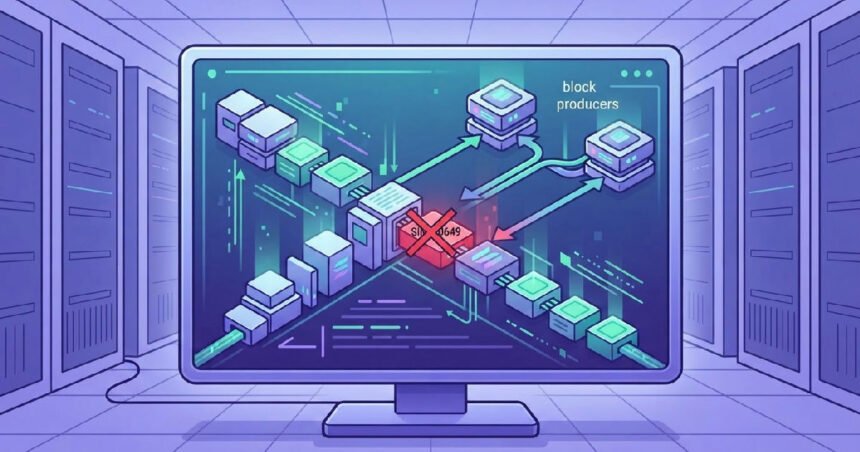
A significant proposal designed to foster more Solana fairer trades by enforcing strict transaction ordering within batches hit a wall on September 25. The Solana Improvement Document (SIMD-0649), which aimed to introduce a new consensus rule, saw its pull request closed without merging.
This development means that Solana’s block producers, known as leaders, continue to hold considerable sway over which transactions make it into a block and how they are grouped, leaving a crucial element of market predictability unresolved.
SIMD-0649: A narrow scope for Solana fairer trades
The stalled proposal sought to allow validators to reject any block where transactions within a single batch were not ordered according to their priority fees. But it deliberately stopped short of dictating which transactions should be included in a block or defining batch boundaries. The closure signals a continued debate within the Solana community about the optimal balance between network efficiency and equitable transaction processing.
SIMD-0649 aimed to introduce a specific, auditable check for transaction ordering. Its core function was to ensure that non-exempt transactions placed within the same batch by a leader appeared in non-increasing priority order. If a validator replaying the block detected a deviation, the block would be deemed invalid.
This approach provided a clear, testable standard for within-batch fairness, designed to be inspected across various validator clients and schedulers. The author of the proposal contended that such a common check would enhance transparency in the sequencing of transactions, contributing to high network performance.
The priority score itself isn’t a simple ranking by the absolute fee. It’s calculated based on the reward a leader receives for including a transaction, divided by its requested cost under a pre-execution model. This score incorporates both the priority fee and the unburned portion of the base fee, creating a more nuanced measure of a transaction’s relative importance.
Block Producers Retain Critical Discretion
Despite the efforts of SIMD-0649, Solana leaders still maintain significant control over the transaction lifecycle. They retain the discretion to select which transactions to include in a block, how to divide them into batches, and even when to defer a transaction to a later batch.
These choices directly influence whether competing transactions ever face the same ordering test. A transaction with a high priority score might still be processed after a lower-priority one if the leader places it in a subsequent batch. This highlights the narrow scope of the proposed within-batch rule compared to a slot-wide ordering guarantee.
The draft did attempt to address potential manipulation by requiring most batches to span at least two forward error correction (FEC) sets. This minimum, equivalent to 64 data shreds, aimed to prevent leaders from creating tiny batches to circumvent ordering rules. However, reviewers argued this didn’t fully remove discretion.
A September 23, 2026, review on the proposal’s pull request noted that leaders could still strategically close batches to separate conflicting transactions. The reviewer requested crucial data, including present-day batch sizes broken down by scheduler, client, and market conditions, alongside a sensitivity test for different minimum sizes. This data remains unavailable.
Without a measured distribution showing how often current leaders produce smaller batches, the practical impact of the proposed minimum size is difficult to quantify. It may close an obvious loophole, but the extent of behavior change it would induce isn’t clearly established.
Solana’s Broader Pursuit of Efficiency and Fairness
Solana’s journey toward optimizing network performance and fairness involves a complex interplay of technical proposals and community debate. The network relies on a priority fee system where users can attach optional fees to accelerate transaction processing, especially during periods of congestion. This mechanism is central to its fee market.
Transactions on Solana can bundle multiple instructions, enabling efficient batching of operations. While individual transaction sizes were previously limited, an increase to 4096 bytes on September 15, 2026, now allows for larger, more complex operations within a single transaction. This change aims to enhance overall network utility.
Solana Improvement Documents (SIMDs) serve as formal frameworks for proposing changes to the protocol. These can range from core feature adjustments to procedural modifications. Significant SIMDs, such as SIMD-0096, which activated in February 2025 to direct 100% of priority fees to validators, require validator governance votes for implementation.
The Alpenglow upgrade, a major overhaul of Solana’s consensus architecture, was approved by a validator governance vote in September 2025. This significant development, spearheaded by the Anza engineering team—a spin-off from Solana Labs—aims to drastically reduce transaction finality times, further bolstering network robustness. Information on the Alpenglow testnet highlights the network’s commitment to speed.
Implications for Fair Trading and Market Predictability
The stalling of SIMD-0649 means the current mechanisms that allow block producers to choose which orders get included will persist. This ongoing discretion by leaders has direct implications for traders attempting to predict where their orders will land within a block. It underscores the challenges in guaranteeing truly Solana fairer trades without more restrictive ordering rules.
Critics also highlight that the proposal wouldn’t have prevented a leader from favoring its own transactions. The draft noted that priority fees return to the leader, creating an incentive structure that could still lead to preferential treatment. This leaves open avenues for Maximal Extractable Value (MEV) and potential slippage, even with within-batch ordering checks.
An August discussion also raised concerns about latency. A check that had to wait for an entire batch to complete could potentially interfere with Firedancer’s practice of replaying partially received data, a critical aspect of Solana’s high-throughput architecture. While the revised draft permits validators to execute transactions as they arrive, the trade-off between ordering checks and broadcast delay at low throughput remains unquantified.
For traders and decentralized application users, the current situation means that while Solana offers high transaction speeds, the precise sequencing of orders remains heavily influenced by leader decisions. The absence of slot-wide ordering guarantees necessitates sophisticated strategies for predicting execution outcomes, particularly in high-frequency trading scenarios.
The Path Forward for Solana’s Transaction Fairness
The closure of SIMD-0649 without merging isn’t necessarily a final rejection, but rather a call for more extensive discussion and support from client developers. The complexities of ensuring transaction fairness while maintaining Solana’s characteristic speed present a significant challenge. Future proposals will likely need to address these trade-offs more comprehensively.
The value of any revised Solana rule will hinge on two key factors: how often meaningful competing transactions genuinely share a batch, and whether a minimum batch size significantly alters leader behavior. Without clear data on current batch distributions, the practical effects on execution predictability remain largely speculative.
Liam ‘Akiba’ Wright, Editor-in-Chief at CryptoSlate, whose work often bridges crypto, finance, and technology, highlighted these ongoing ambiguities.
The Solana Foundation, the non-profit coordinating the protocol’s activities, will continue to facilitate these discussions. Balancing the needs of various network participants, from validators to everyday users, is paramount.
The journey toward a more transparent and equitable transaction environment on Solana is clearly an evolving one, with significant technical and economic considerations still to be addressed. Solana’s recent price surges reflect broader market confidence, but underlying fairness mechanisms remain a key area of development for the network’s long-term health.