

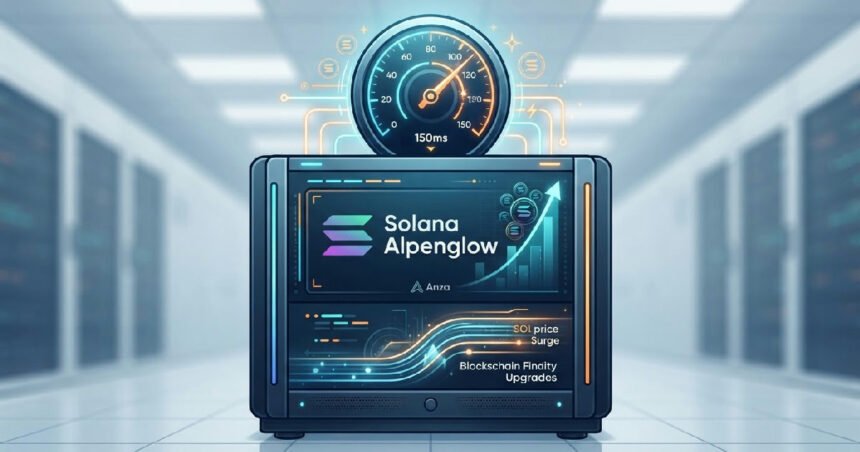
Solana has initiated the public testing phase for its Alpenglow consensus upgrade, deploying the significant overhaul to its testnet environment. This strategic move aims to dramatically enhance transaction finality, reducing the time irreversible transactions take on the network. The development arrives as Solana’s native token, SOL, approaches its January highs, reflecting renewed market confidence and expanding network activity.
Designed by Anza, a research and development firm originally spun out of Solana Labs, Alpenglow is poised to replace the existing TowerBFT consensus system. The upgrade is critical for applications demanding high speed, such as decentralized exchanges and high-frequency trading platforms, which rely heavily on rapid transaction settlement.
Solana Alpenglow testnet targets millisecond transaction finality
Solana’s Alpenglow upgrade represents a substantial leap in the blockchain’s core infrastructure, primarily targeting a reduction in transaction finality. The goal is to achieve an approximate 150-millisecond finality, a stark contrast to the current 12.8 seconds under the existing TowerBFT system. This improvement could cut the waiting period for irreversible transactions by roughly 99%, fundamentally reshaping how quickly operations settle on the network.
The first phase of Alpenglow introduces Votor, a new protocol that streamlines validator communication. Instead of recording every vote on-chain, Votor enables validators to exchange votes directly. This method allows for block finalization within one or two voting rounds, boosting efficiency without altering the Solana Virtual Machine, transaction types, programs, or fees.
A later phase of the Alpenglow rollout will incorporate Rotor, intended to replace Turbine, Solana’s current system for distributing block data. For now, the immediate focus remains on Votor and delivering faster finality to the network, a crucial step for the platform’s continued growth and adoption.
Phased Rollout and Validator Readiness
The journey of Alpenglow from conceptualization to full implementation involves several carefully planned stages, beginning with its deployment on the testnet. Anza, the developer behind Solana’s Agave validator software, confirmed that the testnet rollout process was underway, marking a significant milestone ahead of subsequent deployments on devnet and eventually the mainnet-beta.
This migration mandates considerable preparation across Solana’s validator ecosystem and among infrastructure providers. These entities must adjust their systems, including those that stream blocks, track votes, and depend on Solana’s existing commitment structure. Validators are specifically required to run Agave 4.3 software for the initial testnet phase.
The community has largely backed this evolution, with Alpenglow passing community governance (SIMD-0326) with an overwhelming 98.27% of votes in favor. Such strong consensus underscores the network’s commitment to enhancing its foundational technology.
Testnet operators have also been asked to adopt v4.4 of Agave on September 28, 2026, coincident with the Alpenglow feature gate opening on mainnet-beta, though this date is not for Alpenglow’s full mainnet launch. Proof of History consensus remains a foundational element, but Alpenglow aims to refine the finality layer built upon it.
SOL Price Resurgence Reflects Network Optimism
The technical advancements on the Solana network coincide with a notable resurgence in the price of its native token, SOL. As of September 23, 2026, SOL traded around $117, having touched nearly $120 earlier in the week. This puts the token near its strongest levels since late January, demonstrating considerable momentum.
SOL has experienced a significant upturn, gaining approximately 25% over the past month. This recovery highlights investor confidence, especially given that the token started the year at $124, meaning it was down only 4.23% year-to-date by late September. The low for SOL on September 15, 2026, was $96, marking a strong rebound.
This price action isn’t just speculative; it reflects broader expansion across the Solana ecosystem. For instance, real-world assets (RWA) tokenized on the network reached approximately $4.6 billion in early September, a substantial increase after surpassing the $4 billion mark for the first time in August. This growing adoption of SOL price resilience is a clear indicator of the network’s utility.
Expanding Utility and Transaction Volume on Solana
Beyond asset tokenization, Solana has seen a dramatic increase in its trading activity, solidifying its position as a major player in the decentralized finance landscape. Data from the week ending September 13, 2026, showed Solana decentralized exchanges recording roughly 208 million individual spot trades.
This figure notably surpassed the New York Stock Exchange’s approximate 190 million trades during the same period, underscoring Solana’s burgeoning liquidity and user engagement.
The gap between Solana’s trading volume and Nasdaq also narrowed significantly, settling at around 47 million trades. Jupiter, a prominent decentralized exchange aggregator on Solana, accounted for over 80 million trades in September alone, marking a 38% increase from the previous month. This surge in activity underscores the platform’s growing capacity and appeal to a broad base of users.
These performance metrics bolster the arguments of Solana’s long-term supporters. Kyle Samani, co-founder of Multicoin Capital, has reportedly articulated an aggressive investment thesis, suggesting that SOL’s market capitalization could eventually outstrip Ethereum’s within the current market cycle. Samani points to increasing developer preference for Solana and its recent lead over Ethereum in network fees, signaling a potential shift in the blockchain hierarchy.
Performance Upgrades Pave the Way for Alpenglow
Alpenglow’s impending deployment follows a series of strategic performance upgrades that have incrementally enhanced Solana’s capabilities throughout 2026. This month, Solana activated Transaction V1, significantly expanding the maximum transaction size from 1,232 bytes to 4,096 bytes. This increase allows for more complex and data-rich transactions, boosting the network’s overall throughput and flexibility.
Moreover, Solana’s slot-time roadmap has progressively reduced the target slot time from 400 milliseconds down towards 200 milliseconds. These continuous optimizations contribute to a more responsive and efficient network, laying crucial groundwork for the enhanced finality promised by Alpenglow. Solana transaction processing improvements are a continuous effort.
The network’s commitment to robustness is also a key factor. An August 12, 2026, event saw Solana “nearly halted,” a scenario that Alpenglow aims to prevent in the future.
The new upgrade boasts a 40% crash tolerance, which developers believe would convert a similar incident into a slow half-hour of reduced performance rather than a near-shutdown, albeit at the cost of lower tolerance for malicious stake. Such resilience is vital for maintaining user trust and operational continuity in a high-stakes environment.
The Road Ahead: Mainnet Activation and Beyond
With Alpenglow now undergoing rigorous testing on the testnet, the focus shifts to its successful transition to devnet and, ultimately, the mainnet-beta. This phased approach allows validators and infrastructure providers ample opportunity to adapt their systems and ensure seamless integration of the new consensus mechanism. The successful deployment will be a testament to the extensive preparation and collaboration across the Solana ecosystem.
The enhanced finality provided by Alpenglow is expected to unlock new possibilities for decentralized applications and services requiring near-instant transaction settlement. This improvement will be particularly beneficial for institutional adoption, where speed and certainty of transaction finality are paramount. As Solana continues to attract a growing base of users and developers, upgrades like Alpenglow are fundamental to supporting its ambitious vision.
The long-term impact could solidify Solana’s competitive edge, especially against established rivals like Ethereum. While the market capitalization gap between SOL and ETH remains substantial—around $58 billion for Solana versus approximately $293 billion for Ethereum—continuous innovation in speed and efficiency could significantly influence future market dynamics. The success of Alpenglow will be a critical indicator of Solana’s trajectory in the evolving blockchain landscape.