

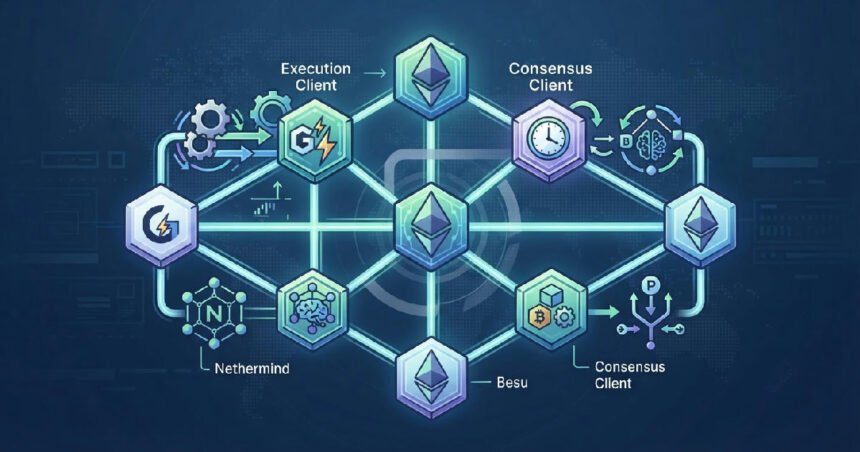
Ethereum’s multi-client approach significantly strengthens the network’s resilience against vulnerabilities by ensuring a bug in one client doesn’t compromise the whole network. This deliberate strategy ensures that a bug or attack affecting one client implementation does not compromise the entire network, thereby enhancing its overall robustness and security.
By fostering diverse development and enabling faster recovery from potential issues, this method directly mitigates single points of failure. It has become a foundational element in Ethereum’s long-term stability and security framework, especially following The Merge in September 2022.
Understanding the Ethereum multi-client approach
An Ethereum client is a software application designed to implement the Ethereum specification. It communicates across the peer-to-peer network with other Ethereum clients, enabling a computer to operate as an Ethereum node. These nodes are crucial for verifying blocks, validating transaction data, and enforcing network rules.
The multi-client approach, often termed client diversity, involves supporting multiple independent software implementations. This applies to both the execution and consensus layers of the Ethereum protocol, strategically distributing risks across various codebases and development teams.
Execution and Consensus Layers Defined
Since The Merge on September 15, 2022, every full Ethereum node requires two distinct clients: an execution client and a consensus client. These components operate in tandem, communicating via the Engine API to form the backbone of the network’s operations.
The execution client processes transactions, executes smart contracts, and maintains the blockchain’s current state. It interacts directly with the Ethereum Virtual Machine (EVM). Conversely, the consensus client manages the Proof-of-Stake mechanism, overseeing validator duties, proposing blocks, and ensuring nodes agree on the blockchain’s state.
How Client Diversity Mitigates Systemic Risk
The mechanical implementation of multiple, independently developed clients, often in different programming languages, is central to network resilience. This diversity means a bug or vulnerability in one client’s codebase is highly unlikely to exist in another, preventing widespread compromise.
This critical function of client diversity was notably demonstrated in 2016. A denial-of-service attack exploited a vulnerability in the dominant Geth client. However, because alternative clients were unaffected and remained operational, Ethereum resisted a network-wide shutdown, allowing for a timely fix.
Such an event highlights why Ethereum’s strength is so reliant on this layered defence. Independent development teams, utilizing languages like Go, Rust, Java, and C#, introduce varied logic and architectural approaches, further reducing the chance of a single flaw propagating across all implementations.
Independent Implementations and Shared Protocols
Despite their independent development, all clients must strictly adhere to a common Ethereum protocol specification. This ensures seamless interoperability and consistent functionality across the network, regardless of the chosen client combination.
Node operators have the flexibility to choose their preferred execution and consensus clients, a choice that actively contributes to overall network resilience. This operator-driven diversity further decentralises risk, making the network more robust against targeted attacks.
The Expanding Ecosystem of Ethereum Clients
Ethereum’s client ecosystem is robust, featuring numerous prominent implementations for both execution and consensus layers. This broad selection underscores the dedication of development talent to the network’s health and stability.
Leading Execution Clients
- **Geth (Go-Ethereum)**: The most widely used Ethereum client, written in Go and maintained by the Ethereum community and the Ethereum Foundation.
- **Nethermind**: A C# client built on the .NET runtime, known for its performance and high-throughput JSON-RPC, active in ZK-readiness research since 2017.
- **Besu (Hyperledger Besu)**: An open-source Java client under the Hyperledger umbrella, designed for both public and private Ethereum networks, supporting various consensus mechanisms.
- **Erigon (formerly TurboGeth)**: A Go client focused on performance optimizations, modularity, and resource efficiency, using a flat database model to reduce disk space.
- **Reth**: A newer execution client written in Rust, which is gaining significant adoption within the community.
Key Consensus Clients
- **Lighthouse**: Developed by Sigma Prime in Rust, emphasizing security and performance.
- **Prysm**: A Go client developed by Prysmatic Labs.
- **Teku**: A full Java client by ConsenSys, built to meet institutional needs, including a beacon node and validator client.
- **Nimbus**: A lightweight Nim client, designed for resource efficiency, suitable for lower-specification devices like Raspberry Pis, offering a unified client approach.
- **Lodestar**: A TypeScript client developed by ChainSafe Systems.
- **Grandine**: Another notable consensus client implementation.
This wide array of options allows node operators to tailor their setups, contributing to the network’s overall health. It also encourages Ethereum network upgrades as teams compete to improve performance and efficiency.
Client Diversity as a Core Security Property
Client diversity transcends mere preference; it’s recognized as a fundamental security property for Ethereum. As ethereum.org states, “Multiple, independently developed and maintained clients exist because client diversity makes the network more resilient to attacks and bugs.”
This attribute, unique to Ethereum, provides a significant advantage over blockchains relying on a single client. A bug in an individual client poses less risk when it represents a minority of Ethereum nodes, ensuring greater network stability. This design principle acts as a crucial protocol safeguard strategies.
Faster Recovery and Containment
In the event of a client-specific issue, the network can effectively isolate the problem to users running the affected client. This allows operators to quickly switch to a different client or await a rapid patch, significantly minimizing downtime and potential penalties for validators.
This distributed risk model fosters competitive innovation among development teams. It pushes them to optimize performance, enhance resource efficiency, and introduce continuous improvements, benefiting the entire platform by creating a more robust and secure environment.
Strategic Choices for Node Operators
For individuals and entities running Ethereum nodes, the choice of client software is a strategic decision that directly impacts their contribution to network health. Selecting from a variety of options helps to evenly spread risk across the ecosystem.
Some advanced validator setups utilize “multinode clients,” such as Vero or Vouch. These systems aggregate data from multiple consensus and execution clients, requiring agreement from a predetermined number of connected clients before casting a vote. This offers an additional layer of protection against client-specific bugs that could lead to an invalid chain fork.
This approach effectively limits the “blast radius” of any undiscovered flaws, ensuring that localized issues do not escalate into widespread network disruptions. It’s a proactive defence mechanism built into the core design.
Reinforcing Ethereum’s Decentralised Future
Ethereum’s multi-client approach is more than a technical detail; it’s a foundational pillar of its decentralised ethos and long-term viability. By deliberately fostering a diverse client ecosystem, the network inherently builds resistance against centralised points of failure and systemic vulnerabilities.
This strategy not only protects against immediate threats but also promotes continuous innovation and adaptability within the Ethereum community. As the network evolves, client diversity will remain paramount in securing its role as a robust and reliable global computing platform.