

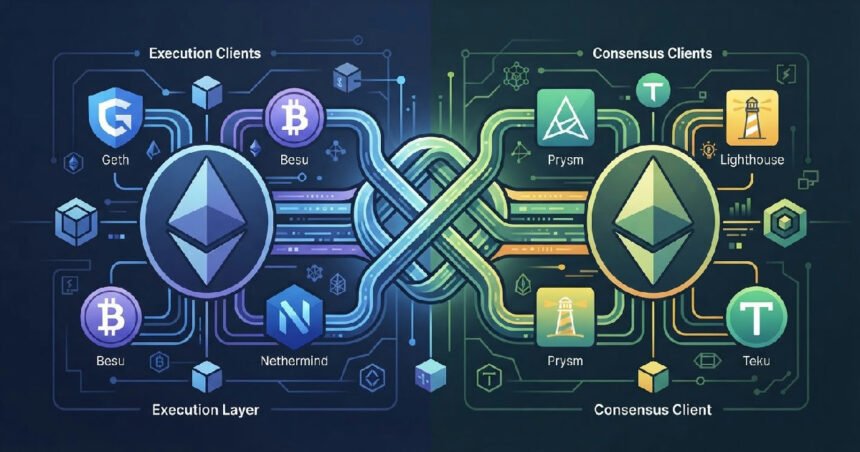
Client diversity is paramount for the ongoing security and resilience of the post-Merge Ethereum network. By ensuring that a variety of independent software implementations run the network, Ethereum significantly mitigates the risk of systemic failures. This crucial strategy prevents a single point of vulnerability from compromising the entire blockchain.
The core principle behind this approach is distributed risk. If a bug or flaw emerges in one software client, only the portion of the network utilizing that specific client would be affected. The broader network, supported by alternative client implementations, can continue its operations unimpeded, maintaining network integrity and uptime even if a significant portion of nodes running one client encounters an issue.
Understanding Ethereum Client Diversity
Ethereum client diversity refers to the distribution of different software implementations across the network. Instead of all nodes running identical codebases, a diverse network features validators and nodes spread across multiple independent clients. These clients are built by separate development teams using distinct programming languages, yet they all adhere to the same Ethereum protocol specifications.
An Ethereum client itself is a software application that implements the Ethereum protocol. It enables a computer to connect to the peer-to-peer network, validate blocks and transactions, and maintain the blockchain’s state. This foundational software is split into two primary components post-Merge: the execution client and the consensus client, similar to how a Solana validator ensures network stability.
These distinct teams foster a competitive environment, driving innovation in efficiency and performance. They also offer diverse perspectives on protocol interpretation, leading to more robust and tested implementations. This collaborative yet independent development model strengthens the network’s overall resilience.
Execution Clients and Consensus Clients
The execution client (EL Client) handles transaction processing, execution within the Ethereum Virtual Machine (EVM), and maintenance of the blockchain’s state and database. Previously known as the Eth1 client, it forms the transactional backbone.
The consensus client (CL Client), formerly the Eth2 client or Beacon Node, implements Ethereum’s Proof-of-Stake (PoS) algorithm. This component ensures network agreement on validated data from the execution client and manages validator duties like block proposals and attestations. Both are critical for a node’s operation.
The Evolution of Ethereum’s Client Strategy
The concept of client diversity wasn’t always at the forefront of Ethereum’s early development. In its Proof-of-Work (PoW) era, security largely relied on computational power. The network’s transition to Proof-of-Stake (PoS) with ‘The Merge’ in September 2022 fundamentally shifted this dynamic.
Under PoS, validators secure the chain through staked ETH and client software. A widespread bug in a dominant client could cause significant chain reorgs or even a halt in finality. This made a single point of failure a far more concrete concern for network integrity, especially as the broader crypto market experiences notable trends like ethereum price dips.
How Dual-Client Operation Enhances Network Security
Following “The Merge” in September 2022, Ethereum transitioned to Proof-of-Stake, fundamentally changing node operation. To participate fully in securing the network, operators must now run both an execution client and a consensus client simultaneously. This dual-client requirement is a cornerstone of the post-Merge architecture.
These two distinct client software applications communicate and coordinate through a standardized interface known as the Engine JSON-RPC API. This interoperability is vital, allowing different client combinations to work seamlessly together. For instance, a node might run one team’s execution client alongside another team’s consensus client.
Mitigating Systemic Risk with Varied Implementations
The primary benefit of client diversity is its ability to mitigate systemic risk. Should a critical bug or vulnerability be discovered in one client implementation, only the segment of the network running that specific software would be affected. The remaining network, operating on different client software, can continue functioning correctly, averting a total network collapse.
This architecture offers a robust defense, limiting the impact of any single client’s vulnerability across the broader network.
This safeguard extends beyond accidental coding errors. It also provides a crucial defense against more malicious attacks. If an attacker compromised a single client codebase, diversity would limit damage, ensuring unaffected nodes continue secure transaction processing.
The Mechanics of a Resilient Ethereum Network
Client diversity is not a feature embedded within the Ethereum protocol itself. Instead, it is a property that arises from the social and operational choices made by individual node operators. Their decisions to utilize a variety of client software implementations collectively contribute to the network’s overall resilience and security posture.
Despite their independent development, all client implementations must strictly adhere to the same Ethereum protocol specification. This ensures that every client, regardless of its origin or programming language, “speaks” the same language and follows the same rules. This adherence allows them to interoperate seamlessly and maintain a consistent, unified view of the blockchain’s state.
Operational Challenges and Community Responsibility
Achieving and maintaining optimal client diversity presents ongoing challenges. Node operators often gravitate towards popular clients, inadvertently creating an imbalance. This requires continuous education and encouragement from the wider Ethereum community to ensure healthy distribution, reflecting a wider imperative for resilience in digital asset markets, where for example XRP gains capital amidst broader ETF movements.
Client development demands significant resources and expertise. Each client team must constantly update software for protocol upgrades and security patches. This ongoing investment is vital for them to remain viable alternatives for node operators.
Future Outlook for Ethereum’s Robustness
The emphasis on client diversity reflects a proactive approach to maintaining Ethereum’s long-term stability. As the network continues to evolve, ensuring a healthy distribution across various client teams remains a critical ongoing effort. This collective responsibility among node operators directly translates into a more secure and reliable platform for all users.
This distributed approach to software implementation is a key factor in Ethereum’s robustness against unforeseen challenges. It underscores the community’s commitment to decentralization and resilience, safeguarding the network against potential single points of failure.